A circular orbit is the simplest kind of orbit: an object moves around a central body in a perfect circle, keeping a constant distance at all times. It is a special case of an elliptical orbit where the eccentricity is exactly zero. While rare in nature, it serves as the fundamental baseline for understanding orbital mechanics, from planetary motion to satellitetrajectories.
History
The concept of circular orbits dates back to ancient Greek astronomy, where celestial motion was believed to be perfectly circular. Johannes Kepler's first law of planetary motion (1609) showed that planets actually follow elliptical orbits, with circular orbits being a limiting case.
How it works
In a circular orbit, the gravitational pull of the central body provides exactly the centripetal force needed to keep the object moving in a circle. The orbital speed is constant, and the object's velocity is always perpendicular to the line connecting it to the central body. Any perturbation, such as a collision or gravitational tug from another body, can turn the orbit elliptical.
In practice
Circular orbits are widely used for artificial satellites, including GPS satellites and the International Space Station, because they maintain a constant altitude and simplify tracking and communication.
A thrown stone arcs through the air, but a planet around the Sun follows a closed curve. Why an ellipse, and not a circle or a spiral? Kepler's first law provides the answer, but its usual proof requires heavy computation. This work offers a shorter path — through a single simple ratio of velocities.
A stellarator fusion reactor resembles an intricately twisted magnetic cocoon. Its job is to confine superheated plasma so that hydrogen nuclei fuse and release energy. But the cocoon's three-dimensional shape creates gaps: some particles escape, especially the fastest ones, which carry most of the heat.
A thrown stone arcs through the air and falls. A planet orbiting a star is the same stone, but it falls forever, looping around the star in a closed curve. In Newton's world, that curve is a perfect ellipse, and the planet returns to the same point each orbit. In reality, the orbit slowly rotates: its closest point to the star, the perihelion, shifts.
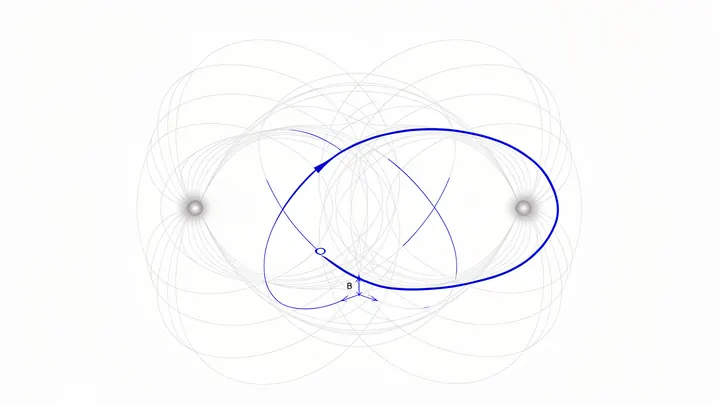
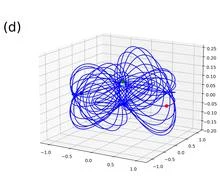
The three-body problem is the eternal stumbling block of celestial mechanics. Even Poincaré realized in the late 19th century that its chaos defies general analytical solutions. In this gravitational madness, islands of regularity appear only rarely — periodic orbits.
At the heart of a warp drive lies Einstein's idea that massive bodies curve spacetime — the very stage on which all cosmic events unfold. Picture a bubble of such curved spacetime. Inside it, the ship floats without any G-forces, like a passenger in an airplane cabin who doesn't feel the headwind.
A quantum computer is like an orchestra where each musician, a qubit, must play their part accurately and on time. Usually, musicians are seated in fixed positions and connected by conductors' consoles. But what if we let them move freely across the stage and turn the movement itself into part of the music?
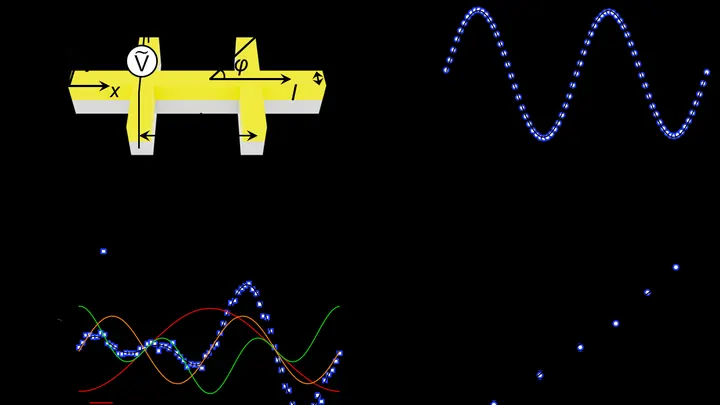
A quantum particle traveling around a closed ring leaves two distinct 'records' along its path. The first is like a fingerprint on a doorknob: it remains unchanged no matter how many times you turn the knob, and it only tells you about the shape and material.
At the edge of the solar system, where the Sun is barely brighter than other stars, icy boulders, trans-Neptunian objects, circle around. Their orbits resemble hoops scattered by someone. But look closer: twelve of these hoops are not just floating in the void.
A plastic heart rests on the water and doesn't tip over, no matter how you turn it. It freezes in any position, as if the water were holding it by invisible strings. This trick is possible thanks to the Zindler curve — a shape in which all lines that divide the area in half have the same length. The Zindler curve is a closed curve where any chord that bisects the area has the same length.
The Kepler telescope spent years watching thousands of stars, spotting planets by the tiny dips in starlight when a planet passes in front of its star. Such a passage, or transit, lets us measure the planet's size but not the shape of its path.
An icy rock is flying through the Solar System on an open trajectory — coming in from interstellar space, swinging around the Sun, and heading back into the dark.
A microbe with flagella rows through water the way a person rows with their arms. But if a person swims breaststroke, they go forward, while a microbe goes in a spiral. The reason is that a microbe has no single direction: each part of its surface pushes water in its own direction, and the body twists like a corkscrew.
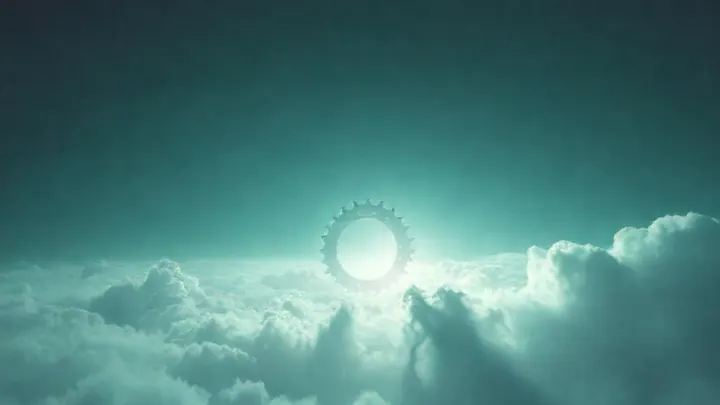
A wormhole is a tunnel through space, connecting distant regions of the Universe. Its shadow against a bright gas background was long thought to be as round as that of a black hole. But for a rotating wormhole (one you could actually traverse), the shape of the shadow might be surprising: the edge becomes jagged, like a gear.
A magnetic material can be compared to a crowd of tiny compasses. In an ordinary magnet, all the needles point in the same direction, and turning them all at once is no easy feat. Physicists have found a way to do this with an electric current.
Two stars, drawing together in a cosmic dance, experience an extra wobble — a consequence of spacetime curvature (an effect predicted by Einstein). A planet orbiting them also wobbles. Sometimes the rhythms align: the gravitational tugs from the stars fall in step with the planet’s orbit, like hands pushing a swing.
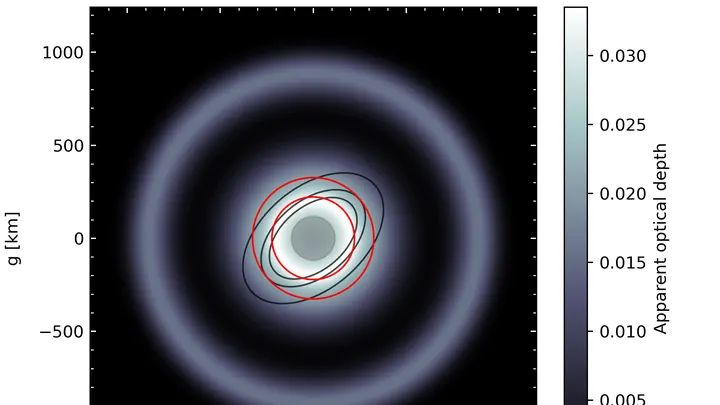
Only by passing in front of a star did Chiron reveal its secret. Three icy hoops encircle the 200-kilometer body — a hybrid of comet and asteroid. Previously, they were only hinted at by spectra of reflected light and brightness fluctuations.
Three bodies attracting each other by universal gravitation: a problem that has stumped mathematics for three centuries. After Poincaré, it became clear that no general solution exists and trajectories are chaotic. But within this chaos there are islands of order: periodic orbits where motion repeats.