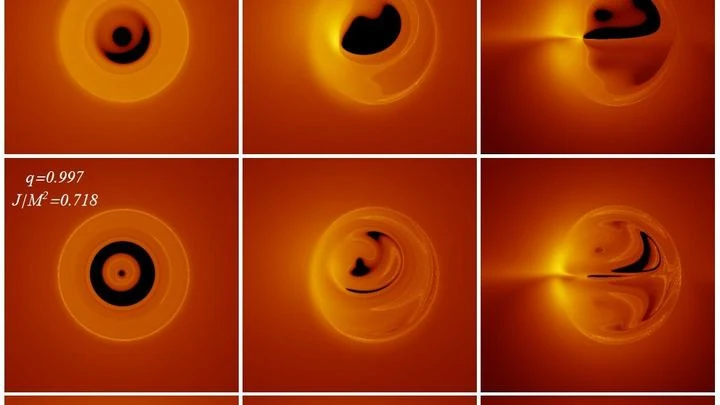
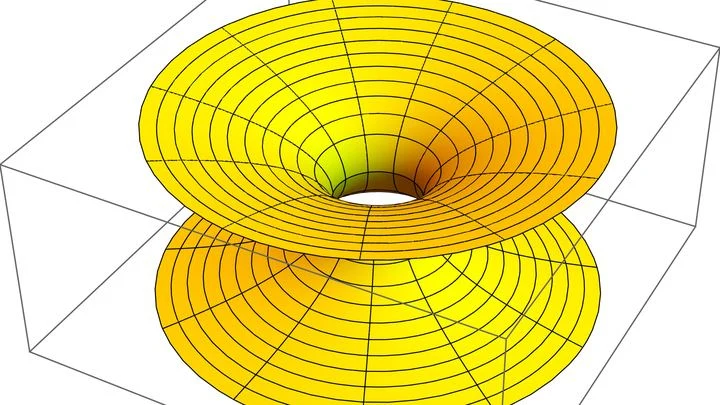
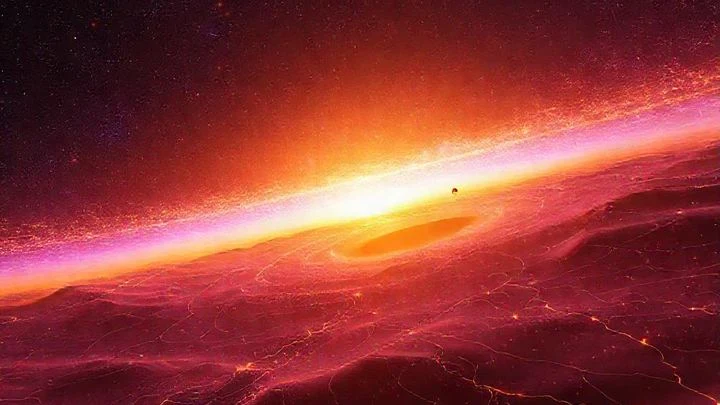
A Kerr black hole is a rotating black hole solution to Einstein's field equations of general relativity, discovered by Roy Kerr in 1963. Unlike the non-rotating Schwarzschild black hole, a Kerr black hole is described by its mass and angular momentum, and it possesses two event horizons and an ergosphere—a region outside the outer horizon where spacetime is dragged along by the rotation. The Kerr metric is considered the most physically realistic description of black holes in the universe, as most black holes are expected to spin.
History
Roy Kerr derived the solution in 1963 while at the University of Texas at Austin, solving a problem that had stumped physicists for decades. His work was a breakthrough in general relativity and remains one of the most important exact solutions in the field.
How it works
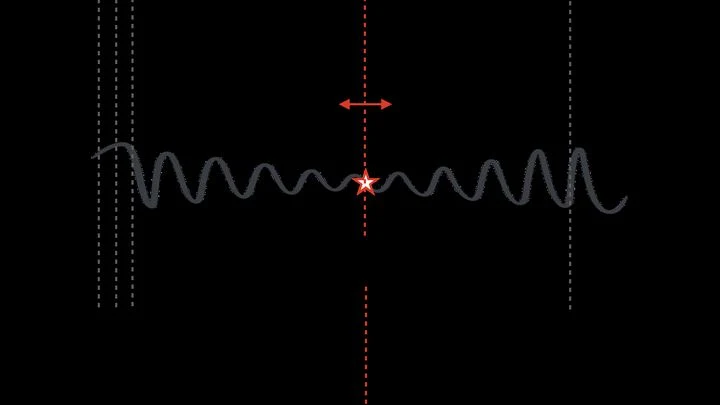
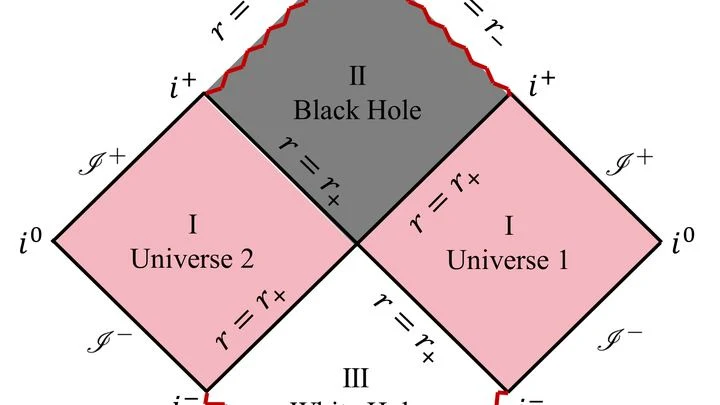
The rotation of the black hole drags spacetime around it, an effect known as frame-dragging. The outer event horizon is the point of no return for infalling matter, while the inner horizon is a Cauchy horizon where causality may break down. The ergosphere allows energy extraction through the Penrose process, where particles can enter the ergosphere and leave with more energy than they entered. The geometry also supports quasinormal modes—characteristic 'ringing' frequencies that encode the black hole's mass and spin, which are now routinely measured by gravitational wave observatories.
In practice
Kerr black holes are used to model astrophysical black holes in X-ray binaries and galactic centers, and to interpret gravitational wave signals from mergers detected by LIGO and Virgo.
Fun fact
The inner horizon of a Kerr black hole is a region where time and space swap roles again, and it may act as a gateway to other universes—though any traveler would first encounter a singularity of infinite density.
Strike a bell, and it rings at its own pitch. A black hole, after being disturbed, also rings — except instead of sound, it's the fabric of space itself that shivers. The frequencies of this ring can tell you a lot about the hole: how fast it spins, what its mass is.
Somewhere in the center of a galaxy, a black hole is spinning. It doesn't hang in a void — around it swirls an invisible swarm of dark matter particles. Until now, this swarm was described for non-rotating holes, but in reality, holes always rotate.
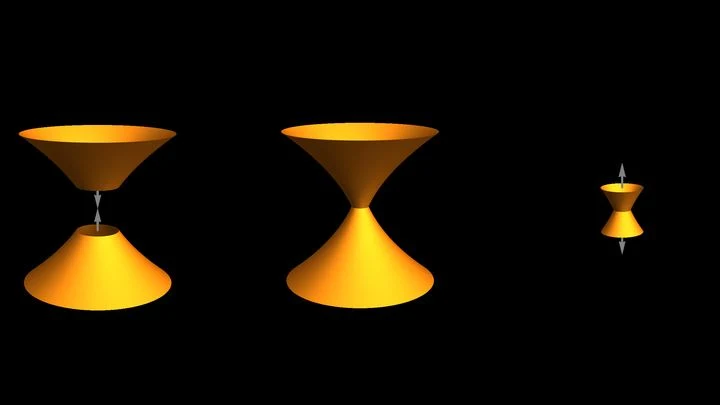
The neck of an hourglass is the narrowest point where grains of sand change sides. In quantum gravity, there is a similar object: an instanton (an instantaneous solution connecting two states of space). It acts like a tunnel through which the geometry of the universe flows from one form to another.
A rotating black hole is no calm whirlpool. Space around it shudders and rings at the slightest disturbance, like a guitar string after a pluck. These oscillations are described by the Teukolsky equation — a complex mathematical construct that physicists have studied for half a century.
Recently, a strange symmetry was noticed in this equation.
When two black holes merge, the newborn object rings like a bell. This ring, gravitational waves of a special kind, astronomers call quasinormal modes (particular damped oscillations). They decay quickly but still reveal the black hole's mass and spin. The question is where in space this ringing begins.
A black hole doesn't just spin: it's surrounded by bristles of an extra field (the Kalb–Ramond field). This paper explores how a massive field (waves with mass) behaves near such a black hole when it's almost spinning at its maximum rate.
The Klein–Gordon–Fock equation for this field was separated into two independent parts — radial and angular.
A black hole is not a perfect vacuum cleaner. It is surrounded by a swarm of particles and fields, and this swarm alters its fate. In a new study, astrophysicists examined how a massive vector field, a hypothetical form of dark matter, behaves near a rotating black hole.
A star circles a rotating black hole like a figure skater at the center of a rink. While it is far away and can be treated as a point, the dance remains predictable: the orbit follows clear laws, like music that is easy to glide to. But as it approaches, gravity begins to act unevenly.
After a hit, a black hole rings like a bell. But instead of sound, it emits gravitational waves whose frequency rapidly decays: these are called quasinormal modes. From such a 'ring,' you can infer the hole's mass, spin, and other properties.
A black hole's horizon is not a wall but rather a one-way membrane. Anything that crosses it disappears forever. Stephen Hawking showed that this boundary should glow faintly, emitting particles. But catching such radiation from a real black hole is impossible: it's too far and too dim.
Physicists have found a workaround: build a "toy" black hole out of magnetic atoms.
A rotating black hole is like a whirlpool in a river — spacetime swirls around it, dragging along everything nearby. In some gravity theories, this whirlpool also includes an extra field — a vector field. At each point, it has a direction and a length, like a compass needle.
A taut trampoline sheet dips under a heavy ball. If the ball spins quickly, the sheet begins to twist around it. Spacetime near a rotating black hole behaves similarly: it is not just curved, but also dragged along by the rotation, like water swirling around a whirlpool.
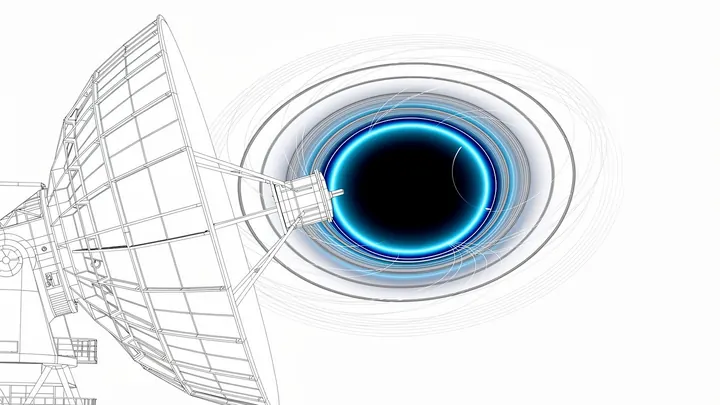
At the center of most galaxies lurk supermassive black holes — the overlords of gravity. Since 2019, thanks to interferometry with very long baselines, we’ve glimpsed their shadows: dark silhouettes set against a blazing gas backdrop. But what exactly is painting that shadow?
At the center of attention is a black hole of unusual shape. Its geometry resembles a spindle: a slight elongation is added to the usual rotation. The parameter B measures this deformation.
The spindle deformation is not just a mathematical toy.
A black hole usually hides its singularity behind an event horizon — an invisible boundary from which not even light can escape. But sometimes this 'cloak' is absent, and the singularity, a point where familiar physics breaks down, is exposed to an outside observer.
A stone drops into a pond — ripples spread and fade. Strike a bell, and it hums at its own pitch. A black hole, after being perturbed, also 'rings,' emitting gravitational waves of a decaying tone.
Hot gas spirals inward, falling onto an invisible superdense object. Such a disk resembles a giant whirlpool, but it is often tilted: its axis does not align with the rotation axis of the central body. The gravity of the massive object makes the disk wobble slightly, like a spinning top losing its balance.
A black hole is not just a dark spot. It rotates, drags space along with it, and can carry imprints of the quantum world. To describe such a hole, one must solve gravitational field equations.
In cricket, there's a special delivery — the googly. The ball spins in a way that deceives the batsman. Physics had its own googly: for nearly half a century, mathematicians couldn't make twistor theory work with real gravity. It described 'nice' fields perfectly, where everything twists in one direction. But as soon as an 'awkward' component appeared, the machinery broke down.
A textbook black hole resembles a perfectly smooth sphere: everything outside it calmly flies off to infinity. However, quantum gravity paints a different picture. Recently, within loop quantum gravity, a solution was found — a 'Kruskal' black hole where spacetime beyond the horizon behaves differently.
At the centers of many galaxies lurk giant rotating black holes. Astrophysicists have long suspected that these objects are remarkably resilient: after swallowing a star or merging with another hole, they quickly settle down and forget the catastrophe.
At the centers of many galaxies lurk black holes — regions with gravity so strong that even light cannot escape. Stars often orbit them, and sometimes one of those stars is a pulsar, a cosmic lighthouse sending out strictly periodic radio pulses. When such a pulsar moves behind a black hole, its signals reach us with a delay.
When massive bodies accelerate (say, two stars orbiting each other) the space around them doesn't stay calm. It trembles like the surface of a pond after a stone is thrown. These tremors are called gravitational waves. They carry energy away, and the source gradually loses mass.
A rapidly spinning black hole, where spacetime is curved to the limit, resembles a bell that can hum for centuries. Its special oscillations barely decay, losing energy incredibly slowly.
A tightrope walker spirals over an abyss, each loop drawing closer to the center. Their path is not a smooth glide but a series of sharp jerks and pauses. That is roughly how a tiny black hole behaves when it is pulled toward a supermassive neighbor.
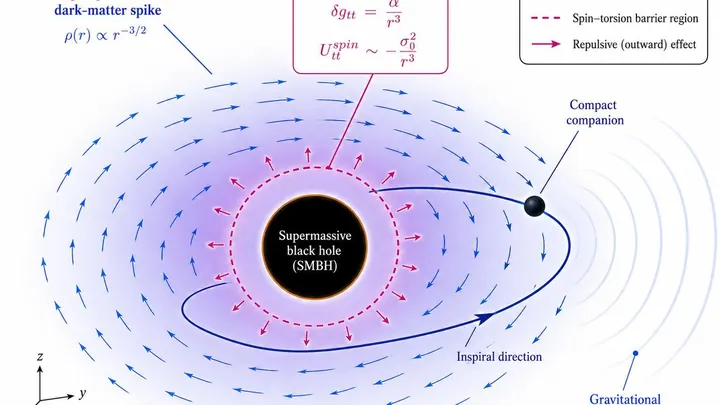
A supermassive black hole drifts through a cloud of dark matter. In the usual picture, this invisible substance just adds mass and barely interacts with ordinary matter. But dark matter particles could have intrinsic rotation — spin.
A black hole is not just a dark spot in space. It is a region where gravity compresses matter so intensely that even light cannot escape. Among all possible black holes, one stands out — the rotating Kerr black hole. Its description was long thought to be tied to Einstein's equations, like a recipe tied to a specific cookbook.
A black hole is like a spinning top: the faster it spins, the more noticeable its behavior. It has two boundaries — the outer and inner horizons, the edges beyond which even light cannot return. In the new work, physicists looked inside a rotating charged black hole and multiplied the areas of these two surfaces.
Usually, a wormhole is imagined as a tunnel in space, whose walls are held open by something unusual — matter with negative energy. Like the supports in a mine that keep the ceiling from collapsing. But in this work, the physicists did without supports.
A black hole isn’t a perfectly smooth ball. Einstein’s theory allows invisible 'hair' — clumps of scalar field — to swarm around it, warping spacetime. The shadow — the dark region from which light can’t escape — was predicted by Penrose in the 1960s.
Many black holes are surrounded by magnetic fields. As it spins, the black hole drags curved spacetime along with it, like a machine's flywheel, and sets the cosmic factory in motion.
Imagine an air mattress being stretched, with a whirlpool of water spinning on it. As you stretch, the whirlpool tightens: its size relative to the whole surface shrinks.
Drop a pebble into a pond, and ripples spread across the water. Strike a bell, and it rings at its own frequency. When a black hole collides with another, it too 'rings'—except instead of sound, it's the trembling of space itself.
A wormhole is a tunnel through the fabric of spacetime, an idea expanded by John Wheeler and Kip Thorne. Just as a mountain passage tends to cave in, the throat of a wormhole wants to snap shut.
Usually, a black hole is an abyss with a point-like dip at the center, where density is infinite and everything breaks down. Einstein and Schwarzschild described such a scenario. But infinity is a sign that the theory stumbled.
Physicists have mastered an elegant mathematical trick that lets them translate gravitational equations into the language of electricity. This method — double copy — works like a kind of dictionary: it replaces the complex geometry of curved spacetime, described by high-dimensional tensor fields, with the simpler rules of…
A whirlpool in a river sucks everything in. Now imagine adding an invisible jelly to the water that thickens near the vortex and suddenly vanishes at its edge: that's roughly what a black hole looks like in a new mathematical model.
Place two identical alarm clocks on a table and set them off at the same time. If one is on a slippery surface and starts to slowly slide, its timing will be thrown off, and within a minute they'll ring out of sync. That's roughly how the new method proposed by astrophysicists for supermassive black holes works.
Twenty-first-century astrophysics is deafening with triumphs: we’ve caught the tremor of spacetime from the merger of invisible giants; glimpsed the 'shadow' of a supermassive monster in a distant galaxy; traced the orbits of stars dancing around a compact something at the heart of the Milky Way.
Hold a magnet near a pile of iron filings, and they line up along invisible lines — the field wraps around the magnet from pole to pole. In a similar way, you can visualize gravity around massive bodies: instead of filings, it's space itself; instead of a magnet, a star or a black hole. The authors propose decomposing gravity into two fields.