A Five-Dimensional Bridge at the Heart of Gravity express
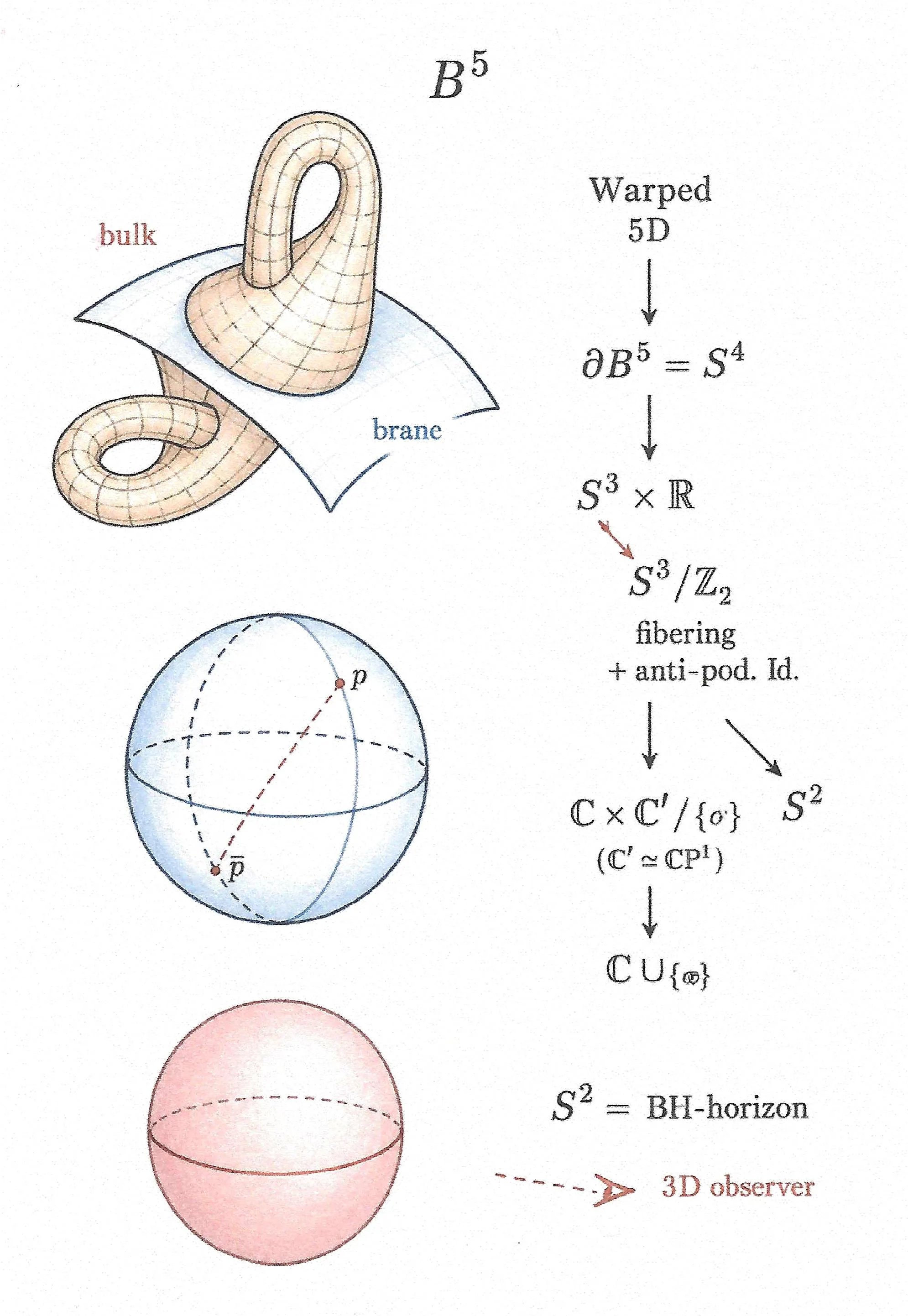
The neck of an hourglass is the narrowest point where grains of sand change sides. In quantum gravity, there is a similar object: an instanton (an instantaneous solution connecting two states of space). It acts like a tunnel through which the geometry of the universe flows from one form to another.
The authors found such an instanton in a five-dimensional world where our four-dimensional reality is merely a membrane (brane) inside a larger space. They took a rotating Kerr-like solution and placed it on a curved background, akin to a crumpled sheet. The key was symmetry: they managed to double-cover the space with a sphere via stereographic projection (like cartographers unfolding a globe onto a plane) and glued the edges using a Klein surface — a one-sided strip where "up" and "down" swap places.
The whole construction rests on a simple first-order equation with an integer parameter, as if the shape of the neck were determined by a single winding number. Remarkably, the angular momentum (rotation) decouples from the other equations and takes on a life of its own. The final touch: the solution admits a complex transformation that makes the hidden self-duality explicit — the geometry turns out to be a relative of elegant Kähler spaces, where curvature obeys a strict symmetry.
Thus, the hourglass gains mathematical rigor: the flow of geometry between worlds can now be described exactly, without approximations.
A Klein surface is like a bottle whose inside is simultaneously its outside; an ant crawling on it would return to its starting point mirrored.
The idea of transitioning between universes through a quantum tunnel is explored in Interstellar, where heroes dive into a wormhole near Saturn.