Galaxy Blows a Hot Self-Regulating Wind express
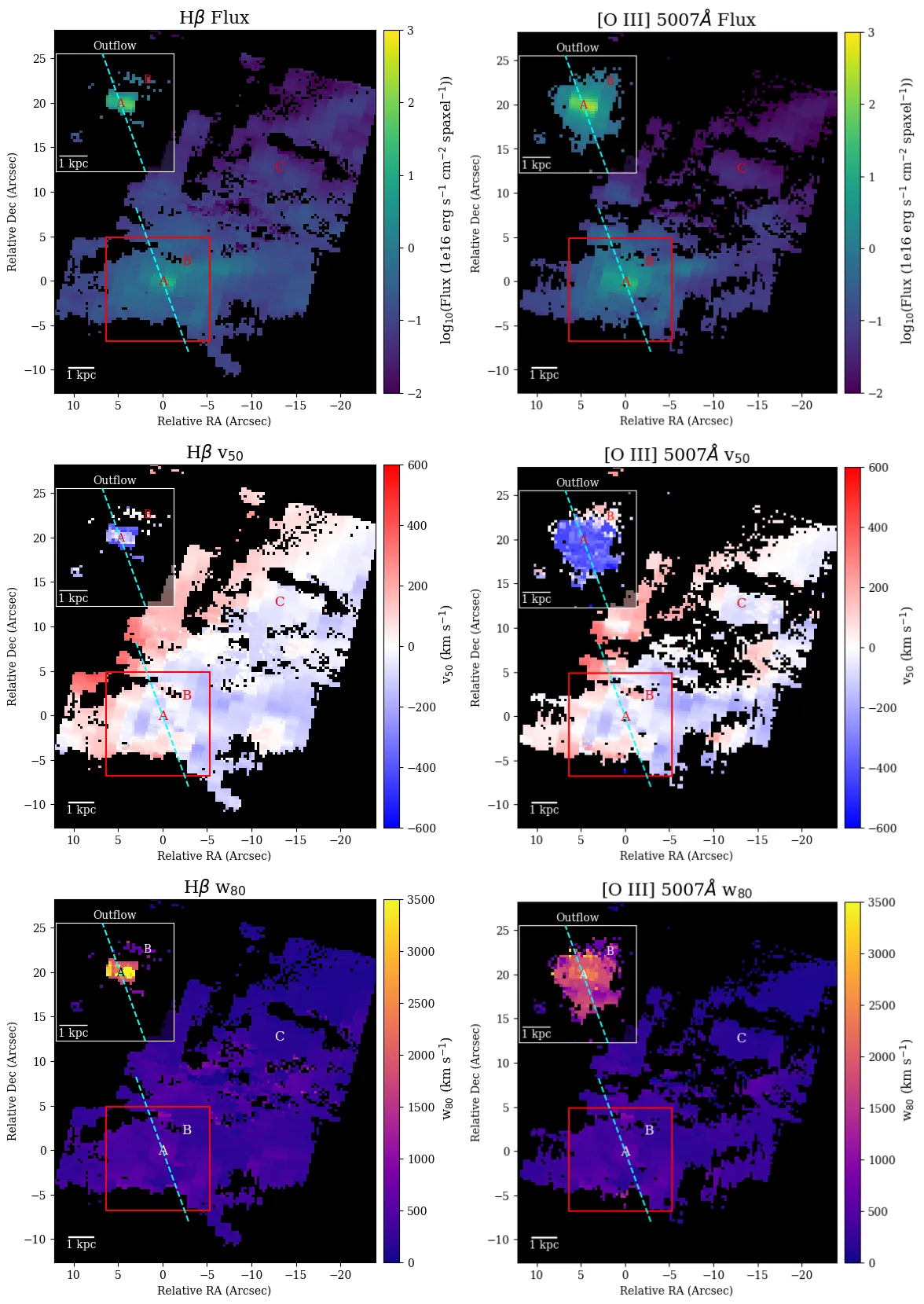
In the heart of the Perseus galaxy cluster lives the galaxy NGC 1275. From its core blows a wind of superheated gas — astronomers have now seen it in detail for the first time.
The wind shows up in the glow of hydrogen and oxygen. It accelerates to 570 kilometers per second — faster than a bullet. Each year, the galaxy ejects roughly 2.7 solar masses. At the same time, about the same amount of cold gas falls toward the center. So the galaxy keeps itself in balance: as much matter comes in as goes out.
Alongside the wind, a jet also works — a narrow stream of particles blasting from near the black hole. Where the jet passes, the gas glows differently. But both the wind and the jet act only within two thousand light-years of the center. Farther out, their influence fades.
This is how the galaxy in the Perseus cluster shows the endless dialogue between a black hole and the gas around it: one blows, the other falls.
Original abstract
as written by the authors arXiv:2608.08331v1
We present new Keck Cosmic Web Imager observations of the central few kiloparsecs of NGC 1275, the brightest cluster galaxy of the Perseus Cluster. These integral field spectroscopic data reveal a warm-ionized outflow traced by H$$\beta$$ and the [O III] doublet extending out to $$\sim2.5$$ kpc from the nucleus. The warm-ionized outflow has an [O III]-derived $$v_{50}$$ of up to $$\sim570$$ km/s, $$w_{80}$$ of up to $$3780$$ km/s, and H$$\beta$$-derived outflowing mass of $$(2.7 \pm 0.3)\times 10^6$$ M$$_\odot$$. Our H$$\beta$$-derived warm-ionized outflowing mass rate of 2.7$$\pm$$0.7 M$$_\odot$$ yr$$^{-1}$$ is comparable to the estimated cold molecular disk accretion rate of 1$$-$$10 M$$_\odot$$ yr$$^{-1}$$, which could be a sign of self-regulation between the pc-scale cold gas feeding the active galactic nucleus (AGN) and the warm wind accelerated out to kpc scales. In the host galaxy, we detect an enhancement in the [O III] / H$$\beta$$ ratio in the direction of the receding jet, which may imply jet interaction with the host interstellar medium. The outflow component also shows a clear enhancement of [O III] / H$$\beta$$ that positively correlates with $$w_{80}$$ and $$v_{50}$$, indicative of AGN influence and/or fast shocks. Both the outflow and host galaxy [O III] / H$$\beta$$ ratio decrease with increasing distance from the center, showing that the influence of the AGN is confined to the central $$\sim2$$ kpc. These results are the first resolved measurements of a kpc-scale ionized wind in NGC 1275 and provide a view into how both jets and winds contribute to the feedback cycles in complex cool core cluster systems.
The wind from NGC 1275's core reaches 570 km/s — in one hour, such a flow would cover the distance from Earth to the Moon.