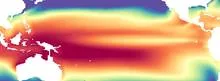
The North Equatorial Countercurrent (NECC) is an ocean current that flows eastward across the tropical Pacific Ocean, sandwiched between the westward-flowing North and South Equatorial Currents. Unlike those broad, wind-driven currents that move with the trade winds, the NECC runs against the prevailing wind direction, a feature made possible by a slight slope in sea surface height. It is strongest from late summer to early winter, when it can transport warm water, nutrients, and marine larvae over thousands of kilometers from the western Pacific toward the Americas. Its variability is closely tied to the El Niño–Southern Oscillation, making it a key player in regional climate and marine ecology.
History
The existence of an eastward current in the tropical Pacific was inferred from ship drift data in the 19th century, but its dynamics were clarified in the mid-20th century through oceanographic expeditions and theoretical work on equatorial currents. The name 'North Equatorial Countercurrent' became standard in oceanography textbooks by the 1950s.
In practice
The NECC is a dispersal corridor for fish larvae and other plankton, influencing the distribution of commercially important species like tuna; tracking its strength helps fisheries managers predict stock movements.
Fun fact
During strong El Niño events, the NECC can become so intense that it carries warm, nutrient-poor water far eastward, contributing to the collapse of anchovy fisheries off Peru.
An interpreter in a room where three languages are spoken simultaneously first hears only a general noise. But if they start asking clarifying questions, listening to intonations, and repeatedly confirming who answered with which phrase, individual voices gradually emerge from the cacophony.
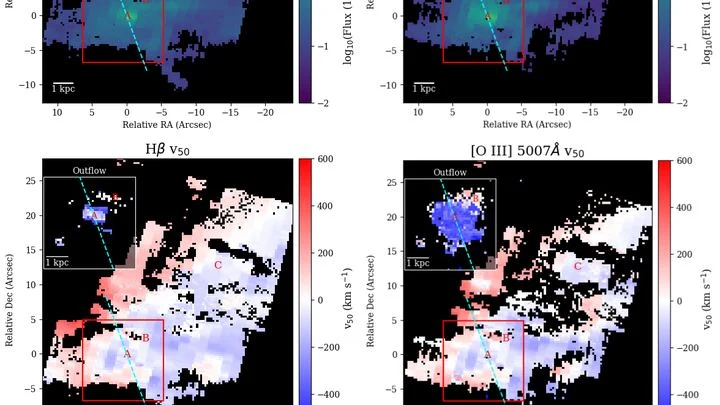
In the heart of the Perseus galaxy cluster lives the galaxy NGC 1275. From its core blows a wind of superheated gas — astronomers have now seen it in detail for the first time.
The wind shows up in the glow of hydrogen and oxygen. It accelerates to 570 kilometers per second — faster than a bullet.
In 1976, physicists predicted that an electron could do more than just fly past a nucleus: it could slam into it, transferring energy and making the nucleus 'shudder.' They called this effect NEEC — nuclear excitation by electron capture. But for nearly fifty years, no one has managed to observe it in an experiment.
Every 165 days, the giant planet dives toward its star, nearly grazing its fiery corona, then flies off into the icy void. This is TIC 241249530 b — an exoplanet with a record eccentricity of 0,94.
In the first seconds after the Big Bang, the Universe left us not only light but also something far more elusive — the relic neutrino background. This echo of creation permeates every cubic centimeter, yet we barely notice it.
In 1991, Mount Pinatubo erupted with such force that it blanketed the planet in a thin veil of ash and gases for years. That veil, like a blanket on a hot night, trapped heat and cooled the ocean surface, causing tropical sea surface temperatures to dip. This event marks the start of a detective story about why some oceans are spawning ever more ferocious hurricanes while others remain calm.
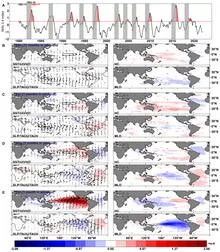
Every winter, the tropical Pacific Ocean seems to replay the same script: sea surface temperatures off the coast of Peru rise, trade winds weaken, and a wave of droughts and floods spreads across the planet. This is El Niño, and its peak almost always falls in December. Why winter in particular?
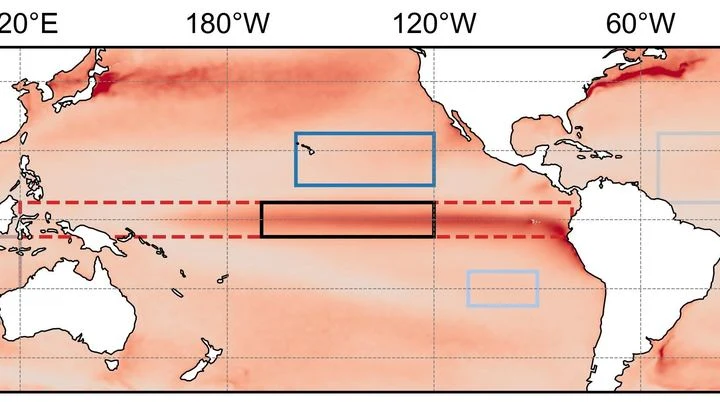
In the Pacific Ocean, there is a warm current that flows eastward against all the others. It is called the North Equatorial Countercurrent, or NECC. In normal years, this band of warm water, a few hundred kilometers wide, quietly carries heat from Indonesia toward the Americas.
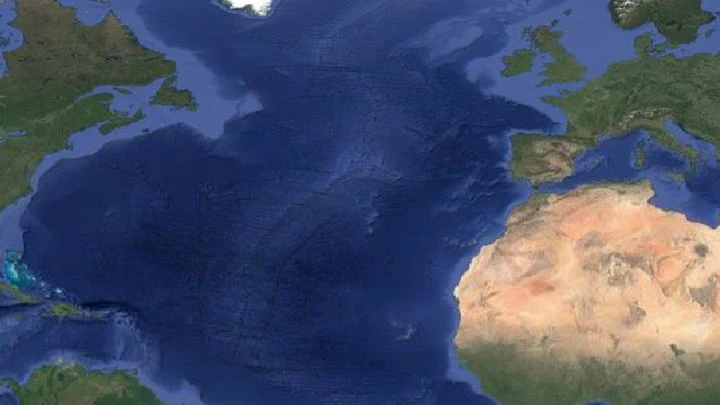
In the Atlantic, a giant invisible conveyor operates: warm surface waters flow north, cool, sink, and return south. This circulation, AMOC, carries heat, making Europe noticeably milder than Canada at the same latitudes. But the conveyor isn't eternal: if diluted by fresh water from melting Greenland ice, the engine stalls.
The shape of a riverbed precisely follows the equation describing the growth of a universe with negative curvature. In the lab, water flowing over sand spontaneously carves a cross-section that matches the solution for the Anti-de Sitter model.
A river tends toward a shape that maximizes bottom friction.
Beneath Enceladus's icy crust churns an ocean, acting like a perfect heat pump. It pushes heat from the equator to the poles, spending a thousand times less energy than it transports — like a perpetual motion machine built into the moon. The secret lies in salt.
Normally, current flows equally well in both directions if there's no magnet. A magnetic field or magnetic material breaks that symmetry: electrons start to prefer one direction. But in a new study, physicists found a way to do without magnets.
In a crystal, atoms may not sit perfectly ordered but with some disorder.
The ocean does not shout about its intentions. It whispers: a warm patch off the coast of Peru, a cold tongue near Hudson Bay, a barely perceptible shift in a current. The atmosphere does not respond immediately, and by winter Europe may get either mild slush or Siberian frosts.
Thousands of kilometers of open ocean separate the reefs of the central Pacific from the sparse coral outposts to the east. This stretch of water, known as the Eastern Pacific Barrier, has long been considered nearly impassable for tiny coral larvae. The currents here mostly carry water westward, away from the eastern islands.
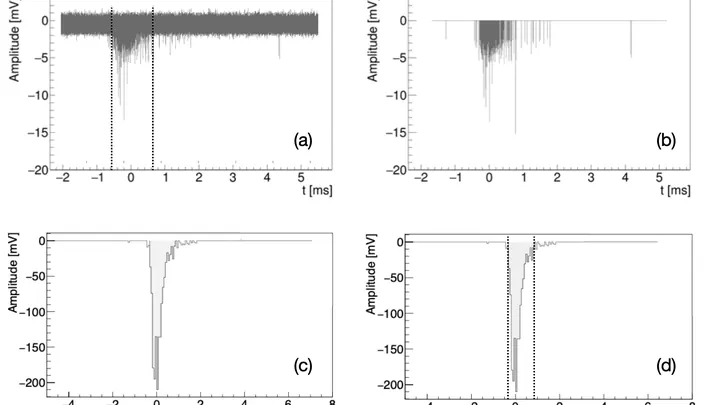
Deep in a cave beneath the Italian Apennines, a tank of gas sits in the dark. Inside, charged particles fly through, leaving faint flashes of light in their wake. These flashes are like the wake of a boat on dark water: they reveal where the particle went and how fast.
Every few years, the Pacific Ocean off Peru warms so abruptly that fish disappear and rains flood the desert. This phenomenon is called El Niño, and it acts like a pendulum that swings the planet's climate. But when the planet itself warms, the pendulum behaves strangely: first its swing widens, then it suddenly fades.
The Sun constantly emits a stream of charged particles — the solar wind. Among them are many electrons, some of which fly back toward the Sun. But observations show that fewer electrons return than expected.
The popping lid of a jam jar is the hero of this story. Press it, and with a loud click it flips from a convex to a concave shape. Exactly the same happens with a hinged beam inside each cell of a new mechanical lattice.
Scientists assembled these snapping beams into a hexagonal grid, like honeycomb, but made of elastic plates. When one beam is sharply compressed, it snaps and pushes its neighbor.
The Pacific Ocean breathes slowly and deeply. Every few years, its warm surface waters shift eastward toward the coast of South America, and then Peru gets drenched while Australia goes up in flames. A year or two later, the water retreats, and the picture flips. This breathing is called El Niño, and until now its rhythm could only be guessed a couple of steps ahead.
A warm ocean off the coast of Peru can make winter in Moscow unusually mild. Climate scientists call these invisible threads that link weather in distant corners of the planet teleconnections. For a long time, they were thought of as something like permanent wiring: the signal sources may pulse, but the wires themselves lie still.
Two conductors stand before one orchestra. One waves the baton quickly, setting the tempo every few bars. The second is almost motionless, but his slow breathing changes the overall sound throughout the symphony. So it is in the tropical Pacific: one part of the wind governs the fast oscillations of El Niño, the other governs decadal climate shifts.
The orchestra assembled, the instruments were tuned, but there was barely any music: that's what the 2025 Atlantic hurricane season looked like. The ocean was the fifth warmest on record, and a weak La Niña usually adds strength to storms. But instead of a continuous concert, we got isolated thunderous chords: three Category 5 hurricanes, with silence in between.
Why was the orchestra silent?
In summer, the South China Sea can show a strange pattern: the water in the north warms while the south cools at the same time. A year later, it's the opposite. This isn't random; it's a steady seesaw that the ocean rocks every summer.
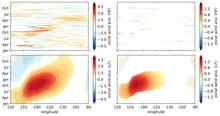
An invisible relay race runs through Earth's tropics: a wave of heavy rain and winds, which meteorologists call the Madden–Julian Oscillation, travels eastward at about five meters per second. Most runners tire quickly, but rare marathoners carry the torch all the way across the Pacific.
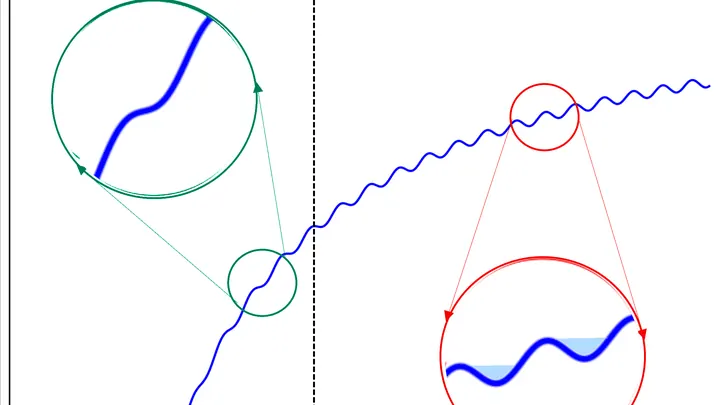
The tropical Pacific Ocean lives in two rhythms. The first is fast: a wave of thunderstorms born over the Indian Ocean races eastward and dies out off the coast of the Americas within a month or two. The second is slow: every few years, the ocean surface warms enough to alter weather across the entire planet. That is El Niño. Between these rhythms lies a bridge, and building it took climatologists decades.
Picture a pendulum hanging in a room with drafts. Sometimes a gust pushes it harder, sometimes softer. If the pendulum barely loses energy, it will swing long and steady. But if friction is strong, each push quickly fades, and the motion becomes jerky: a sharp swing, then a long sway. That's exactly how the tropical Pacific behaves when the heat of El Niño gives way to the cold of La Niña.
The Pacific Ocean breathes. Every few years, its warm western "lung" exhales eastward, and from Peru to Indonesia, rains, droughts, and hurricanes shift. This breath is called El Niño–Southern Oscillation, or ENSO.
A warm patch off the coast of Peru does not appear every year, but when it does, deserts are drenched with rain and Australia is plagued by wildfires. This is El Niño, a phenomenon that climate models struggle to reproduce. Simple models do well at estimating how often it occurs but lose spatial details.
Imagine a translator sitting in on a conversation between two parties: the ocean and the atmosphere. Usually, the translator conveys the meaning with a six-month delay, and in spring it loses the thread entirely. The new model, called CTEFNet, translates up to two years ahead and, on top of that, explains which remark turned the tide.
The Pacific Ocean is a giant network of nerve endings that warns of an impending attack a year in advance. In 2023–2024, El Niño, the warm phase of the Pacific climate oscillation, pushed global temperatures to record highs. Now, two independent methods, like two doctors examining the same symptoms, agree: no new attack in 2025.
The tropical Pacific breathes in two rhythms. One lasts several years: the water off the coast of Peru warms and cools, which fishermen call El Niño. The second rhythm is fast: every month or two, a giant cloud wave is born over the warm waters of the Indian and Pacific Oceans, creeping eastward at a runner's pace and dying out near South America.
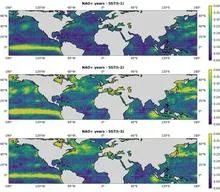
Each Atlantic hurricane season is like a game of dice, where the number of spots depends on three major climate forces: El Niño, ocean temperature in the 'hurricane nursery,' and the North Atlantic Oscillation.
The ocean breathes, and hurricanes swing on its breath like on a seesaw. Over the past seventy years, hundreds of tropical cyclones have crossed the North Atlantic, and not all of them behaved alike. Some decades brought a barrage of destructive storms to coastlines; others brought calm.
The Pacific Ocean behaves like a conductor setting the tempo for outages in the American power grid. When the ocean shifts into its cold phase, known as La Niña, lights start going out more often across the US. Researchers traced this connection over 24 years and confirmed that the ocean really does drive the weather, and the weather batters wires and transformers.
Water remembers. Every current, every eddy, every degree of temperature in the ocean's depths does not vanish without a trace; it leaves a mark that can be read. But until recently, that mark was read only by bulky physical models that spent weeks on supercomputers and still got the details wrong.
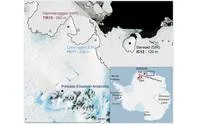
On the coast of Dronning Maud Land, two ice cores stand like two seismographs on one shore. One, FK17, was drilled on the crest of the Lokenryggen ice rise; the other, TIR18, on the crest of Hammaryggen. A hundred kilometers apart, they catch different tremors of the climate. One hears the Pacific, the other the Atlantic and Indian Oceans.
In the summer of 2022, the sky over western India seemed to have forgotten about drought: rains fell more often than usual, while eastern states languished in dryness. Such an imbalance puzzled forecasters, because ocean currents in the Pacific had promised a steady, abundant monsoon across the country.
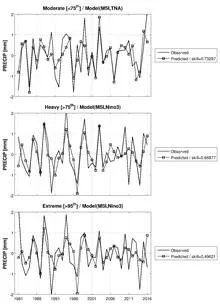
Every year, over the semi-arid belt south of the Sahara, the sky stages the same play: gentle rains that nourish millet, and violent downpours that wash away villages. Until recently, both acts were attributed to a single conductor: ocean surface temperature. But if you listen closely, each rain has its own control panel.
A blindfolded sapper searches for a mine by tossing pebbles at random. He cannot see the map or calculate where the charge is buried. But if he throws enough pebbles and listens for which one lands with a duller thud, he can pinpoint the danger. That is roughly how a new method for predicting El Niño works: the warm current that every few years alters weather across the entire planet.
The Pacific Ocean is a vast pot of water that someone occasionally stirs, now at one edge, now at another. When warm water piles up off the coast of South America, fishermen call it El Niño, "the child," because it often arrives around Christmas.