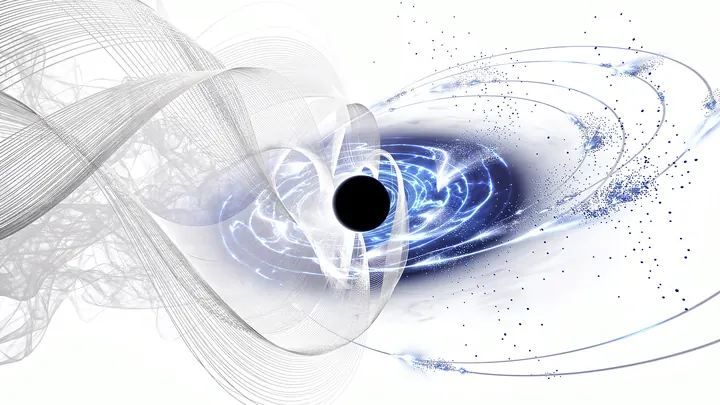
A supermassive black hole is a type of black hole with a mass ranging from hundreds of thousands to billions of solar masses, typically residing at the centers of galaxies. These objects are so massive that their gravitational influence shapes the orbits of stars and gas in their vicinity, and they are believed to play a key role in galaxy formation and evolution. Unlike stellar-mass black holes, which form from collapsing stars, supermassive black holes likely grow through mergers and the accretion of vast amounts of gas over cosmic time.
History
The existence of supermassive black holes was first proposed in the 1960s to explain quasars, and by the 1990s, observations of stellar orbits at the center of the Milky Way provided strong evidence for one, later confirmed by the Event Horizon Telescope's image of M87* in 2019.
How it works
Supermassive black holes are detected by their gravitational effects on surrounding matter, such as the rapid orbital motion of stars near a galactic center, or by the emission from hot gas spiraling into them, which can outshine entire galaxies. Their event horizons—the point of no return—are enormous, spanning regions larger than our solar system. They can also produce relativistic jets, powerful streams of particles launched at near-light speeds, which are observable across the universe.
In practice
They serve as natural laboratories for testing general relativity, and their gravitational influence is used to map the dark matter distribution in galaxies and to probe the early universe through quasars.
Fun fact
The supermassive black hole at the center of the galaxy M87, imaged in 2019, is about 6.5 billion solar masses, yet it appears as a tiny shadow against a glowing ring of hot gas.
A black hole with a mass of 35,000 Suns drifts through a galaxy's gas like a barge through fog. Its gravity rakes the material ahead of it, leaving a dense trail behind — a wake of gas. Some of that gas gets pulled into the black hole, and it grows.
A black hole is like a spinning top that never stops on its own. But if a cloud of ultra-light particles, bosons, forms around it, the picture changes. This "fog" acts like an invisible brake: the particles drain the hole's spin, slowing it down.
The explosion of a massive star is not just a flash: it's a blow to the surrounding gas. But until now, no one had looked at how the gas itself moves at the sites of such explosions. Now astronomers have gathered data on 33 nearby supernovae and for the first time measured the turbulence of the cold molecular gas around them.
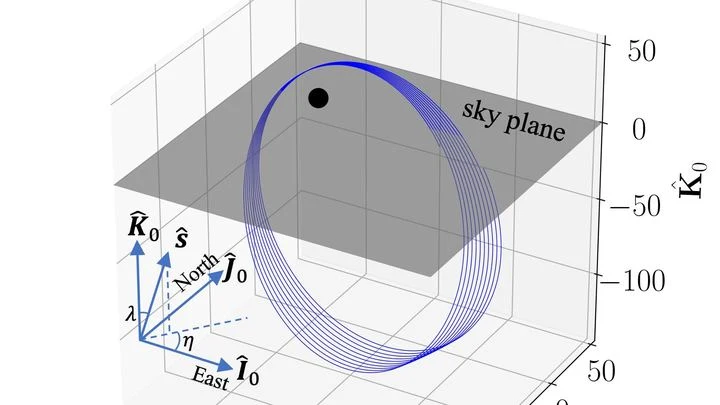
At the heart of our Galaxy lives the supermassive black hole Sagittarius A*. If an invisible companion orbits nearby, their dance can be spotted through the light of other stars. The pair's gravity works like a lens: as the black holes pass in front of a background star, its light briefly brightens and splits into two.
In a distant galaxy about 290 million light-years away, the object HLX-1 lies hidden. It once flared brighter than hundreds of billions of suns, but now it has quieted down. From 2018 to 2022, the Hubble, Chandra, and Swift space telescopes tracked its fading.
Layer by layer, artifact by artifact — an archaeologist reconstructs the history of an ancient settlement. Similarly, astrophysicists sifting through 259 records from LIGO–Virgo–KAGRA saw a clear layered structure among merging black holes.
In 2016, astronomers saw something incredible: a distant star, named Icarus, flared up for several weeks, crossing the abyss of space. Gravitational lensing, an effect predicted by Einstein, had kicked in: a massive object bends spacetime and focuses light like a giant magnifying glass.
In the heart of a dense star cluster, a true forge reigns: here stars, like glowing blanks, collide and merge under gravity, and these mergers are not a catastrophe but an opportunity. Each strike of the stellar hammer transfers spin to the future black hole.
The early universe at redshift z>7 was an arena of rampant growth: black holes with masses up to a billion solar masses already blazed as quasars, devouring gas at monstrous rates. How these giants managed to grow in such a short time is one of astrophysics' sharpest puzzles.
Imagine a spotlight: if you look at it from the side, it glows dim red, but if you stare straight into it, it blinds you with white-blue light. That, according to new data, is exactly what the mysterious 'little red dots' in the early universe look like. They are giant black holes, objects with gravity so strong that even light cannot escape, turned edge-on to us.
A field sown with seeds. Some seeds are large and sprout at the slightest rain; others are finicky, requiring special soil and rare conditions. Which seeds fall into the ground determines what kind of forest will grow years later. Astrophysicists think about the birth of black holes in the early universe in much the same way.
A giant cloud of invisible matter acts like a funhouse mirror — distorting the light from a distant galaxy. From these distortions, astronomers can weigh the cloud and peer into its depths.
The universe is full of the invisible. We know about dark matter from galaxy rotation and gravitational lensing, but its nature has eluded us for a century.
A black hole is like a bottomless well. You can measure how much water has flowed into it by watching the level from outside. But how do you find the mass of the water itself if you're standing inside the well? That's roughly the problem the authors of a new paper tackle.
Detectors pick up the “ripples” of gravitational waves from mergers of black holes or neutron stars — like an echo from the kitchen where a cosmic dish was being prepared. Astronomers are trying to reconstruct the recipe: how two massive stars turned into an exotic pair and collided.
A vast hall where hundreds of orchestras play at once. Amid this din, you need to pick out one specific duet — two supermassive black holes circling each other in a distant galaxy. That's how pulsar timing arrays work: they listen to the "hum" of the entire sky, created by gravitational waves from many such pairs.
The city has long been asleep: not a single lit window, not a single new house. Only in the very center, in one lone building, someone forgot to turn off a spotlight. That's what a galaxy looks like when stars are no longer born, yet its central black hole still shines.
The cosmic accounting has hit a snag. The bookkeeper is balancing the books: in one column, all the planets astronomers have counted in the galaxy; in the other, the stockpile of building material in the dusty cocoons of newborn stars. The numbers don't line up. Even if you gathered every last grain of dust and molded it into planets, there wouldn't be enough material.
Two figure skaters glide on the ice. One is light and cautious, barely rotating. The other is massive and fast, spinning with all its might, and in different directions at that. That's roughly the picture painted by gravitational waves from black hole mergers.
In space, merging black hole pairs are common, and often one is noticeably more massive than the other. This mass difference isn't just a number: it's a key to their shared history.
Astrophysicists studied the stable mass transfer channel — a process where matter flows smoothly from one star to another without disrupting the system.
Black holes come in two types: tiny ones — the remnants of supernova explosions, and giants in the cores of galaxies. But where are the intermediate ones, with hundreds and thousands of solar masses? The answer may lie in star swarms, where black holes collide like balls on a billiard table and, merging, bulk up.
A handful of sand weighing as much as a small mountain: that's roughly what strangelets are like: tiny clumps of 'strange' quark matter where particles are squeezed to unimaginable densities. In a new study, astrophysicists tested whether such objects could exist in nature and what they would look like.
The universe is full of invisible substance that governs the movement of galaxies. In the 1970s, astronomer Vera Rubin showed: without dark matter, stars on the outskirts would have long since flown apart. But what it's made of remains unknown.
After the Big Bang, the Universe resembled a tightly inflated balloon: pressure prevented matter from clumping together. But hypothetical superheavy particles — sort of ‘heavyweights’ of the microcosm — momentarily made the balloon less stiff. Matter easily clumped, giving birth to black holes with masses from a billion to a billion billion tons.
When two supermassive black holes circle each other before merging, they shake spacetime itself, like a speedboat racing across a lake leaves waves in its wake. These waves are called gravitational waves. They travel through the Universe and pass through everything, even the Earth.
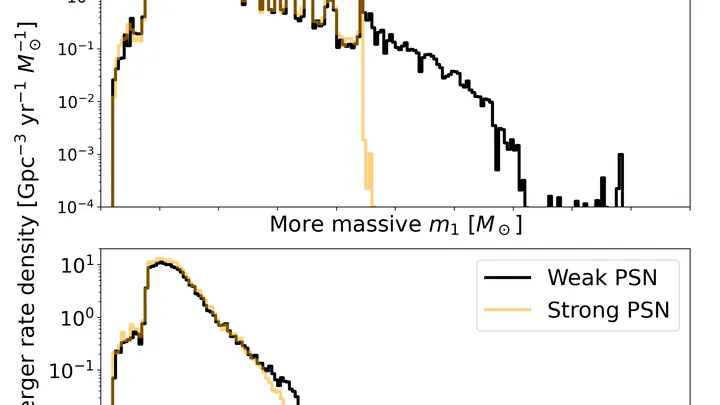
The latest crop of gravitational waves brought a puzzle. The LIGO, Virgo, and KAGRA detectors caught dozens of signals from merging black holes, and the mass plot shows a glaring gap: objects heavier than 45 Suns are almost absent, and the few that exist spin suspiciously fast. Some say giant stars explode too 'cleanly,' leaving nothing behind.
The galaxy MCG+11-11-032 is relatively close to us: its light takes about 150 million years to reach us. At its center, like in most large galaxies, sits a supermassive black hole. But a few years ago, astronomers began to suspect: what if there are two?
The clue came from the X-ray spectrum.
Water in a kettle, as it boils, clearly separates into liquid and steam. But under enormous pressure, the boundary vanishes: the substance enters a supercritical state — neither one nor the other, but something in between.
Black holes can do this too.
A galaxy is like a giant merry-go-round: stars and gas whirl around the center, and their speeds reveal how much stuff is on the ride. If we only saw the luminous matter, the outer parts would spin slower than observations show. So there must be invisible mass, dark matter, that holds the galaxy together.
The globular cluster M22 is a dense swarm of hundreds of thousands of stars, hanging in our galaxy like a glowing beehive. In such a crowded environment, stars often collide and swap partners, but massive objects like black holes were thought to be quickly ejected by gravitational interactions.
Black holes heavier than a trillion Suns act like cosmic umbrellas. They cast a shadow on the faint afterglow of the Big Bang — ancient light that fills the entire sky. The shadow turns out not blurred, but with a sharp edge, as if cut out with scissors: around it glows a bright ring of photons trapped by gravity.
In 2019, gravitational-wave detectors caught a signal from the merger of distant objects. One was a black hole of 23 solar masses. The other weighed just 2.5 solar masses — and that's weird.
Usually, neutron stars don't get heavier than two solar masses: beyond that, they collapse into a black hole.
At the center of our Galaxy lurks the supermassive black hole Sagittarius A* — a heavyweight that holds stars in its grip. Astronomers dream of finding pulsars near it: these cosmic lighthouses emit radio pulses with the precision of atomic clocks.
When a massive star dies and explodes, it releases not only light but also invisible lightweight particles. They fly out in all directions at nearly the speed of light. Only a small fraction reaches Earth, but each explosion sends its own clump. These clumps stretch along the way: fast particles overtake slow ones, and by the time they arrive, a clump can be spread over tens of thousands of years.
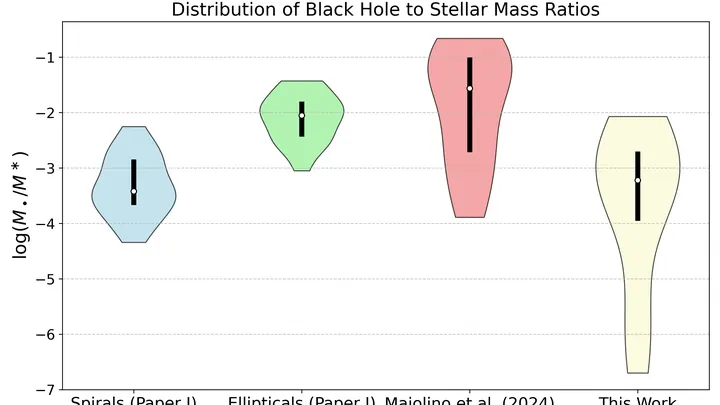
Growing a galaxy is like a dance between two partners: at the center of nearly every large galaxy sits a supermassive black hole, and they grow together. But who leads?
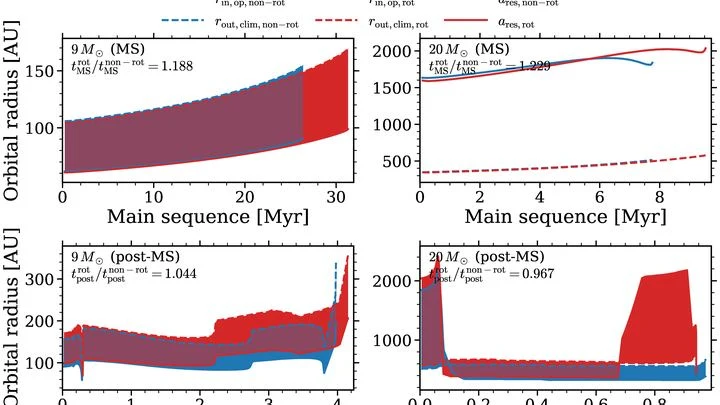
A star nine times heavier than the Sun ignites a zone around it where liquid water could slosh on a planet's surface. But this zone is like a narrow strip of beach at low tide: it will vanish in 30 million years. Such stars live bright and die young, leaving life no time for the long journey from microbes to complex beings.
Imagine a city where a skyscraper and a huge park are being built at the same time. The skyscraper grows upward, and the park expands outward. Both processes are fast and get in each other's way, but in the end they are meant to become a single whole. That's the situation in galaxy GNz7q: a black hole grows at the center while new stars burst to life around it.
The center of a galaxy is a bustling metropolis where a giant black hole often snatches inattentive stars. But telescopes caught a flare in a quiet suburb, tens of thousands of light-years from the core. This gave away a wandering black hole — an invisible predator, flung out of the center after an ancient galaxy collision.
Star S2 completes an orbit around the black hole at the Milky Way's center every 16 years, reaching speeds of 7650 kilometers per second. Its orbit is a stretched ellipse, and at its closest approach, the star comes within a distance 120 times the Earth-Sun separation.
Some stars fizzle out like a dud firework: instead of a bright blast, just a cloud of smoke. Usually, a massive star ends with a supernova explosion, leaving a black hole. But sometimes there's no bang: the star collapses straight into a black hole, almost unnoticed.