The solar corona is the outer layer of the solar atmosphere, extending millions of kilometers. It consists of rarefied plasma (about 10^15 particles/m^3) with a temperature from 1 to 3 million kelvins, significantly hotter than the underlying photosphere (about 5800 K). The corona radiates mainly in the ultraviolet and X-ray ranges due to the high ionization of atoms (e.g., iron ions Fe IX–Fe XIV). The brightness of the corona is a million times less than the solar disk, so it is observed with coronagraphs or during eclipses. The coronal heating problem remains central in solar physics: mechanisms of magnetic reconnection and wave heating by Alfvén waves are likely at work.
History
The first mentions of the corona appear in chronicles of ancient civilizations describing solar eclipses. Systematic observations began with the invention of the telescope. In 1868, Pierre Janssen and Norman Lockyer independently discovered helium in the chromosphere spectrum. The mysterious green line at 530.3 nm, discovered in 1869, was identified in 1939-1942 as Fe XIV emission—iron stripped of 13 electrons, indicating high temperatures. Space missions like Skylab (1970s), SOHO, TRACE, and the Solar Dynamics Observatory revolutionized understanding of the corona, revealing its dynamics and connection to magnetic fields.
How it works
Coronal heating is explained by two classes of models: direct heating through current dissipation (alternating current models) and wave heating (direct current). Magnetic reconnection, described by magnetohydrodynamic equations, converts magnetic energy into thermal and kinetic energy. Energy conservation (first law of thermodynamics) in plasma accounts for heating, radiation, and thermal conduction. The corona loses energy through radiation, thermal conduction into the chromosphere, and solar wind acceleration. Maxwell's equations combined with hydrodynamic equations form the basis of MHD description of the corona. Spectral analysis allows diagnosing temperature and density.
In practice
Studying the corona helps predict solar flares and ejections that affect satellites, communications, and power grids on Earth.
Fun fact
During solar eclipses, the corona appears to be several solar diameters in size, but in reality it extends far beyond Earth's orbit, gradually transitioning into the solar wind.
Picture a guitar string stretched between two frets. When you pluck it, a standing wave forms: some points on the string oscillate strongly, while others, the nodes, remain almost still. The chromosphere, a layer of the solar atmosphere sandwiched between the photosphere and the corona, behaves in much the same way.
In a pot on the stove, water starts to churn from the bottom long before the whole thing boils. Bubbles of steam rise from the base even though the burner itself hasn't heated up yet.
Around every galaxy lies an invisible corona of cold gas. It extends far beyond the stellar disk and serves both as a fuel depot for new stars and as a graveyard for ejected material.
The Sun has a layer called the chromosphere, sitting just above the visible surface. Bright arcs often flare up there, visible through telescopes, but to understand what ignites them, you need to look at invisible magnetic fields.
The XMM-Newton X-ray telescope stared at galaxy Mrk 1044 for two straight hours. Inside it, a black hole is surrounded by a swirling disk of superheated gas. This gas glows in X-rays, and its light flickers — brighter, then dimmer.
For the first half hour, the flickering of soft and hard X-rays was in step.
The Sun's edge looks like a fuzzy fringe: thin jets of hot gas, spicules, shoot upward from it. They live only a few minutes and are constantly changing. In 2024, a balloon-borne telescope managed to spot not only the jets themselves but also their faint glow in hydrogen lines that had never been captured there before.
In a pot of boiling soup, light fat droplets rise to the top, while heavy vegetable chunks sink to the bottom. Particles in the tenuous hot gas around the Sun and other stars behave much the same way — except instead of broth, there's a mixture of charged particles: electrons, protons, and alpha particles.
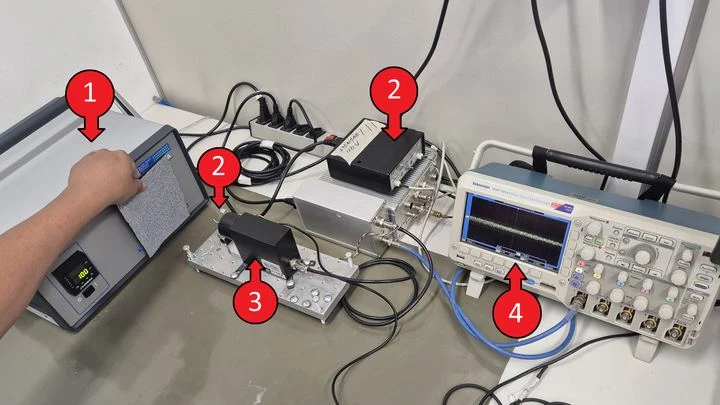
In the kitchen, when a pan heats up, your hand feels the heat before you even touch it. A solar telescope picks up similar invisible heat — only from a star, not a stove. The instrument, called HATS, captures radiation in the terahertz range, which was previously little studied due to technical difficulties.
The solar wind is a continuous stream of charged particles flowing from the Sun. It has two main components: protons (hydrogen nuclei) and alpha particles (helium nuclei, four times heavier).
The solar wind is a stream of charged particles constantly blown off the Sun's surface, filling the entire solar system. It's not like a steady breeze: it has eddies, gusts, and calm patches. Scientists call this turbulence.
The solar wind is a continuous stream of charged particles flowing from the Sun. It has two main components: protons (hydrogen nuclei) and alpha particles (helium nuclei, four times heavier).
The solar wind is a stream of charged particles constantly blown off the Sun's surface, filling the entire solar system. It's not like a steady breeze: it has eddies, gusts, and calm patches. Scientists call this turbulence.
In the solar corona, it rains from time to time — only not water, but plasma. The hot gas cools, clumps into blobs, and rushes downward along magnetic loops, like drops running down invisible gutters.
In the solar corona, it rains from time to time — only not water, but plasma. The hot gas cools, clumps into blobs, and rushes downward along magnetic loops, like drops running down invisible gutters.
The solar corona is the Sun's outer atmosphere, heated to millions of degrees. How it gets so hot is still unclear. One candidate is torsional waves: they twist magnetic field lines like a rubber band. Such waves were recently spotted with the new Daniel K. Inouye Solar Telescope.
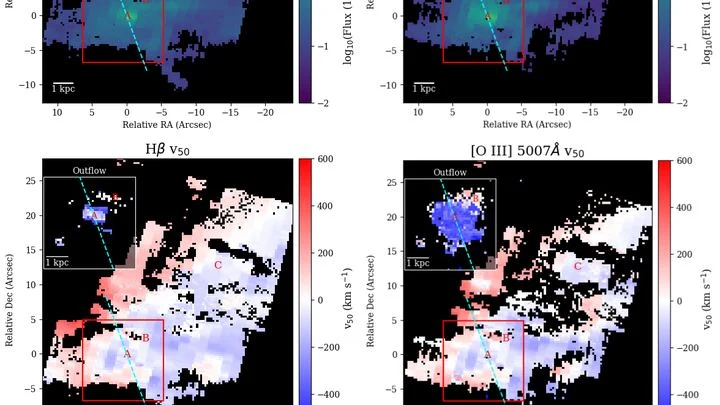
In the heart of the Perseus galaxy cluster lives the galaxy NGC 1275. From its core blows a wind of superheated gas — astronomers have now seen it in detail for the first time.
The wind shows up in the glow of hydrogen and oxygen. It accelerates to 570 kilometers per second — faster than a bullet.
Cosmic rays aren't rays in the usual sense: they're fast particles bombarding Earth from all directions. Mostly they're protons and atomic nuclei. Their energies vary widely, from modest to fantastically huge. When such a particle heads our way and the Moon or Sun gets in its path, it gets absorbed.
The solar corona lives its own turbulent life. Magnetic fields here are governed by the motions of the dense surface — the Sun's photosphere — but occasionally they rewrite the magnetic pattern themselves.
May 2022. The space polarimeter IXPE, the spectroscope NuSTAR, and the monitor NICER simultaneously stared at one spot in the sky — at the black hole in the Cygnus X-1 system, where it orbits a blue supergiant in a close binary system with a period of 5.6 days.
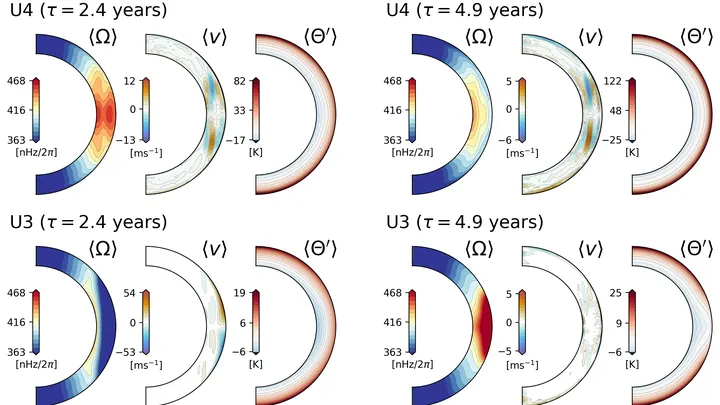
27 days at the equator, 32 at the poles. Five days' difference, and over a year, the equator gains almost a week. A gas ball 1,4 million kilometers in diameter spins like a layered top: each layer moves at its own speed.
The Sun is constantly struck by blows — magnetic reconnection in the plasma releases energy, making the corona flare up. After each such blow, magnetohydrodynamic waves linger in the plasma loops, like the fading ring of a bell.
When a star ventures too close to a supermassive black hole, a cosmic requiem plays out — a tidal disruption event. Thanks to photometry and spectroscopy, astronomers discern every instrument in this orchestra.
A waterfall that doesn't heat up from the fall but freezes — that's roughly how gas behaves as it flows onto a neutron star in an X-ray pulsar when the star shines dimly. Usually, infalling matter is heated to a white-hot glow, but new work shows the opposite.
For years, the Sun teased astrophysicists. In its atmosphere, refractory elements, like spices in a basic recipe, were slightly less abundant than in nearly identical twin stars. Suspicion arose: could our star be modest, skipping the planetary "dessert" that others devour with gusto?
The Sun is not just a blazing ball, but a colossal orchestra, where the strings are solar filaments — giant arches of dense plasma floating in the scorching corona. They tremble, and each oscillation is an encrypted melody of magnetic fields.
Active galactic nuclei (AGN) are the universe’s powerhouses: their X-ray coronae blaze millions of times hotter than stellar atmospheres. But what strikes the spark? A ten-day X-ray campaign by the XRISM and XMM-Newton satellites, aimed at NGC 3783, provided the answer: it’s actual thunderstorms.
Moments before totality, swift shadow bands glide across the ground, like ripples from pebbles tossed into water. For centuries, this phenomenon baffled scientists. It turns out the key is that light is a wave.
The Sun isn't a pinpoint lamp but a vast disk. When the Moon nearly covers it, a thin glowing crescent remains.
A powerful spotlight flickers on and off. Light reflects off surrounding clouds, and by measuring the delay of the reflected signal, you can figure out how far away the clouds are. That's roughly how astronomers study the hot corona — a scorching cloud of plasma above the black hole at the center of an active galaxy.
But there's a catch.
A tightly twisted phone cord snaps and scatters sparks. Magnetic fields on the Sun behave the same way: they twist, break, and reconnect, powering flares. For the first time, astronomers have witnessed this process directly. One loop was twisted by 540 degrees — one full turn and then half again. That’s three times more than previously thought possible.
A sunspot cools, and above it a dark filament, a prominence, hangs for weeks. Inside it, like a compressed spring, hides the magnetic field. It can be laid out in neat arches, or it can be twisted into a tight rope.
The solar corona (the outer atmosphere of the Солнца, heated to millions of degrees) glows in ultraviolet light, but these rays are absorbed by the air and never reach Earth. Direct images of the corona from space have only been available since the 1990s.
The paradox of the young solar wind has long puzzled heliophysicists. Measurements showed that near the Sun, proton beams aren’t smeared out but sharply compressed, as if someone had neatly hammered them into the shape of a hammerhead.
The Sun is a boiling cauldron of hydrogen and helium, where scorching gas is caught in magnetic snares. When invisible ropes reconnect, energy comparable to billions of thermonuclear explosions is released. Where does it go?
On a scorching afternoon, a stifling haze hangs over the city, and not a single cloud is on the horizon. Usually, in such weather, all you can do is wait for nature to take pity and send some cool relief. But what if shade and rain could be switched on schedule, like a light in a room?
The Sun doesn't burn steadily: it erupts in series. Like a campfire that dies down and then suddenly throws out showers of sparks, these "fiery seasons" last from six months to a year and a half, and during them the star shows an unusually high number of sunspots.
Imagine a powerful hair dryer that blows not warm air but white-hot plasma, such devices are called plasma wind tunnels. They are used to test on Earth how a spacecraft will enter the atmosphere.
If you stick two identical thermometers into a pot of hot water, they'll both read the same, and we relax, thinking the temperature is measured correctly. But in a rarefied gas heated to millions of degrees, this trick stops working.
The ionosphere at an altitude of 70 kilometers acts like a giant mirror for radio waves. Ground antennas constantly beam signals into it and listen for the reflection. When a solar flare occurs on the Sun, a stream of X-rays reaches Earth in 8 minutes and compresses the lower layer of the ionosphere.
The crown of a huge tree sways in the wind, but the roots and trunk are hidden underground. On the Sun, magnetic fields play the role of such invisible roots. They emerge from the depths, thread through the entire atmosphere, and govern the motion of the hot gas — plasma.
Planet WASP-121 b always shows the same face to its star, like a rock in a campfire. The dayside is so hot that ordinary hydrogen, the very stuff most of the universe is made of, can't take it: its molecules tear apart into individual atoms, and the temperature flips upside down: the higher you go, the hotter it gets.