Why Cancer Comes Back Even After Aggressive Chemo express
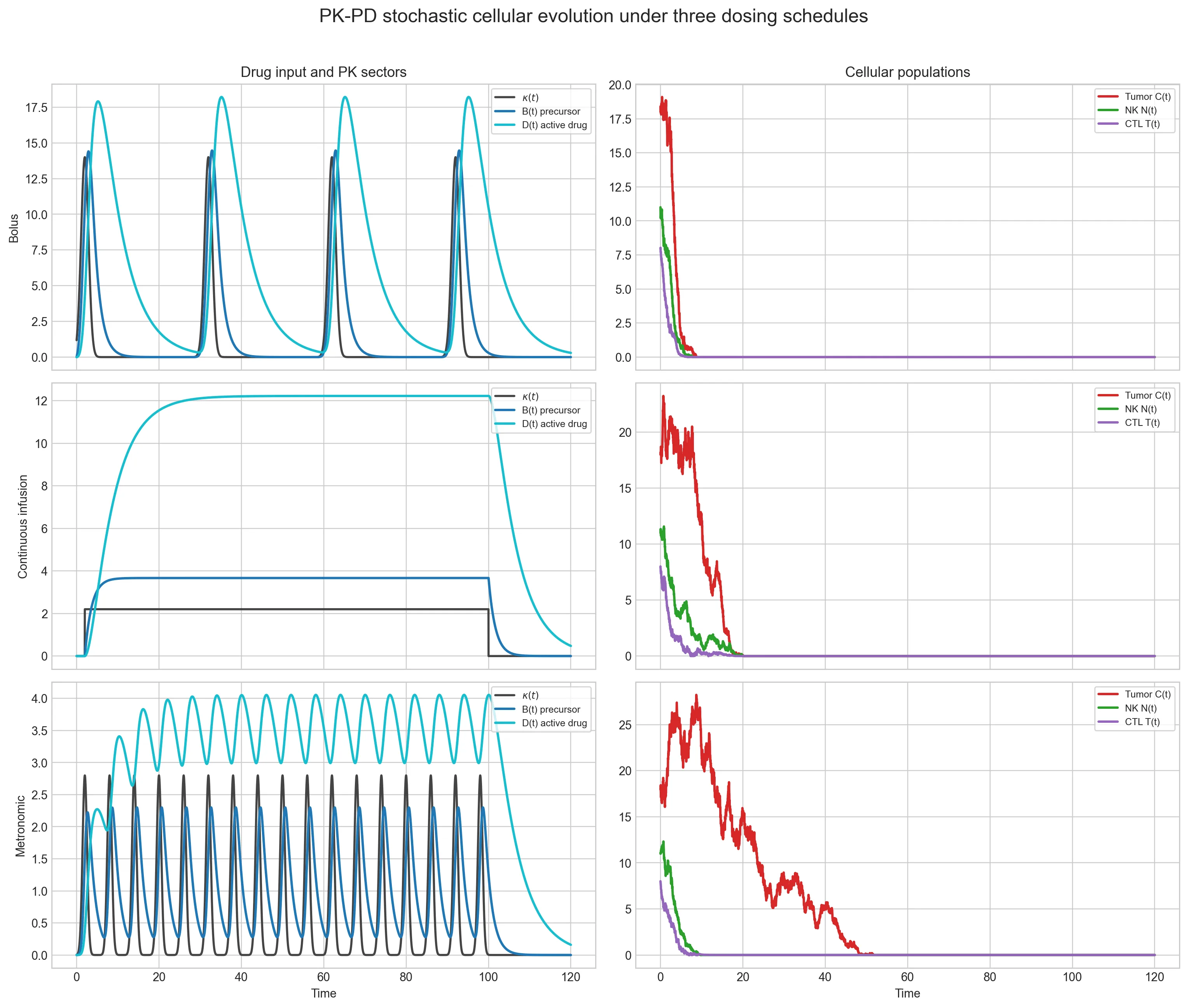
Chemotherapy hits cancer like a powerful spray on a dirty plate: the stream washes away almost everything, but crumbs remain in the cracks. Old models said that if you make the pressure strong enough, the plate becomes perfectly clean. New work shows this isn't so. Even the highest dose leaves a few cells, because in a small group there are always random fluctuations, like the last drops you just can't shake out of a bottle.
Scientists combined two things: how the drug spreads through the body and how tumor cells multiply and die. It turns out that standard treatment, a big dose at once, acts like a broom that sweeps away not only cancer but also the immune cells around it. In these "swept" areas, stochastic gene expression fluctuations in cancer cell numbers get free rein. Even if just a couple of cells remain, they can start growing again. This mechanism was dubbed "stochastic pharmacokinetic escape."
Validation on 1461 patient histories confirmed: in most patients, the tumor first shrinks to a minimum and then grows again. This is not the exception but the rule. The model accurately reproduced this pattern. It also turned out: the smaller the tumor, the stronger the noise, like in a small company where every voice sounds louder. So it's the tiny pockets that are the most dangerous.
The way out is not to hit harder but to hit smarter: give the drug in small, continuous doses and simultaneously support immunity. Then random cells have nowhere to hide, and the chance of recurrence drops.
Original abstract
as written by the authors arXiv:2608.15356v1
Classical mathematical oncology employs deterministic mean-field models predicting that sufficiently high chemotherapy doses drive tumor density to zero. We show that this apparent cure is an artifact of neglecting demographic fluctuations. We construct a nonequilibrium stochastic PK-PD field theory combining a two-compartment pharmacokinetic model with a stochastic tumor-immune sector in the Doi-Peliti formalism, then map it to coupled multiplicative Langevin equations via the Martin-Siggia-Rose/Janssen-De Dominicis approach. In immune-depleted sanctuary sites, the dynamics reduce to a time-dependent Feller diffusion whose Fokker-Planck equation yields an analytical survival functional: demographic noise implies a strictly nonzero relapse probability for tumor micro-clusters under high-dose chemotherapy. Standard bolus administration acts as a nonselective annihilation process, driving immune fields into an absorbing state and creating a spatially immune-depleted vacuum that enables fluctuation-induced relapse -- Stochastic Pharmacokinetic Escape. We derive quantitative conditions under which metronomic dosing and adjuvant immunotherapy suppress this stochastic window of vulnerability. A model-agnostic analysis of 1461 longitudinal patient records shows that the majority of evaluable lesions exhibit a nadir followed by measurable regrowth rather than monotonic elimination; fitting the model's drift functional to these trajectories reproduces this pattern quantitatively, and a direct test of the predicted demographic-noise scaling law reveals size-dependent noise largest at the smallest observed tumor volumes, consistent with the proposed mechanism.
In the smallest group of cells, noise is strongest: like in a room where three people argue louder than a hundred.