Stochastic inflation is a theoreticalframework that describes the behavior of the inflaton field—the field responsible for cosmic inflation—by treating its quantum fluctuations as a classical stochastic (random) process. During inflation, the universe expands exponentially, and quantum fluctuations of the inflaton are stretched to cosmological scales. These fluctuations become the seeds for large-scale structure. The stochastic approach separates the field into a long-wavelength, slowly varying part and short-wavelength fluctuations that act as random kicks, leading to a diffusion-like equation for the field's probability distribution.
History
The stochastic approach to inflation was developed in the late 1980s by Alexei Starobinsky and, independently, by Andreas Albrecht and Paul Steinhardt, building on earlier work by Vilenkin and others.
How it works
The framework splits the inflaton field into a coarse-grained part (averaged over a Hubble volume) and a fluctuating part. The short-wavelength fluctuations are integrated out, leaving a Langevin equation for the coarse-grained field with a noise term. This equation describes how the field undergoes a random walk, with the noise amplitude determined by the Hubble parameter. Solving the associated Fokker-Planck equation gives the probability distribution of the field, which can be used to compute the spectrum of density perturbations and the probability of eternal inflation.
In practice
It is used to calculate the primordial power spectrum and to study the possibility of eternal inflation, where inflation never ends globally.
Fun fact
In stochastic inflation, the inflaton field can sometimes fluctuate 'uphill' against its potential, leading to regions where inflation continues indefinitely—a scenario called eternal inflation.
Chemotherapy hits cancer like a powerful spray on a dirty plate: the stream washes away almost everything, but crumbs remain in the cracks. Old models said that if you make the pressure strong enough, the plate becomes perfectly clean. New work shows this isn't so.
A superfluid gas is like a crowd of people marching in step: each atom knows where to go and doesn't fall out of the common rhythm. But this crowd has three 'valleys'—three different directions it can take. In a new experiment, physicists made one valley slightly more 'favorable' than the others and watched how the crowd darted between them.
In the first instants after the Big Bang, the universe expanded faster than light could cross it. Like an inflating balloon, but instead of rubber, it was space itself. On this balloon, ripples inevitably formed — tiny compressions and rarefactions from which all galaxies and stars later grew.
A courtroom interpreter is distracted by every rustle: the creak of a chair, a cough in the back row, the rustle of papers. By the end of the day, they are translating not what the witness said, but what they heard through the noise. Rare translation errors are not the result of a single loud shout, but of the accumulation of many small disturbances.
In the first fraction of a second after the Big Bang, the universe expanded at an unimaginable rate. The engine behind this expansion could have been a field that behaves like a slowly rolling ball — the axion. What makes the axion special is that, like a conductor, it can drive electromagnetic waves, creating them literally out of nothing.
The early universe resembled an overheated cauldron, seething with quantum fluctuations (random bursts of energy). In this chaos, like steam over boiling water, a special field, the scalar field, condensed. It became the 'engine' that made space expand at an incredible rate. This process is called inflation.
$$10^{-35}$$ seconds. A tiny instant during which the Universe manages to expand by a factor of $$10^{26}$$. Immediately after, it goes through thousands of rapid transformations — like a ball bouncing along a chain of tunnels. This cascade is the essence of chain inflation, first proposed by Alan Guth.
In the first 10⁻³⁵ seconds after the big bang, the most rapid part unfolded. Space expanded faster than light — that's expansion of the universe (inflation). Almost the entire score was performed by a single field, the inflaton, conducting the tempo and key.
In the first fractions of a second after the Big Bang, the Universe underwent inflation — a monstrously rapid expansion that smoothed out all irregularities. But amid this cosmic smoothness, one "wrong" note could have been hidden: quantum fluctuations of the axion field.
In the first moments after the Big Bang, the Universe hummed like a bell. Inflation, the epoch of rapid expansion confirmed by measurements of the cosmic microwave background, ended, and the inflaton field began oscillating around the minimum of its potential.
Inflation is the rapid expansion of the newborn Universe, when quantum fluctuations were stretched to cosmic scales. The cosmic microwave background is the fossilized light of that epoch, shadows on the wall of our cosmic cave.
After the Big Bang, the universe underwent a rapid expansion — inflation, smoothing out the cosmic microwave background and sowing the seeds of galaxies. But at the quantum level, chaotic fluctuations brewed in the inflaton field.
The early universe expanded at an unimaginable rate — faster than light could cross it. In this boiling cauldron, any region of space resembled an open can of paint: its boundaries continuously captured new 'vapor' from outside, while some of its own contents irrevocably escaped.
When an orchestra is just tuning up, disjointed sounds drift through the hall, but as soon as the conductor raises the baton, chaos turns into a symphony. Much the same can be said for the beginning of our Universe. In its first moments, it expanded at an unimaginable speed — faster than light could cross it.
Quantum noise, like the hiss of an untuned radio, filled the infant Universe. Alan Guth showed that superfast expansion (inflation) caused this ripple to freeze, giving rise to clumps of matter — the seeds of galaxies.
A new method extends this picture to any theory of gravity.
Baking bread starts with nearly homogeneous dough, in which tiny gas bubbles are already hidden. They grow, and the rate of their growth determines the future structure of the crumb. In cosmology, the role of such bubbles is played by the seeds of galaxies — barely noticeable density enhancements in the hot 'soup' of the early universe.
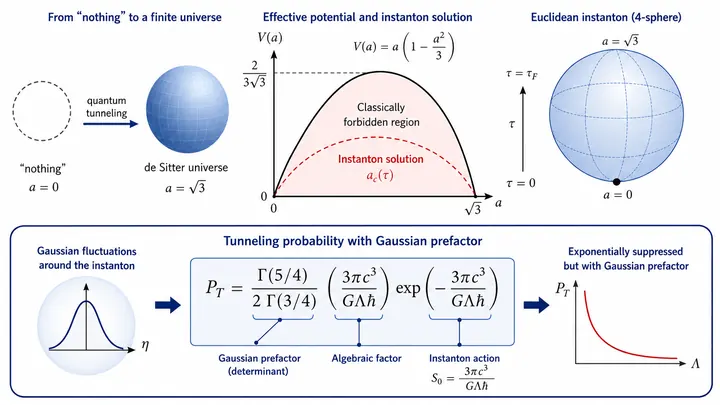
Quantum nothingness resembles water in a pot just before boiling. From time to time, a bubble spontaneously swells up — but not of steam, but of an entire universe. Such a bubble doesn't collapse; instead, it inflates into spacetime, triggering its own Big Bang. The only question is how often this happens.
Imagine a giant orchestra where every musician is a particle born in the fire of the Big Bang. When time's baton gives the downbeat, these particles begin to decay into lighter ones. Each decay is accompanied by a quiet chord — the emission of gravitons, tiny quanta of gravity.
Right after the Big Bang, space swelled at an unimaginable speed — that's inflation. Now expansion has slowed, but galaxies are moving apart faster and faster. The culprit behind the acceleration has been named dark energy.
In one model, spacetime is a smooth lake, and quantum particles are fish swimming in it. Their motion inevitably creates ripples. The math insists that the water trembles — otherwise the theory collapses. This trembling is strictly ordered and comes in two types.
Tuning a radio is a delicate business: one knob turns easily, another resists. In the physics of the early Universe, there are also 'knobs'—parameters that determine what we see today. One of them is the strength of the coupling between a special field (the one that drove the rapid expansion of the Universe) and the geometry of space.
Immediately after the Big Bang, the Universe underwent ultra-fast expansion, an idea proposed by Alan Guth and developed by Andrei Linde. When the expansion stopped, the field-energy began to oscillate like a giant swing.
Water churns behind a rock in a river, air swirls behind an airplane wing: it seems like completely random motion. But the authors of the study found a rigid kitchen recipe in this chaos.
They decomposed the fluid's rotation (angular momentum) into two independent parts.
The birth of the universe is often compared to inflating a balloon: in the first moments, it stretched rapidly. But the very "rubber" of this balloon was probably not perfectly smooth — rather, it was covered with the finest ripples.
The assembly of a virus shell is like fastening a button: protein blocks must interlock in the correct order, and thermal fluctuations act like trembling fingers. With weak binding, the trembling helps find the right position — the shell closes faster.
In the first instants after the Big Bang, the Universe expanded faster than light could cross it. This rapid growth, inflation, stretched tiny quantum jitters to the size of entire galaxies. But from what state did these jitters begin?
A pot on a stove receives heat, but not work: the gas under the lid just heats up. But what if the stove is not ordinary, but quantum? Then heat and work can arrive simultaneously, like from an engine that also heats.
In a new study, exactly this case is described: a classical system (say, a pendulum or a small mirror) bathes in a quantum environment.
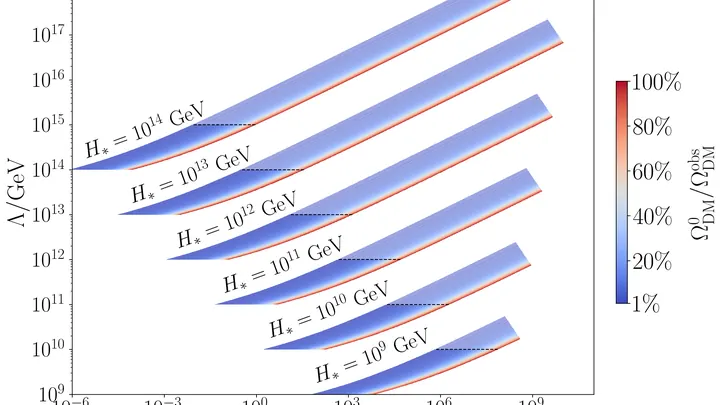
Back in the last century, Vera Rubin discovered that stars on the outskirts of galaxies rotate too fast, as if held by some invisible substance. Since then, dark matter has remained a puzzle. Usually, its origin is linked to new particles or forces. But a new study points to a simpler source — the geometry of space itself.