Why Cancer Comes Back Even After Aggressive Chemo express
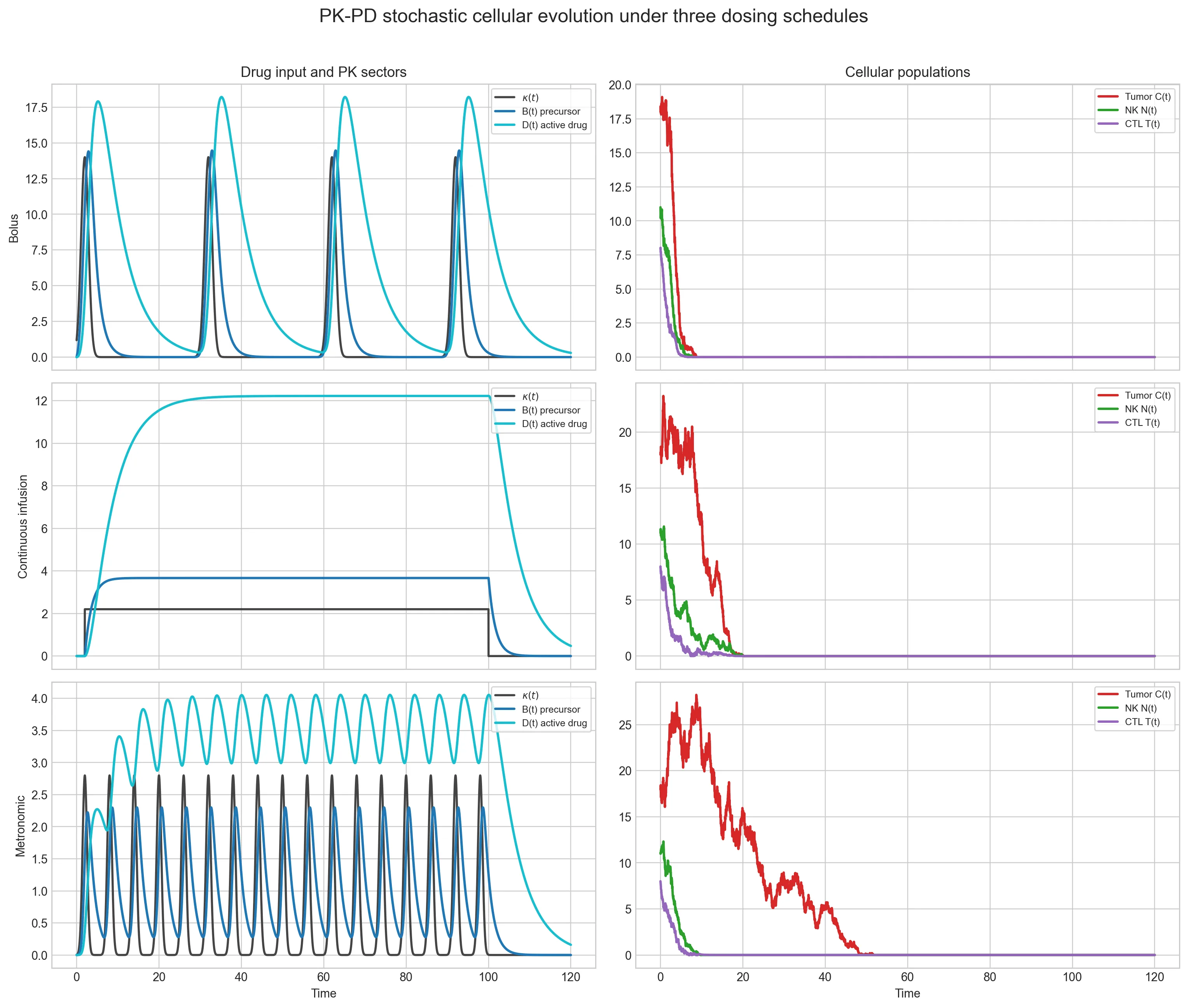
Chemotherapy hits cancer like a powerful spray on a dirty plate: the stream washes away almost everything, but crumbs remain in the cracks. Old models said that if you make the pressure strong enough, the plate becomes perfectly clean. New work shows this isn't so. Even the highest dose leaves a few cells, because in a small group there are always random fluctuations, like the last drops you just can't shake out of a bottle.
Scientists combined two things: how the drug spreads through the body and how tumor cells multiply and die. It turns out that standard treatment, a big dose at once, acts like a broom that sweeps away not only cancer but also the immune cells around it. In these "swept" areas, stochastic gene expression fluctuations in cancer cell numbers get free rein. Even if just a couple of cells remain, they can start growing again. This mechanism was dubbed "stochastic pharmacokinetic escape."
Validation on 1461 patient histories confirmed: in most patients, the tumor first shrinks to a minimum and then grows again. This is not the exception but the rule. The model accurately reproduced this pattern. It also turned out: the smaller the tumor, the stronger the noise, like in a small company where every voice sounds louder. So it's the tiny pockets that are the most dangerous.
The way out is not to hit harder but to hit smarter: give the drug in small, continuous doses and simultaneously support immunity. Then random cells have nowhere to hide, and the chance of recurrence drops.
In the smallest group of cells, noise is strongest: like in a room where three people argue louder than a hundred.