In 1914, Dutch physicist Adriaan Fokker studied Brownian motion, and three years later Max Planck derived a general equation named after them. It is a central tool in the theory of stochastic processes. If the Boltzmann equation is about billions of colliding particles, the Fokker–Planck equation is about one particle under a hail of impacts. It describes how the probability of finding a particle in a given region smoothes out and shifts—like an ink drop spreading in flowing water. The left side is the change in probability, the right side is the sum of drift (flow) and diffusion (spreading). In financial mathematics, it is called the Black–Scholes equation, and it helps price options. The drop turns into a blurry cloud—predictably and inevitably.
History
In 1914, Adriaan Fokker derived a special case for rotational Brownian motion. In 1917, Max Planck generalized the equation in the work 'On the Theory of Fluctuation Phenomena'. Later, Andrey Kolmogorov in 1931 provided a rigorous mathematical justification. The equation infiltrated economics, biology, and quantum optics, becoming a universal language of random processes.
How it works
The probabilitydensity p(x,t) is drifted by a deterministic force (coefficient μ) and blurred by random jolts (coefficient D). Applied to analysis of diffusion processes, in radiophysics (shot noise), biophysics (ion channels), economics (option pricing models). Limitations: valid for memoryless Markov processes; for strong non-Gaussian noises, generalizations are needed (Kolmogorov–Feller equation).
In practice
Used for modeling noise in electronic circuits, stock price dynamics, and motion of microparticles in traps.
Fun fact
Max Planck used this equation to study fluctuations in quantum systems, laying the foundations of quantum stochastic dynamics.
A vacuum cleaner sucks in dust even if there is more of it near the nozzle. The same happens in a tokamak: plasma particles are drawn toward the center, even though their density is higher at the edge. This phenomenon is called particle pinch, and it contradicts the usual rule that everything tends to move from dense regions to sparse ones.
Water confined between two cylinders flows in smooth layers when the inner one rotates. But once the speed crosses a certain threshold, the layers crumple into toroidal rolls, like a stack of bagels. Physicists call these Taylor vortices: the flow loses stability and a regular pattern emerges.
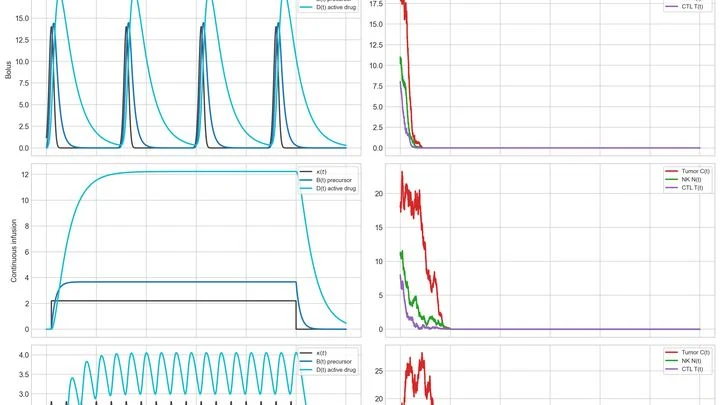
Chemotherapy hits cancer like a powerful spray on a dirty plate: the stream washes away almost everything, but crumbs remain in the cracks. Old models said that if you make the pressure strong enough, the plate becomes perfectly clean. New work shows this isn't so.
A protein chain folds into a working tool in a fraction of a second, and almost never makes a mistake. For a long time, it was thought that evolution specifically polishes amino acid sequences so that a protein not only works but also easily finds its unique shape. New work turns this idea on its head.
It is commonly believed that a black hole is a merciless cosmic vacuum cleaner, sucking in everything indiscriminately. But new research flips the picture: right at the horizon, curvature transforms from a trap into a trampoline.
The early universe expanded at an unimaginable rate — faster than light could cross it. In this boiling cauldron, any region of space resembled an open can of paint: its boundaries continuously captured new 'vapor' from outside, while some of its own contents irrevocably escaped.
Time in physics is like a conductor setting the tempo for the whole orchestra. But in the quantum world, there's no single baton: each particle can live by its own clock. Usually, we simplify the picture and assume time flows the same for everyone.
An ordinary magnet always carries two poles — north and south. Split it in half, and each piece immediately grows its own pair. But deep in particle theory lives a strange notion: the monopole — a particle carrying just one magnetic charge, a lone pole without a partner.
If you pour sand into a glass, it settles in a flat layer. But instead of sand, take the tiniest particles of gas: in a gravitational field they don't just fall: each particle races along its own trajectory, collides with neighbors, and all this commotion creates pressure.
Near black holes and neutron stars, plasma churns like water in a boiling kettle. But this 'kettle' has no walls — only magnetic fields that twist and tear. At the tears, thin sheets form where magnetic field lines reconnect, giving particles a kick like a surfer catching a wave.
Toss a handful of sand on the floor: there are few large grains, many medium ones, and even more tiny ones. This skew, where small events are common and large ones are rare, is described by a power law. It shows up in city sizes, earthquake magnitudes, and citation counts of scientific papers.
A neural network learning something new is like a traveler in mountainous terrain. Each piece of learned knowledge is a depression in the landscape into which the traveler rolls and gets stuck. To escape and reach a new basin, energy is needed. But as the traveler gains experience, the walls of their pit become steeper, and each subsequent climb requires more effort.
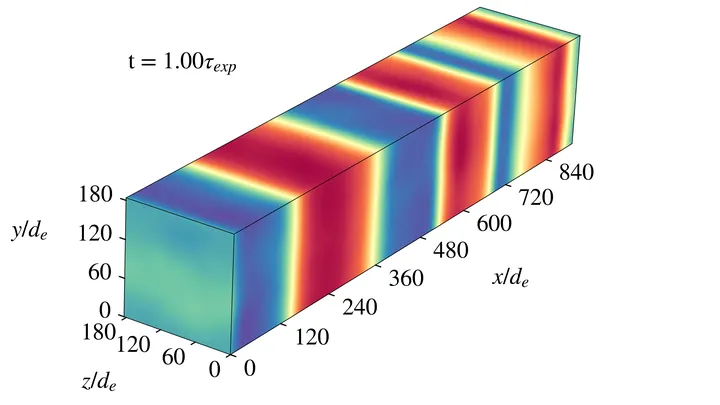
Plasma is a gas in which electrons are stripped from atoms, and it conducts electricity. In space, such gas is often so rarefied that particles rarely collide, and its behavior is described by the equations of motion for each particle. The computer method Particle-in-Cell (PIC) does exactly that: it tracks millions of particles and the electric fields they create.
The diffusion equation, a mathematical tool describing how particles spread out in space, has long painted a paradoxical picture: a disturbance, like ripples on Water, instantly engulfs the entire universe. This challenged the theory of relativity, which holds that nothing can move faster than light.
Bacteria in a drop of water jostle and swim: each on its own, but together they create patterns. With weak motion, the fluid churns like soup on a high flame: vortices collide, and the flow direction changes every second. This is called bacterial turbulence.
Drop honey onto a sponge. It lazily creeps, avoiding the voids. But if the honey becomes thinner under pressure, the flow gets trickier. Liquid with variable thickness in an uneven labyrinth of pores — a problem that had defied calculation. The authors of the new work averaged the chaos of microchannels into simple equations.
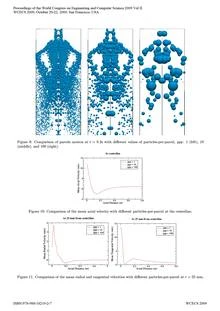
A vertical pipe with a sudden expansion is a classic testbed for turbulence. Air swirling like a tornado rushes into a wider chamber and spawns vortices, recirculation zones, and regions where glass particles 45 μm in diameter, about half the thickness of a human hair, dart along intricate paths.