A Cardiograph That Isn't Afraid of Noise express
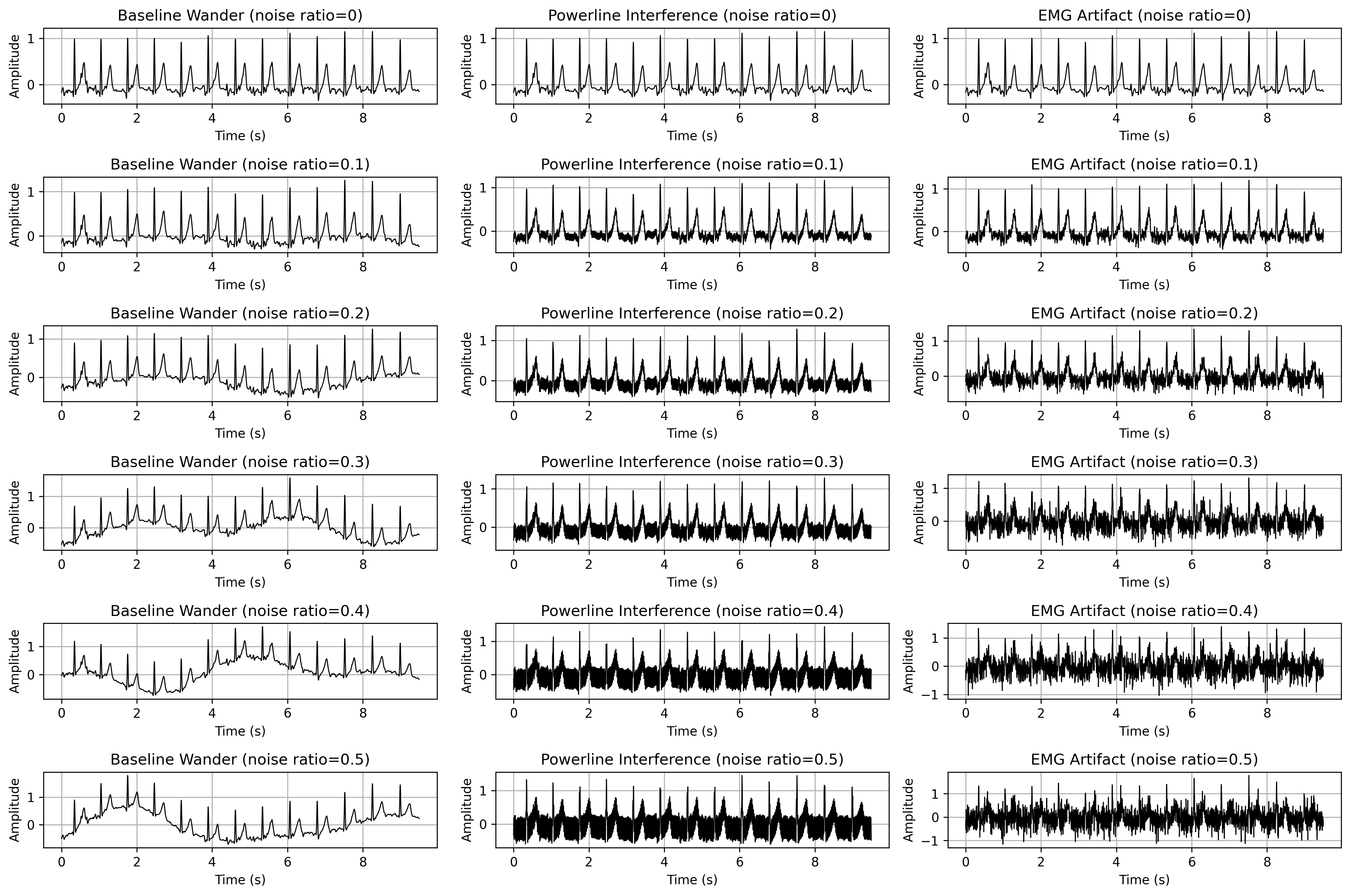
An electrocardiogram is like a recording of a conversation where the heart whispers and a construction site roars in the background. Atrial fibrillation, where the atria quiver instead of contracting, changes that whisper almost imperceptibly. An experienced doctor can hear the difference, but in a hospital there are many recordings and even more noise: the patient shifts, a device switches on nearby, a shiver runs through the skin. The program described by the authors learns to separate the heart's voice from any background rumble.
The trick is that the program looks at the ECG with two eyes at once. One eye captures the overall pattern — how the heart beats over many seconds. The other examines individual waves, like letters in a word. By comparing the big picture with the details, it learns what in the signal is from the heart and what is random interference. Then, when a new recording arrives from another hospital, taken on different equipment, the program doesn't get lost: it looks for a familiar handwriting, not an exact copy of old lines.
This robustness is like recognizing a friend in a crowd: by their gait and the turn of their head, even if they're wearing a different jacket and standing in the shade. For a doctor, this means the smart assistant won't demand a perfectly clean recording. It will be useful in the emergency room, in an ambulance, at home with a portable ECG monitor — anywhere the heart's signal doesn't look like a textbook picture.
Original abstract
as written by the authors arXiv:2608.18451v1
\textbf{Background and Objective}: Reliable atrial fibrillation (AF) detection from electrocardiogram (ECG) signals remains challenging in real-world clinical settings due to variable lead configurations, cross-dataset domain shifts, and pervasive physiological and technical artifacts. So we develop a robust and generalizable deep learning model for accurate AF detection.\\ \textbf{Methods}: We propose the Dual-Codebook Graph Collaborative Network (DCGCNet), a novel end-to-end vector-quantized variational autoencoder that jointly performs AF classification and ECG reconstruction. DCGCNet introduces two key components: (1) a Local-Global Contrastive Module for learning noise-invariant representations, and (2) an Adaptive Codebook Vector Quantizer that dynamically refines codebook prototypes to better align with input data distributions, thereby preventing codebook collapse and enhancing generalization.\\ \textbf{Results}: DCGCNet achieves state-of-the-art performance in standard intra-dataset 12-lead evaluation and demonstrates exceptional cross-dataset generalization across seven diverse settings, consistently attaining AUC > 0.98 in all cases. Furthermore, it maintains high diagnostic accuracy under realistic noisy conditions, including baseline wander, powerline interference, and EMG artifacts.\\ \textbf{Conclusions}: DCGCNet establishes a new benchmark for robust, generalizable, and noise-resilient AF detection, showing strong potential for deployment in real-world clinical environments.
Atrial fibrillation is the most common heart rhythm disorder in the world. In many people, it goes unnoticed, and they only find out about it after a stroke, which the arrhythmia can trigger.
In the series 'Westworld,' machines read human biometrics to predict behavior. Here, the principle is similar, the program learns to see a hidden signal in noise, but it serves not control, but early assistance.