Quantum Communication on 16 Parallel Channels express
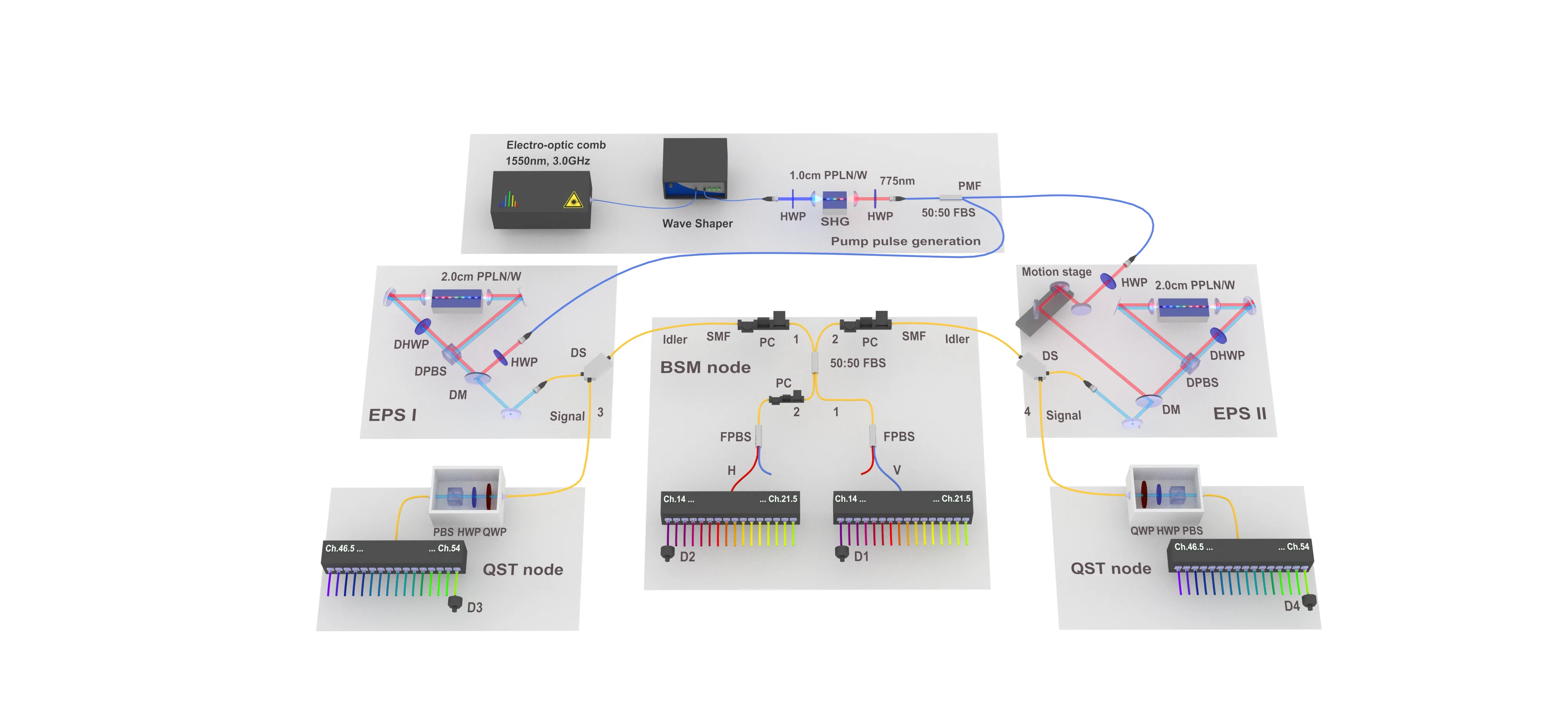
Quantum communication is like sending a secret letter that tears apart at any attempt to peek. So far, such a letter can only be sent along one road, and that's slow. Scientists have figured out how to send 16 couriers along 16 parallel roads, different frequencies of light, and verified that the letters arrive intact.
In the experiment, pairs of quantum particles (entangled photons) were created in 16 different color channels, like 16 streams in one flow. Each stream was narrow so that particles wouldn't mix. Then particles from different streams were brought together: this is called "entanglement swapping": as if two couriers, without seeing the letters, exchange envelopes so that the letters remain linked at a distance.
This trick allows faster transmission of quantum states and brings us closer to creating quantum repeaters — devices that amplify the signal without reading it. Then quantum communication could cover long distances, like the regular internet.
Original abstract
as written by the authors arXiv:2608.18666v1
Boosting the communication rate of quantum networks is a central challenge in quantum information science. Recently, an efficient entanglement distribution scheme employing quasi-deterministic Bell-pair sources based on time-frequency multiplexing, referred to as zero-added-loss multiplexing~(ZALM), has been proposed. Its implementation, however, requires high-fidelity entanglement swapping across densely multiplexed time-frequency modes, which has remained an experimental challenge. Here we demonstrate entanglement swapping across 16 parallel frequency modes with a high average fidelity of 93.9$$\pm$$\SI{1.4}{\%}. Notably, polarization-entangled photon pairs in each frequency mode are spectrally single-mode using only off-the-shelf 50-GHz dense wavelength-division multiplexing~(DWDM) filters, eliminating the need for additional narrowband filtering. Furthermore, in order to fully exploit the temporal degree of freedom, the pump pulse is operated with a repetition frequency of \SI{3.0}{GHz}. By combining the frequency and time multiplexing, the total swapping rate reaches 5.38$$\pm$$0.17\,\si{pairs\,s^{-1}}, which corresponds to the ZALM Bell-pair rate of \SI{8.2e2}{pairs\,s^{-1}}. Our results establish the key experimental capabilities required for ZALM and demonstrate a scalable route toward practical high-rate quantum repeaters and long-haul quantum networks.
Entangled photons behave like two socks from the same pair: if one turns out to be left, the other instantly becomes right, even if they are separated by kilometers.
In the series "Dark," quantum entanglement connects characters across time, but in reality it helps transmit information without interception.