A photon pair consists of two photons that are generated together in a single quantum event, such as spontaneous parametric down-conversion or atomic cascade emission. These pairs often exhibit quantum entanglement, meaning their properties (like polarization or momentum) are correlated in a way that cannot be described independently. This makes them a key resource for quantum technologies.
History
The theoretical foundations were laid in the 1930s, but the first experimental generation of correlated photon pairs via down-conversion was demonstrated in the 1970s. The use of such pairs for entanglement experiments became prominent in the 1980s and 1990s.
How it works
In spontaneous parametric down-conversion, a high-energy photon passes through a nonlinear crystal and occasionally splits into two lower-energy photons, traditionally called 'signal' and 'idler.' Energy and momentum are conserved in the process, so the two photons are born with correlated properties. If the crystal is engineered appropriately, the photons can also be entangled in polarization, meaning measuring one instantly determines the state of the other, regardless of distance.
In practice
Photon pairs are used in quantum key distribution for secure communication, in quantum teleportation experiments, and as a source of single photons for quantum computing and metrology.
Fun fact
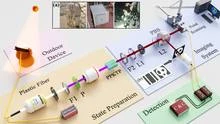
Photon pairs can be generated from sunlight, not just lasers, as demonstrated in a recent experiment that used solar radiation to create entangled photon pairs.
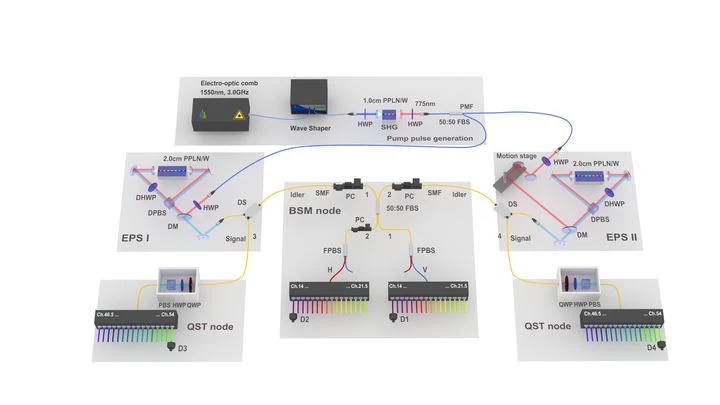
Quantum communication is like sending a secret letter that tears apart at any attempt to peek. So far, such a letter can only be sent along one road, and that's slow. Scientists have figured out how to send 16 couriers along 16 parallel roads, different frequencies of light, and verified that the letters arrive intact.
An ordinary random network is like a road map: to connect four cities with a complex interchange, you need to lay down many highways. In the quantum world, things are different.
To probe deeper into the workings of the universe, physicists accelerate electrons and smash them together. An ordinary electron is like a spinning top that wobbles randomly. For delicate experiments, you need particles whose spins all point in the same direction: this is called polarization.
An empty resonator isn't truly empty. Even in an absolute vacuum, where not a single photon exists, quantum fluctuations persist. They resemble ripples on water in a dead calm: the surface appears smooth, but molecules keep jittering. Physicists have learned to turn this jitter into real waves.
A thrown stone sends ripples across water. A gravitational wave is the same kind of ripple, but in spacetime. It is produced, for example, by the merger of two black holes. In classical physics, this ripple is eternal: once created, it travels through the Universe without fading.
An electron and its antiparticle — the positron, predicted by Дираком, — upon meeting, momentarily form позитроний: a tiny pair circling each other, like in an atom but without a nucleus. Almost instantly it decays, emitting two photons that turn out to be mysteriously linked.
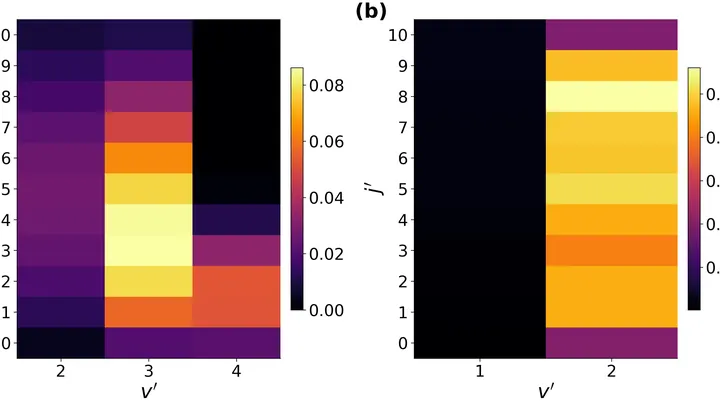
Quantum computers of the future will likely communicate via light. An atom stores information, and a photon carries it across the network. But an atom doesn't hang still: it jitters and oscillates, and this motion can corrupt the signal.
Previously, engineers could only calculate for a stationary atom.
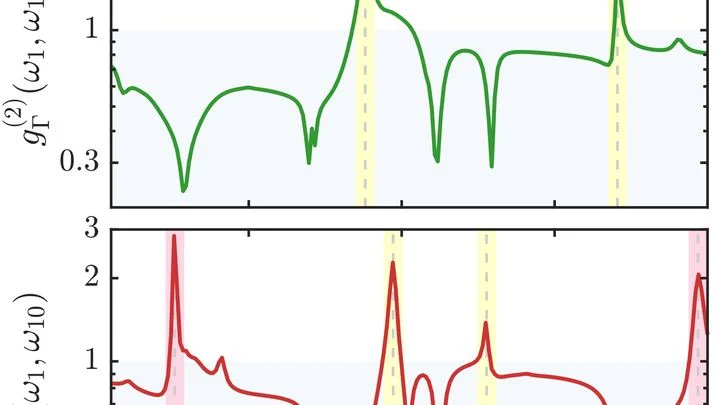
The quantum world is full of surprises. In a Kerr parametric oscillator, a device where light is trapped in a ring and driven by an external field, researchers recently noticed something strange: pairs of energy levels merge in an embrace. Physicists have dubbed this a "spectral kiss" spectroscopy.
In a boron nitride crystal, the perfect atomic lattice is sometimes disrupted: an atom is missing here, or replaced by a foreign one there. Under a powerful microscope, these tiny imperfections appear as traps for electrons: they capture particles and start to emit light, and they also respond to magnetic fields.
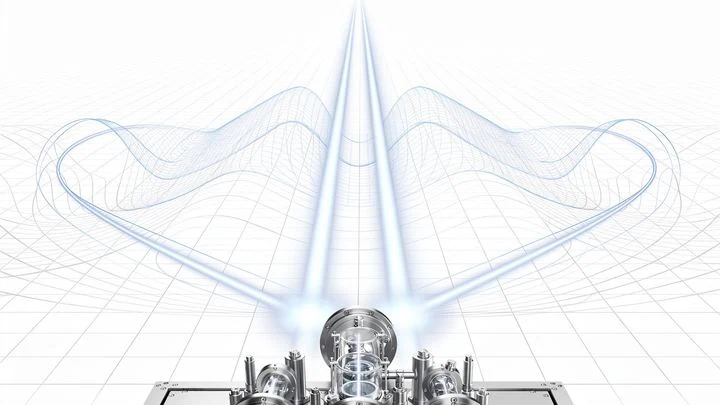
Two parallel streams of atoms, released from Bose condensates, begin their journey in free fall. In the classical picture, their separation remains unchanged — like two skiers gliding down a perfectly smooth slope. But if spacetime is not frozen snow, but a living, rippling membrane, then every tremble of it is transmitted to matter.
Two mailboxes at opposite ends of a city. Drop a letter in one, and an identical one instantly appears in the other. That's roughly how quantum entanglement works: two particles behave as a single unit, even when separated by a great distance. But until recently, this connection could only be maintained within a single room or across a lab bench.
A lantern shines through thick fog. Light scatters off water droplets, and the lantern appears blurred. Something similar happens around a black hole: hot gas, like fog, envelops it, while X-rays from the inner parts of the disk struggle through this cloud. Only here, the "droplets" are electrons, and the "fog" itself is called the corona.
In a giant particle accelerator, particles smash into each other, and sometimes after the collision only two photons, particles of light, remain. Physicists can predict how often this happens, but their calculations have long disagreed with what detectors see. Each refinement of the theory changed the answer, and there was no consensus.
In a dark room, an infrared laser flashes, and a speck of black K3C60 powder conducts electricity without resistance for a split second. The light strikes at 10 terahertz — a thousand times faster than a microwave oven. The effect is a hundred times stronger than at other frequencies. Why this particular frequency?
Two particles flying apart in opposite directions behave as a single whole: measuring one instantly determines the state of the other. Such quantum entanglement has long been known for light particles, but now it has been observed for the first time in heavy Z bosons — the carriers of the weak force.
A quantum dot the size of a virus, squeezed between mirrors, gives birth to two photons in a short flash of light. These photons fly out as a pair, and their polarizations, the directions of wave oscillation, are linked such that knowing one instantly tells you the other.
In a dark room, an atom and light are locked together in a mirrored box. The box is so small that the atom cannot simply release light: they constantly exchange energy, like two dancers who never let go of each other's hands.
A semiconductor diode normally conducts current in only one direction, like a spring-loaded door: it opens easily one way but pushes back the other. But if you dope the crystal heavily, the door starts behaving strangely: under reverse bias, the current doesn't just flow: it shoots up.
A regular laser is like a choir where everyone sings their own part — the sound is loud, but with inevitable roughness. In the new quantum laser, the singers hear each other and harmonize their voices.
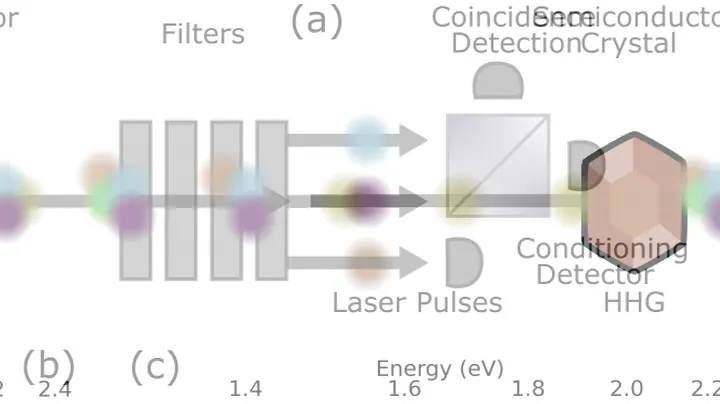
A powerful laser strikes a semiconductor, and it responds with light at many frequencies, like a string sounding a chorus of overtones. Previously, this was used in spectroscopy to observe ultrafast processes. But now physicists have noticed: the overtones are not independent; they behave as if connected by invisible threads.
Light from tiny perovskite crystals is like a choir performance, where voices sound sometimes solo, sometimes in a tight duet. Previously, such a duet could only be heard under extreme cooling, nearly to the chill of outer space. Now the choir sings at room temperature.
A flashlight in thick fog is useless: the beam scatters, and the reflected light drowns in noise. But if you tie two photons with an invisible thread, one can pass through the fog and come back, while the other stays safe. This connection is called quantum entanglement — when two particles behave as a single whole, even when far apart.
A single light source in a thin layer of boron nitride flashes on and off in a couple of nanoseconds. You can create many such sources in the material, but each one used to work on its own. In the new work, they were made to glow together, like musicians playing in unison.
At the Large Hadron Collider, physicists accelerate protons to nearly the speed of light and smash them together. Usually, the protons themselves take part in such collisions, but sometimes they pass close by without touching, and it is their electric fields that interact.
In the quantum world, a collision between particles doesn't destroy their individuality but ties them into an inseparable knot: internal states and motions become intertwined like threads in an intricate tapestry.
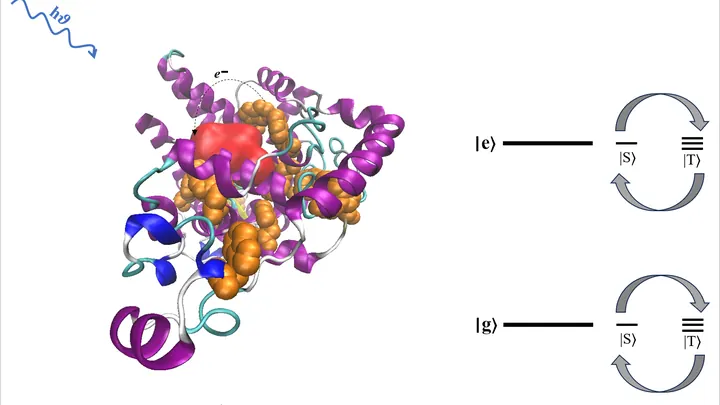
Birds migrate using the magnetic field. In their eyes, there's a protein called cryptochrome. It captures sunlight, especially blue light, and triggers a reaction. Absorption of light leads to the formation of a particle pair that is acutely sensitive to magnetic fields.
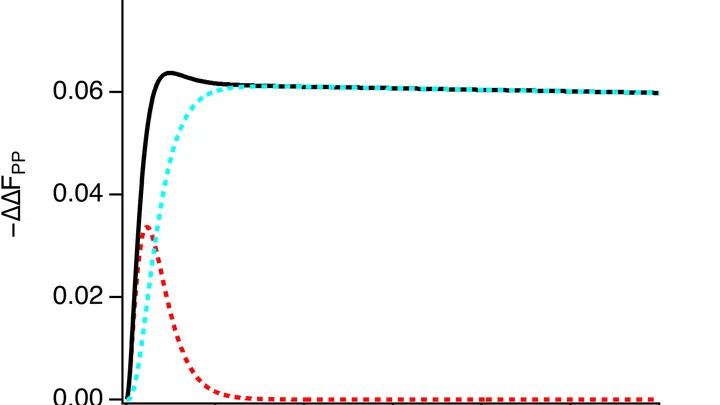
Inside every living cell, chemical transformations are constantly taking place. Some of them create unstable particles whose electrons behave like paired magnets. Their interaction resembles a dance: each movement of the pair responds to external magnetic fields, as if to a changing rhythm.
In September 2024, the concert hall in Linz had more than just an orchestra on stage. Next to the musicians, a setup was generating pairs of entangled photons: a laser with a wavelength of 405 nm passed through a nonlinear crystal and split into two photons at 810 nm, which flew off to two measurement stations, Alice and Bob.
A laser on a lithium niobate crystal comes to life with a current of 40 milliamps. Its light splits into two streams, each passing through a six-millimeter waveguide, where twin photon pairs are born. One stream rotates the polarization of its twins, after which both flows merge into a common channel.
Sunlight collected by a Fresnel lens and passed through 20 meters of plastic fiber had a power of just 3 microwatts, a million times less than a typical laser pointer. That was enough to generate photon pairs correlated in position inside a nonlinear crystal. One photon from each pair passed through the object, the second was scanned by a detector, and coincidences built up the image.
Spontaneous emission, the very process that lights up lamps and stars, has long been considered a pesky noise in quantum physics. This cacophony of random photons ruthlessly destroys fragile quantum entanglement, like radio static drowning out a distant melody.