Quantum Communication on 16 Parallel Channels express
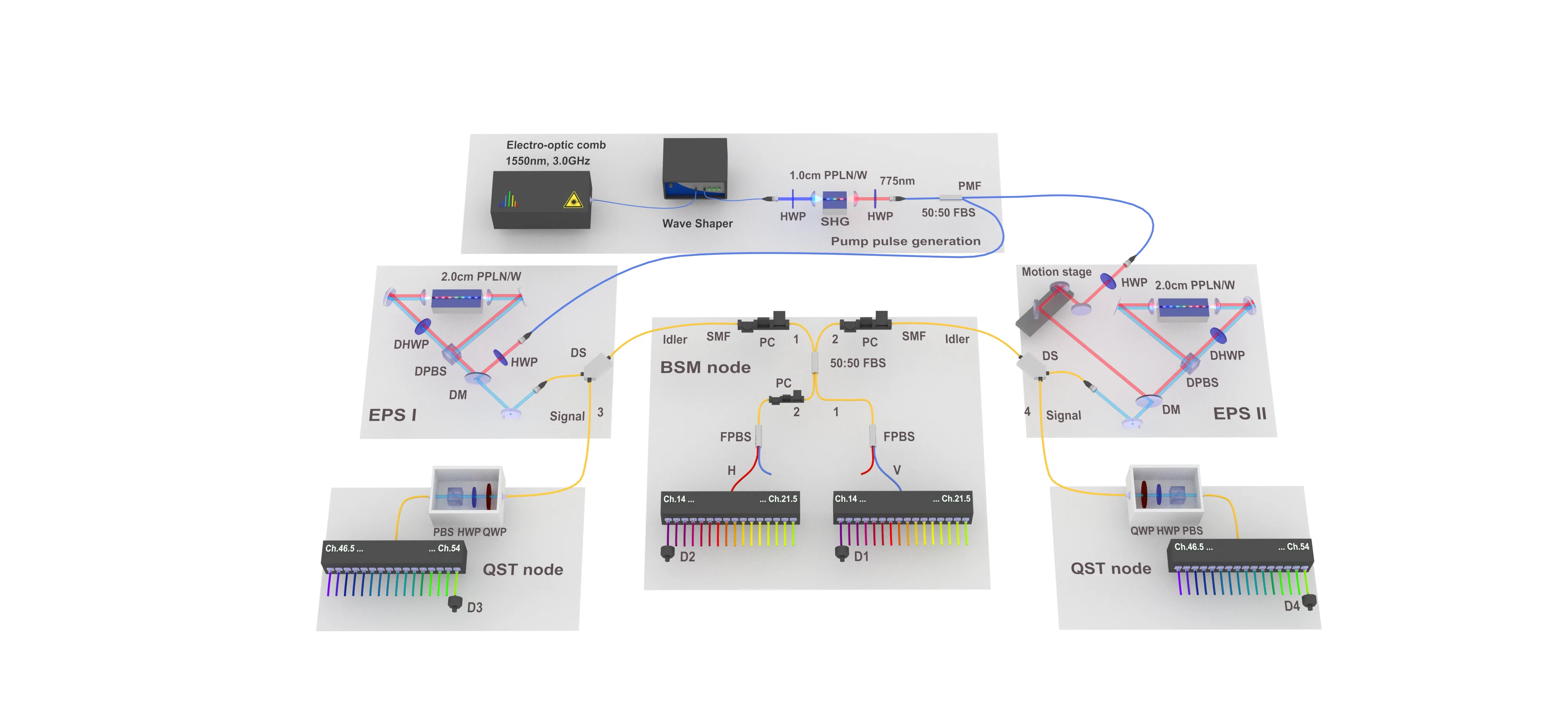
Quantum communication is like sending a secret letter that tears apart at any attempt to peek. So far, such a letter can only be sent along one road, and that's slow. Scientists have figured out how to send 16 couriers along 16 parallel roads, different frequencies of light, and verified that the letters arrive intact.
In the experiment, pairs of quantum particles (entangled photons) were created in 16 different color channels, like 16 streams in one flow. Each stream was narrow so that particles wouldn't mix. Then particles from different streams were brought together: this is called "entanglement swapping": as if two couriers, without seeing the letters, exchange envelopes so that the letters remain linked at a distance.
This trick allows faster transmission of quantum states and brings us closer to creating quantum repeaters — devices that amplify the signal without reading it. Then quantum communication could cover long distances, like the regular internet.
Entangled photons behave like two socks from the same pair: if one turns out to be left, the other instantly becomes right, even if they are separated by kilometers.
In the series "Dark," quantum entanglement connects characters across time, but in reality it helps transmit information without interception.