A quantum entanglement network is a system where multiple quantum bits (qubits) are linked through entanglement, a phenomenon where the quantum states of particles become interdependent regardless of distance. In such a network, the qubits are the nodes, and the entanglement between them forms the connections, enabling tasks that are impossible in classical systems. This architecture is foundational for quantum communication, distributed quantum computing, and quantum cryptography, as it allows for the transfer of quantum information without physically moving the particles.
History
The concept of entanglement was introduced by Erwin Schrödinger in 1935, following the famous Einstein-Podolsky-Rosen paper. The idea of using entanglement as a network resource for communication was developed in the 1990s, with key proposals by Artur Ekert for quantum cryptography and Charles Bennett et al. for quantum teleportation.
How it works
The network operates by first creating entangled pairs of qubits, often through processes like spontaneous parametric down-conversion for photons or controlled interactions for trapped ions. These entangled pairs are then distributed to different nodes, and by performing joint measurements on certain qubits, the entanglement can be 'swapped' or extended to connect distant nodes. This creates a web of entanglement that can be used for quantum teleportation, where the state of a qubit is transferred from one node to another by sending classical information and using the shared entanglement as a resource.
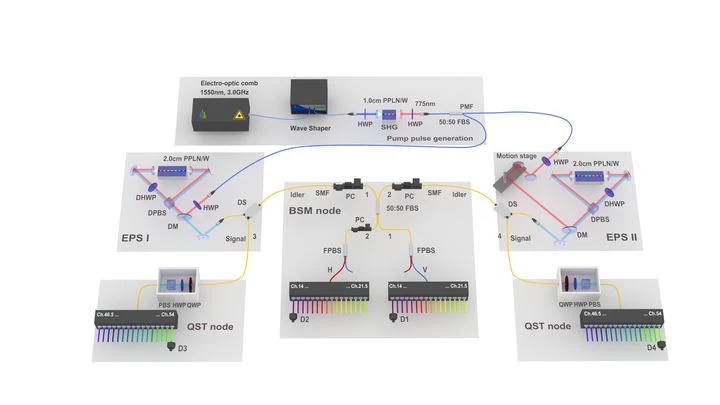
Quantum communication is like sending a secret letter that tears apart at any attempt to peek. So far, such a letter can only be sent along one road, and that's slow. Scientists have figured out how to send 16 couriers along 16 parallel roads, different frequencies of light, and verified that the letters arrive intact.
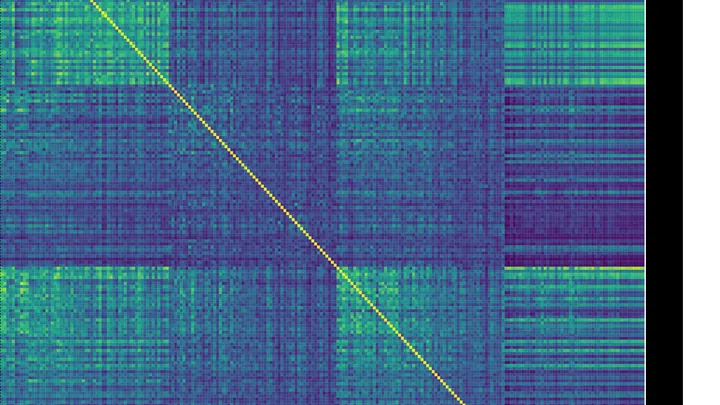
A quantum computer isn't just a bunch of qubits: it's a whole city, where each resident is one of the machine's possible states. Residents get to know each other through weak interactions between qubits: if one state can transition to another, a thread of acquaintance is drawn between them.
An ordinary random network is like a road map: to connect four cities with a complex interchange, you need to lay down many highways. In the quantum world, things are different.
A black hole resembles a safe that slowly gives up its contents, energy and information, through a faint glow known as Hawking radiation. But if the safe opens too quickly, a 'firewall' may flare up at its boundary — a region where the familiar laws of physics break down.
In the new work, physicists complicated the model of this safe.
Two simultaneous interpreters sit in the same booth. The first translates from English into Russian but swallows half the words. The second goes from Russian into French, and also loses half. If you put them together, you'd expect a mess: the losses would add up, and only a quarter of the meaning would reach the listener. But what if they start correcting each other?
Two mailboxes at opposite ends of a city. Drop a letter in one, and an identical one instantly appears in the other. That's roughly how quantum entanglement works: two particles behave as a single unit, even when separated by a great distance. But until recently, this connection could only be maintained within a single room or across a lab bench.
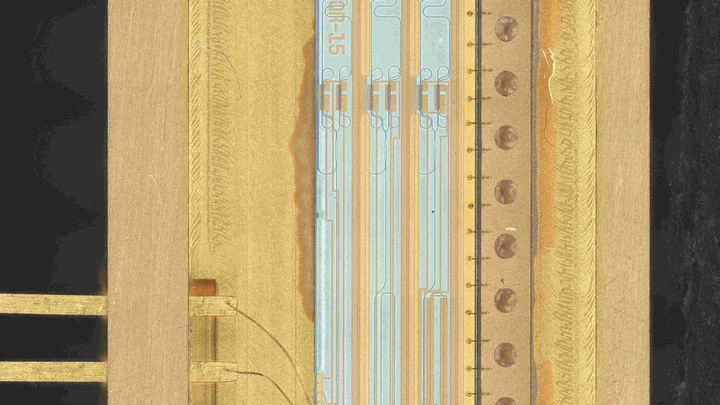
Light can act as a courier carrying secret messages. But to ensure the courier doesn't lose a single letter, you need to meet and check it very quickly. The new chip made from a thin film of lithium niobate is like a turnstile that opens and closes in billionths of a second, letting light pulses through at just the right moment.
In ping-pong, two paddles connected by an invisible thread feel each other's movements, guessing the ball's trajectory. Researchers gave a computer a similar thread — quantum entanglement. Into an ordinary trial-and-error learning program, they embedded a quantum circuit of eight qubits — particles that can spin like a coin on its edge.
An ion quantum computer is like a chandelier with a dozen pendants: pull one, and they all start swinging. Each ion is a qubit, but when there are many, their collective vibrations crowd the stage. Any operation on one pair disturbs the neighbors, and the computation goes awry.
For a long time, physicists were certain: quantum entanglement requires direct quantum contact. A new study refutes this. Two microscopic magnetic particles, connected only by a classical spring, successfully become entangled.
Two water droplets tremble in sync — because they're connected by a straw. So it is with entangled particles: their unity may be held together by a microscopic wormhole.
Hundreds of cooks in a kitchen — total chaos. Usually disorder grows. In quantum physics, the measure of such disorder is called entropy John von Neumann. For a many-particle system, entropy typically increases with their number. But scientists have found an exception.
The secret lies in a strict rule: two cooks cannot enter the same aisle at the same time.
Regular quantum communication is like a postal service that sends letters strictly one at a time. If the route is long, you have to wait an indecently long time for a reply. Physicists sped up the process by dispatching ten 'postal trucks' — light pulses — into a single optical fiber, but in different time windows.
In 1935, Erwin Schrödinger, peering into the equations of quantum mechanics, saw something strange: two particles could be linked so tightly that the state of one instantly determines the state of the other, even if they are separated by kilometers.
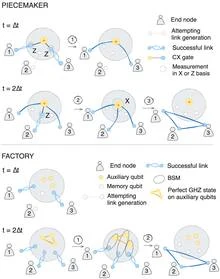
Assembling a puzzle as pieces arrive, rather than waiting for the complete set, is the philosophy behind a new protocol for distributing quantum entanglement. In quantum networks, where nodes exchange Bell pairs, the traditional approach resembles a patient assembler who waits until all pieces are on the table before starting.
In an accelerator, two Higgs particles collide. For a fleeting moment, their fates intertwine, then separate, carrying away information about the encounter.