Three-photon entanglement is a quantum state in which three photons are linked in such a way that the properties of each photon cannot be described independently of the others, even when they are separated by large distances. This is a stronger and more complex form of entanglement than the more familiar two-photon (bipartite) case, and it is a key resource for collective quantum communication protocols. In such protocols, information is encoded in the correlations shared among all three photons, allowing for tasks like secret sharing, where a message can only be reconstructed if all three parties cooperate.
History
The theoretical concept of multi-particle entanglement was introduced by Daniel Greenberger, Michael Horne, and Anton Zeilinger in 1989, and the first experimental demonstration of three-photon entanglement was achieved by Zeilinger's group in 1999.
How it works
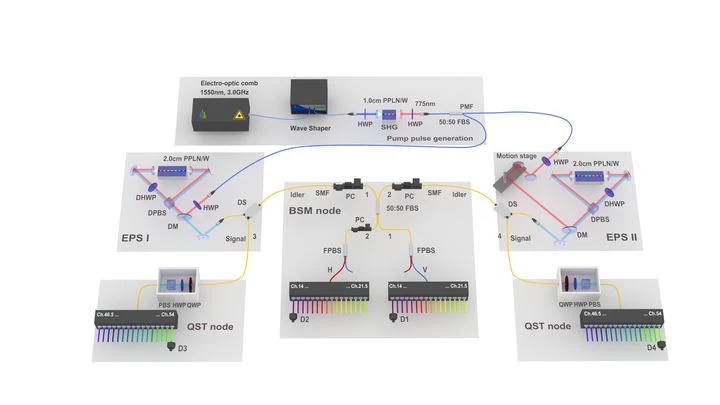
The entanglement is typically generated through a process called spontaneous parametric down-conversion, where a single high-energy photon is converted into two lower-energy photons inside a nonlinear crystal. To create three-photon entanglement, one of these photons is then used to generate another pair, and the resulting photons are manipulated with beam splitters and polarizers to create a state where the polarization of each photon is correlated with the others in a non-classical way. The specific state often used is the Greenberger-Horne-Zeilinger (GHZ) state, where the three photons are in a superposition of all being horizontally polarized and all being vertically polarized.
In practice
Three-photon entanglement is used in quantum secret sharing, where a cryptographic key is split among three parties, and in tests of quantum nonlocality, which probe the foundations of quantum mechanics.
Fun fact
In a GHZ state, the three photons can be used to demonstrate a contradiction between quantum mechanics and local realism in a single measurement, unlike the statistical arguments needed for two-photon entanglement.
A layered cake of molybdenum disulfide MoS2 sits on the lab bench. It is prepared in the usual way: adhesive tape peels off the top layers to obtain a thin sample. But beneath the tape remains an invisible cavity where the atomic floors are no longer pressed together. It is there that electrons begin to behave differently than in the crystal bulk.
Three voices merging into a single chord. In the physics of quantum materials, this image takes on a literal meaning: three layers of graphene, separated by thin spacers, force electrons and holes from different layers to move as a single fluid.
Quantum communication is like sending a secret letter that tears apart at any attempt to peek. So far, such a letter can only be sent along one road, and that's slow. Scientists have figured out how to send 16 couriers along 16 parallel roads, different frequencies of light, and verified that the letters arrive intact.
Quantum systems made of many particles are the basis of future computers and secure networks. But the more particles there are, the harder it is to understand how they are arranged: the number of possible states grows like an avalanche. The usual approach, measuring everything, takes an incredibly long time.
In a thin perovskite film, a material for cheap solar cells, light creates pairs of charges: an electron and a "hole." They need to reach the electrodes and produce current, but many vanish along the way. Where exactly they go is the question that determines how efficient the cell will be.
The lifetime of the entangled triplet pair in the protein is about 60 picoseconds, which is eight times longer than in solution.
Sunlight is like a continuous stream of balls flying at a wall.
Three billiard balls scatter across the table after a strike: their trajectories depend only on the initial push. But in the world of atomic nuclei, things are more complex: particles sense each other on the fly, even if they are not bound together. For a long time, physicists could only measure pairwise interactions, while what happens when three meet remained behind the scenes.
Light from the hottest stage of the universe has been traveling toward us for nearly 14 billion years. This is the cosmic microwave background — a faint glow filling the entire sky.
In a tight row of atoms, spaced closer than the wavelength of light, a remarkable state hides. The excitation is distributed among all particles so that their radiation cancels itself out. This quantum 'silence' is an ideal vault for a photon: it can be stored there hundreds of times longer than usual.
The quantum networks of the future resemble the Tower of Babel: each node speaks its own dialect. Some store information in the polarization of a photon — the direction of oscillation of the light wave. Others use time bins: that is, when exactly the pulse arrives.
Three laser beams intertwine into a triangle. Each is linked to the other two: this is the structure of the new scheme that physicists call "fully connected three-mode squeezed vacuum." This is not just three independent light sources: inside a special crystal, triples of entangled photons are born, and the connection between them resembles a complete graph of…
Each positron annihilation is like the birth of a pair of dancers, connected by an invisible thread of polarization. Two gamma quanta fly apart, but their states remain entangled: measuring one instantly determines the other — as if one partner senses every movement of the other, no matter the distance.
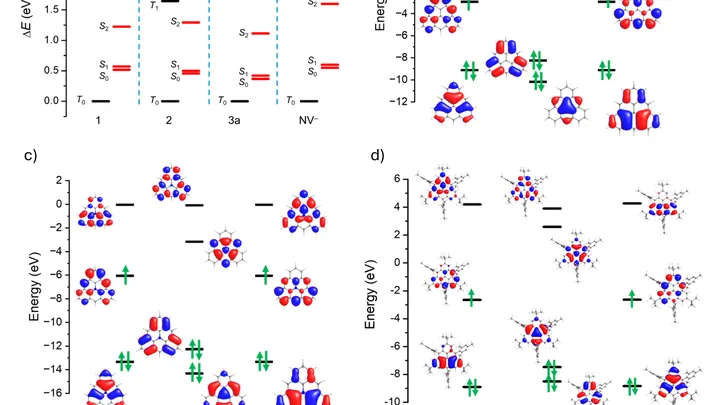
At the heart of a future quantum computer might lie a tiny organic molecule shaped like a triangle. It has two 'extra' electrons that don't pair up. Such molecules are called diradicals, and their electrons can store information in a special, quantum way.
Quantum entanglement — a phenomenon where the states of two or more particles become interconnected regardless of the distance between them — usually links intrinsic properties such as spin or polarization. However, a new experiment has for the first time realized entanglement of the positions of two atoms in space.
Light hits an organic molecule, and inside, a pair of twin excitations is born. They're called triplet pairs. In single pentacene molecules, such pairs have long been known to share their energy with neighbors: this is the basis of singlet fission, which boosts the efficiency of solar cells.
The carbon nucleus was long imagined as a uniform ball of protons and neutrons, evenly mixed like dough. But physicist George Gamow suspected otherwise: particles inside might group into tiny, sturdy blocks — helium nuclei, or alpha particles.
Neutrinos are the true ghosts of the microcosm. Nearly massless and chargeless, they pass through planets as if through empty space. But inside each neutrino hides not one particle but three — three 'flavors' (electron, muon, and tau) that constantly morph into one another. This dance is called oscillation.
Three dancers move as one: each feels all the others, and the overall harmony cannot be reduced to individual interactions. This is roughly how three particles behave, born from an electron and positron collision at the speed of light. They are a top quark, its antiparticle, and a Z boson.
A kitchen sponge soaked in syrup: in some spots there's more syrup, and your finger sticks right away; in others, it barely touches. That's roughly how a catalyst surface works. Molecules don't react everywhere but at especially sticky points — active sites.
A single camera shot stores both a normal picture and a hidden map of how light rippled through the scene. Quantum entanglement makes this possible. Pairs of linked photons are generated: one visits the object, its twin takes a detour. Later, measuring the twin one way pulls out the brightness information.
Atomic nuclei are not always like billiard balls. Some are elongated, like cigars, others are flattened. But xenon-129 resembles a potato — a bumpy triaxial ellipsoid.
A typical photon source can be likened to a club entrance with a single bouncer. He tries to let people in one at a time, but occasionally couples sneak past. Physicists call this the purity problem: photons must arrive strictly solo, otherwise quantum computing breaks down.
Two black holes smash head-on at full speed — while a third one circles nearby. In ordinary life, such a crash would produce a burst of gravitational waves (ripples in space, like the ripples from a stone thrown into a pond). But here, part of the ripple passes by the massive neighbor, and changes, like light in a funhouse mirror.
Light is a stream of photons. In a special waveguide, resembling a narrow corridor, a 'gatekeeper' atom usually lets them through one at a time. This phenomenon is the domain of single-particle spectroscopy.
A flashlight beam aimed through frosted glass turns into a blurry spot with every extra millimeter of thickness. Scintillators, materials that convert X-rays into visible light, behave much the same way. They underpin medical imaging, baggage screening, and detectors at particle accelerators.
An orchestra where every musician plays their own part, yet together they weave a complex melody: that's what a cloud of atoms looks like when their spins (intrinsic rotations, like tiny tops) oscillate in sync. Usually, these tops behave independently.
Quantum networks need a mediator between storage — spin — and carrier — light. No single molecule had ever pulled off such a feat. But now physicists have found a solution. They placed a carbene molecule into a crystal and cooled it to -269°C.
Tiny semiconductor islands grown right on silicon fire off single photons, like a machine gun that shoots exactly one bullet at a time. These islands are called quantum dots. They can emit light in discrete packets, which is needed for secure information in quantum networks.
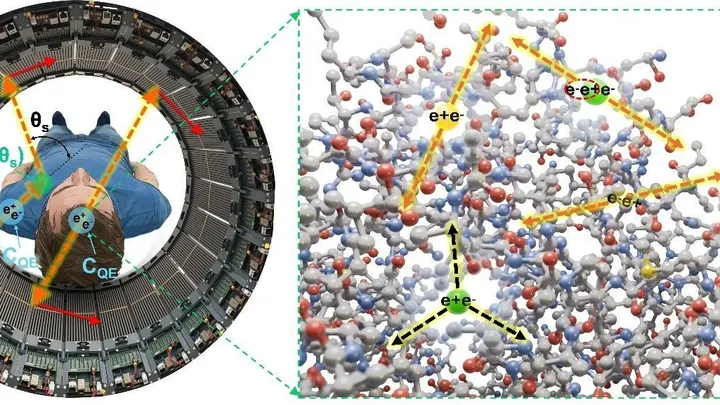
Two photons fly out from a single point in a patient's chest. They are twins: alter one, and you instantly know about the other. This connection is called quantum entanglement. In a PET scan, these pairs are born inside the body when an injected radioactive substance meets electrons in the tissues.
The degree of entanglement is not constant.
A deuterium molecule, two atoms of heavy hydrogen, falls apart under a laser pulse. One electron is ripped away, leaving an ion behind. At that moment, they are still linked: the direction of one immediately tells you which way the other went. This link is called quantum entanglement.
Two pendulums on a stable table swing independently. If you place them on a shaky surface, vibrations synchronize their motion. The same principle worked on a silicon chip with photons.
Scientists created two sources of light that emit pairs of particles.
Imagine a tap that doesn't pour a stream but releases water strictly one drop at a time: that's the single-photon source the authors describe. In ordinary light, photons travel in a crowd, like water from an open tap.
Light and atoms, like dancers, can move in sync or out of step. When their interaction is anisotropic (that is, direction-dependent) the dance gets trickier. In a new study, physicists considered a model where many atoms (qubits) collectively interact with an anisotropic light field, and each component is connected to a thermal reservoir.
Ordinary light is like a crowd in a square: each photon moves on its own, bumping into others and scattering. But in some media, photons start running together like a pack of dogs: they bunch up. Scientists have built a random fiber laser where light particles gather into especially dense clusters.
In a dark room, an atom and light are locked together in a mirrored box. The box is so small that the atom cannot simply release light: they constantly exchange energy, like two dancers who never let go of each other's hands.
A laser strikes a strontium atom, and two electrons fly out at once. Previously, it was thought that in such double ionization each electron acts on its own: one is knocked out first, the second later, randomly.
In two mirrored rooms, set at right angles, lives a cloud of atoms. Each atom is like a singer in a choir: on its own, it may stay silent, but when neighbors start to sing, it joins in. Here, the conductor's role is played by geometry itself: one room helps the atoms emit light together, while the other gently nudges them toward that — not directly, but through a clever detour.
Light from tiny perovskite crystals is like a choir performance, where voices sound sometimes solo, sometimes in a tight duet. Previously, such a duet could only be heard under extreme cooling, nearly to the chill of outer space. Now the choir sings at room temperature.
Quantum light is not just a stream of particles but an intricate pattern woven from space and time. A single photon can be stretched, squeezed, smeared across different directions.
Ordinary light is a stream of independent particles: photons fly through each other without noticing their neighbors. But in superconducting circuits cooled to near absolute zero, the situation changes. There, photons travel along narrow metal tracks, and if tiny elements called Josephson junctions are embedded in these tracks, light begins to 'feel' itself.