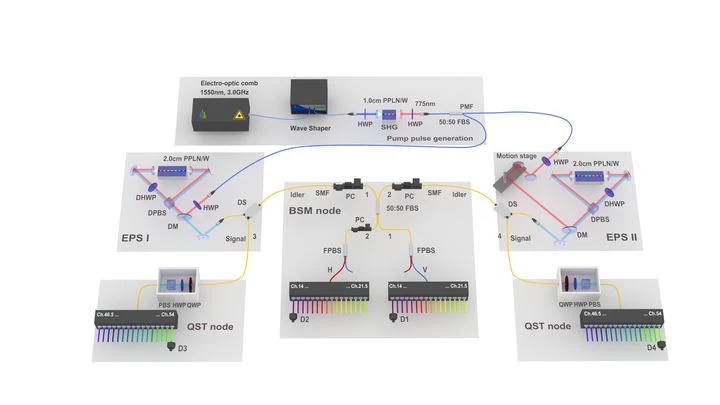
Entangled photon pairs are two photons whose quantum states are linked in such a way that measuring one instantly determines the state of the other, regardless of the distance separating them. This phenomenon, which Einstein famously called 'spooky action at a distance,' is a cornerstone of quantum mechanics and has no classical analog. Entangled photons are generated when a single high-energy photon splits into two lower-energy photons that share a common quantum state, often in terms of polarization or momentum.
History
The theoretical foundations were laid in the 1930s by Einstein, Podolsky, and Rosen, who proposed the EPR paradox to question quantum mechanics. In 1964, John Bell formulated inequalities that could experimentally test entanglement. The first experimental generation of entangled photons was achieved by Alain Aspect in 1982, confirming the predictions of quantum mechanics.
How it works
The most common method to create entangled photon pairs is spontaneous parametric down-conversion (SPDC), where a nonlinear crystal (like beta-barium borate) converts one pump photon into two correlated photons. The two photons are emitted with correlated properties—for instance, their polarizations are always opposite (or always the same) when measured in certain bases. Because the pair is described by a single quantum wavefunction, measuring one photon collapses the state of the pair, instantly fixing the state of the other, even if they are light-years apart.
In practice
Used in quantum key distribution (QKD) for secure communication, in quantum teleportation experiments, and as a resource for quantum computing and quantum metrology.
Fun fact
Entangled photon pairs have been successfully transmitted over distances exceeding 1,200 kilometers via satellite, demonstrating that quantum correlations survive across global scales.
Quantum communication is like sending a secret letter that tears apart at any attempt to peek. So far, such a letter can only be sent along one road, and that's slow. Scientists have figured out how to send 16 couriers along 16 parallel roads, different frequencies of light, and verified that the letters arrive intact.
When a heavy atomic nucleus splits into two fragments, an invisible quantum thread remains between them. This thread is entanglement: the state of one fragment is instantly linked to the state of the other, as if they were still a single whole. For the first time, physicists have precisely calculated how long and strong such a thread can be, tracing the fission process step by step.
Two pebbles drop into water at a distance. The waves from them run toward each other and at certain spots they cancel out — the water becomes smooth, even though each stone alone would create ripples. Much the same happens with a pair of photons (light particles) born in a single crystal and flying off in different directions.
A spinning top whirls so fast that the air around it starts to rotate in unison. A black hole behaves in much the same way: if it spins, it can transfer its energy to particles that happen to be nearby. This process is called superradiance: it's like an echo in the mountains, but instead of sound, new particles are born.
On the wall: light and dark fringes. That’s what light looks like when it cancels itself out.
Way back in the 17th century, Christiaan Huygens suggested that light is a wave.
A quantum computer relies on two forces: entanglement (particles behaving as a single whole) and "magic"—a measure of how far a state is from familiar classical physics. But how these two resources relate as a many-particle system evolves in time has remained a puzzle.
The authors approached the problem through time.
Quantum entanglement — a phenomenon where the states of two or more particles become interconnected regardless of the distance between them — usually links intrinsic properties such as spin or polarization. However, a new experiment has for the first time realized entanglement of the positions of two atoms in space.
Light hits an organic molecule, and inside, a pair of twin excitations is born. They're called triplet pairs. In single pentacene molecules, such pairs have long been known to share their energy with neighbors: this is the basis of singlet fission, which boosts the efficiency of solar cells.
An electron and its antiparticle — the positron, predicted by Дираком, — upon meeting, momentarily form позитроний: a tiny pair circling each other, like in an atom but without a nucleus. Almost instantly it decays, emitting two photons that turn out to be mysteriously linked.
Quantum entanglement often behaves like a synchronized dance visible from only one angle. Change the way you observe it, and the particles appear disconnected. This limits secure communications. Now physicists have created a pair of photons whose 'dance' is flawless from all perspectives.
The quantum world is full of surprises. In a Kerr parametric oscillator, a device where light is trapped in a ring and driven by an external field, researchers recently noticed something strange: pairs of energy levels merge in an embrace. Physicists have dubbed this a "spectral kiss" spectroscopy.
Neutrinos are the true ghosts of the microcosm. Nearly massless and chargeless, they pass through planets as if through empty space. But inside each neutrino hides not one particle but three — three 'flavors' (electron, muon, and tau) that constantly morph into one another. This dance is called oscillation.
Two floats on the waves. Throw a stone into water, and the ripples will spread, rocking both floats one after another — not simultaneously. In the quantum world, such rocking is called entanglement: particles, like floats, begin moving in sync.
Three dancers move as one: each feels all the others, and the overall harmony cannot be reduced to individual interactions. This is roughly how three particles behave, born from an electron and positron collision at the speed of light. They are a top quark, its antiparticle, and a Z boson.
Spacetime can be imagined as a tightly stretched fabric. A massive body dents it, guiding light. Rotation twists the fabric into a spiral. Such a gravitational funnel can entangle a passing photon with the very source of rotation — say, a tiny mirror. Quantum entanglement springs up: an invisible thread binding their fates.
Two dice lie in different rooms. If they are 'entangled,' a roll of one instantly determines the outcome of the other — even at a distance. In the quantum world, such a link is called steering: one party, by performing measurements on their side, seems to dictate the state of the partner.
Any measuring device is spoiled by quantum noise — the chaotic jitters of elementary particles. To tame it, physicists used a trick on calcium fluoride molecules, much like squeezing a balloon: press in one spot, and it bulges in another.
Imagine an orchestra where every musician plays their own part without listening to the others. Suddenly, without any visible command, neighboring musicians begin to sync perfectly, yet there is still no overall melody.
Two tiny mirrors in a vacuum are like figure skaters in a pairs routine. Their oscillations are synchronized by an invisible gravitational thread. When cooled to millionths of a degree above zero, this thread turns them into a single quantum link — the motion of one instantly echoes in the other.
In a boron nitride crystal, the perfect atomic lattice is sometimes disrupted: an atom is missing here, or replaced by a foreign one there. Under a powerful microscope, these tiny imperfections appear as traps for electrons: they capture particles and start to emit light, and they also respond to magnetic fields.
A quantum particle can be in two states at once, like a coin spinning, both heads and tails. Near a black hole, the event horizon, where spacetime curvature bends space and time to the extreme, acts as a one-way gate.
An orchestra where every musician plays their own part, yet together they weave a complex melody: that's what a cloud of atoms looks like when their spins (intrinsic rotations, like tiny tops) oscillate in sync. Usually, these tops behave independently.
Two entangled photons fly apart in opposite directions but continue to behave as a single whole: measuring one instantly determines the state of the other. That's quantum entanglement. But sometimes it resembles a seasoned spy — leaving no traces detectable by ordinary checks.
The dance floor is packed: everyone moves on their own, no one holds hands. Suddenly the music gets louder and more rhythmic — neighbors start grabbing each other, forming pairs that spin in sync. That's roughly what the experiment looked like in the lab, where a cloud of lithium atoms, cooled to near absolute zero, was made to suddenly strengthen its mutual attraction.
Two tiny spinning tops fly apart after a collision. Their rotation is not predetermined: it becomes definite only at the moment of measurement. This is quantum entanglement: the state of one top instantly responds to the state of the other, no matter how far apart they are.
Two mailboxes at opposite ends of a city. Drop a letter in one, and an identical one instantly appears in the other. That's roughly how quantum entanglement works: two particles behave as a single unit, even when separated by a great distance. But until recently, this connection could only be maintained within a single room or across a lab bench.
Light bends around massive bodies: this has been known since Einstein's time. But what if gravity itself is not a smooth fabric of space but a stream of tiny carrier particles? Then a beam passing near a particle should not just bend but enter into a special quantum relationship with it.
This relationship is called entanglement.
Light isn't just straight rays; it's electromagnetic waves that can twist through space like a pair waltzing. Physicists call their total twist orbital angular momentum, and for a long time it was thought to obey the conservation law — a fundamental principle that follows from the symmetries of nature discovered by Emmy Noether.
Picture two choirs in soundproof rooms on a wobbly stage. They sing, but can't hear each other — the air doesn't carry the tune. Yet if the stage trembles, its vibrations link their songs. That's the idea behind a new test for quantum gravity.
Gravity is like a stretched trampoline: massive bodies press into it, making other bodies roll toward them. This shared curvature of space, gravity, affects everyone, but it doesn't convey secret messages.
Two musicians play a duet. In a perfect hall, they hear each other perfectly and gradually fall into resonance. But try playing in a room where someone keeps slamming the door. You'd think the rhythm would be thrown off. But no: sometimes that very random slam makes both of them sync up instantly.
In a dark room, an infrared laser flashes, and a speck of black K3C60 powder conducts electricity without resistance for a split second. The light strikes at 10 terahertz — a thousand times faster than a microwave oven. The effect is a hundred times stronger than at other frequencies. Why this particular frequency?
A drummer stays silent, but from the pauses you can tell where he didn’t hit. Similarly, physicists built an image by catching not light, but moments of absolute darkness. The picture emerged from silence.
In the experiment, they shone light from an ordinary lamp onto the object.
Two particles flying apart in opposite directions behave as a single whole: measuring one instantly determines the state of the other. Such quantum entanglement has long been known for light particles, but now it has been observed for the first time in heavy Z bosons — the carriers of the weak force.
A quantum dot is like a tiny lamp that turns on and off at the command of a laser, emitting exactly one photon at a time. But this light has a quirk: the photons don't interact with each other; they fly independently, like random drops from a faucet.
Entangled photons are like two couriers marching in lockstep: their quantum states, particularly polarization, are synchronized so that measuring one instantly determines the state of the other, even at a distance. In a material, this synchronization gets disrupted.
A quantum dot the size of a virus, squeezed between mirrors, gives birth to two photons in a short flash of light. These photons fly out as a pair, and their polarizations, the directions of wave oscillation, are linked such that knowing one instantly tells you the other.
A ring of magnetic atoms resembles a round dance where each participant holds hands with their neighbors. In ordinary magnets, each atom has its own permanent magnetic moment, and they interact like little arrows striving to align opposite to each other.
Physicists have discovered exact laws by which quantum entanglement mixes in chaotic systems. In a model with rhythmic jolts — like a baker kneading dough — they studied the growth of entropy of entanglement, a measure of quantum disorder.