Defects in the Cellular Dance: How Obstacle Size Dictates Symmetry ✛
A cell monolayer resembles a crowd of people lined up one behind the other. If there are obstacles in the crowd, say two pillars, people must go around them, and vortices appear in the flow. In living tissue, such vortices are called topological defects, and they are not just a random occurrence but a way for the tissue to adapt to the shape of its surroundings.
The researchers grew a layer of muscle cells on a substrate with a circular well and two symmetric cylindrical pillars. The pillar diameter was varied from 0.1 to 0.4 mm. It turned out that at diameters of 0.3 and 0.4 mm, exactly two defects form stably in the layer, each with a charge of -1/2. Such a charge means that the cell orientation around the point twists by half a turn. The total charge of the two defects is -1, which satisfies the Poincaré–Hopf theorem for a region with two holes.
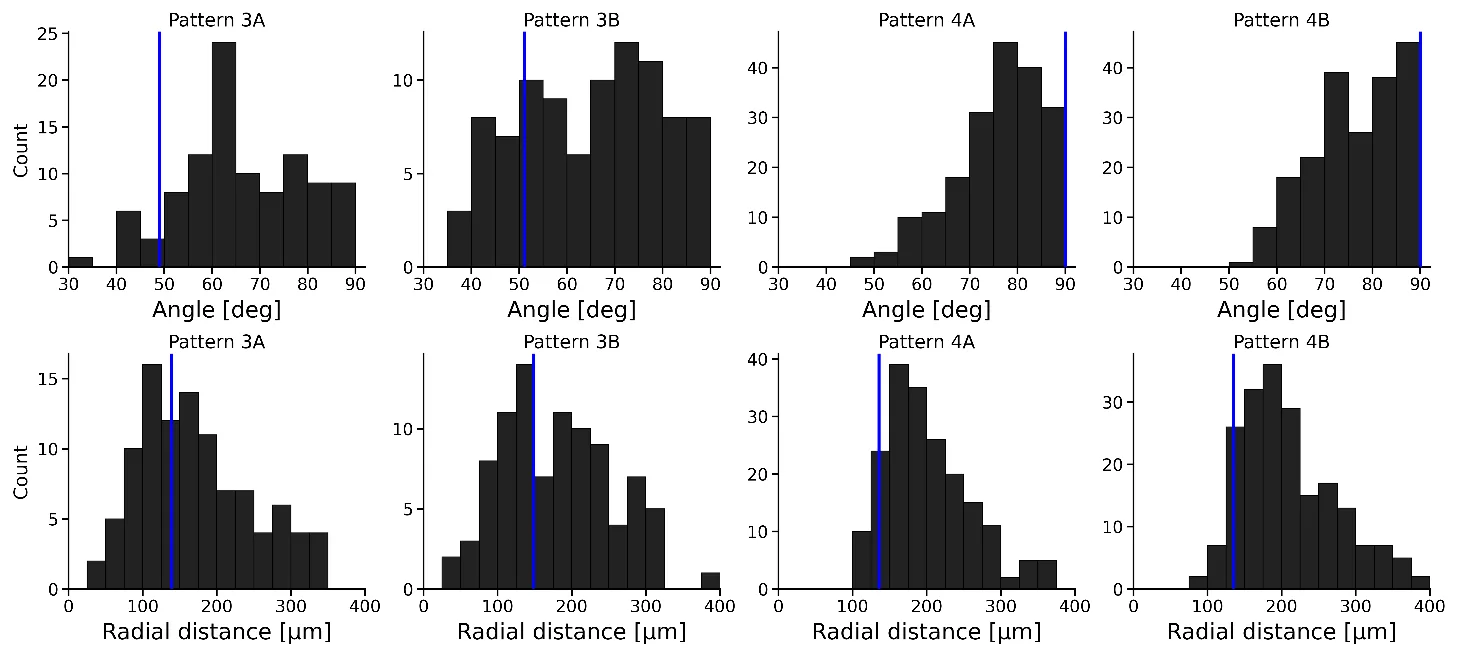
The scientists noticed that the position of the defects depends on the pillar size. At a diameter of 0.4 mm, the defects lie almost on the vertical axis connecting the centers of the holes. At 0.3 mm, they shift toward the center and deviate from the axis. To explain this, they built a theoretical model in which cell orientation is described as a field in a liquid crystal. Minimization of the Frank energy, that is, the energy of elastic distortions of orientation, showed that for obstacle radii less than 0.18 mm, the horizontal defect configuration is favored; from 0.18 to 0.38 mm, the off-axis configuration; and above 0.39 mm, the vertical configuration. The predicted positions matched the experimental peaks within 60 μm, which is less than the size of a single cell.
This work is the first to show how internal obstacles control the symmetry of cell alignment through topological constraints. Previously, studies focused on regions without holes or with a single hole, where the total charge is non-negative. Now it is clear that in tissues surrounding multiple cavities, such as vessels or ducts, defects with negative charge arise, and their location can be predicted from geometry. This opens the way to designing microenvironments to control cell orientation in tissue engineering, and also helps understand how tumors grow around vessels or how epithelial tissues rupture.
Returning to the crowd: the size of the pillars determines where exactly people will cluster into vortices. Similarly, in a cell layer, the obstacle diameter dictates where defects appear, and hence how the tissue will contract and move.
In the human heart, two -1/2 defects are found between the ventricles, and their position matches predictions for a triply connected domain.
In Stanisław Lem's novel Solaris, the ocean creates complex structures that react to the geometry of the station; similarly, cell layers reorganize their orientation around obstacles, generating topological defects.