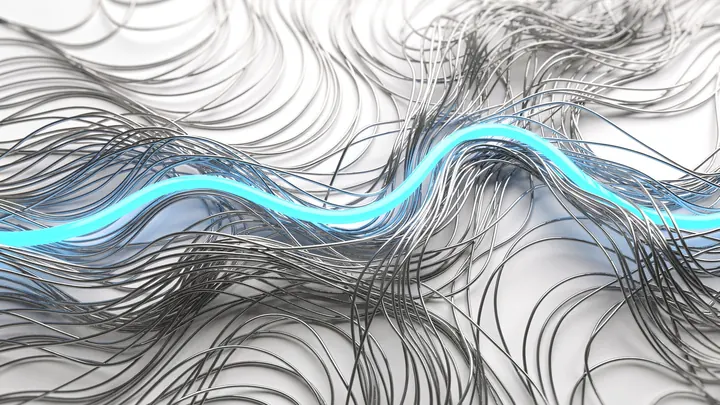
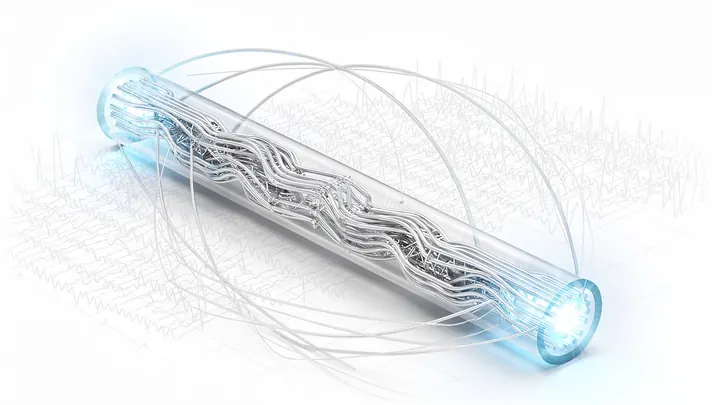
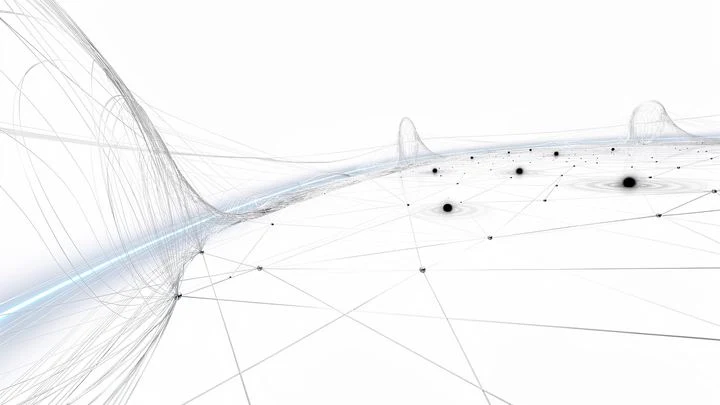
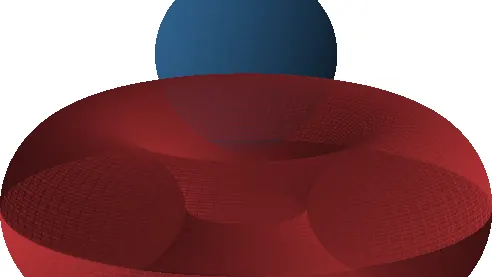
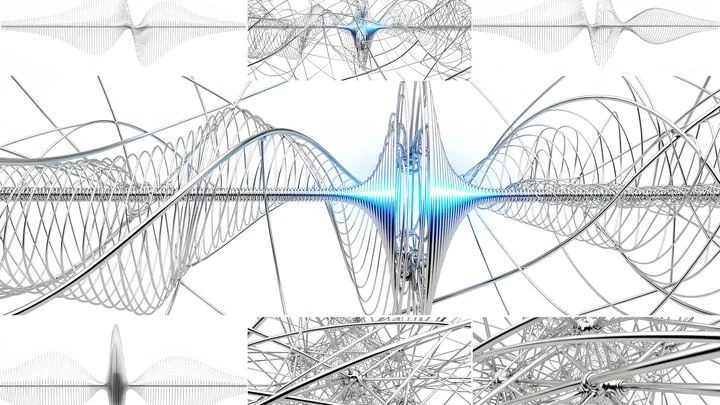
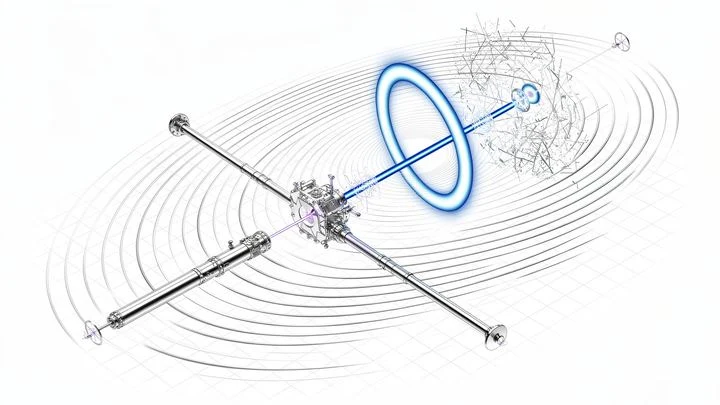
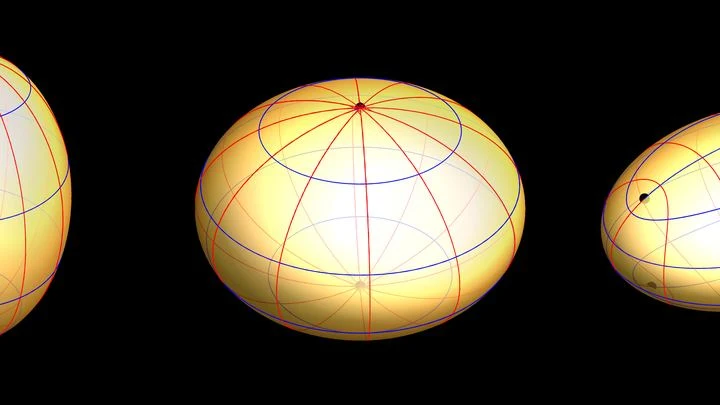
Topological defects are stable field configurations that cannot be smoothed out without breaking continuity. They arise in grand unified theories during symmetry breaking in the course of inflationary expansion. Three main types: domain walls (two-dimensional), cosmic strings (one-dimensional), and monopoles (point-like). The most promising for observation are strings — infinitely thin tubes of false vacuum with enormous linear density (~10^22 g/cm).
History
Tom Kibble in 1976 connected the mechanism of spontaneous symmetry breaking in quantum field theory with cosmological phase transitions. Subsequently, Yakov Zel'dovich and Alexander Vilenkin developed the theory of cosmic strings as gravitational lenses and sources of gravitational waves. The search for monopoles in the 1980s stimulated the development of inflation theory, which would 'inflate' the density of primordial defects to an unobservable level, but strings and walls can remain if the formation scale is below the Planck scale.
How it works
Spontaneous symmetry breaking leads to a degenerate ground state of the field. When the Universe cools below a critical temperature, uncorrelated vacua are randomly chosen in causally disconnected regions, creating a nontrivial field topology with a nontrivial homotopy class. For strings, this is a π_1 defect: upon circling around the string, the phase of the Higgs field winds, forming a closed loop that traps energy. Local stability is ensured by an energy barrier: to 'smooth out' the string, one would need to overcome the cost of flipping the field throughout the entire volume.
In practice
If such cosmic strings are found, they will explain anomalies in the microwave background and serve as natural gravitational lenses for distant galaxies.
Fun fact
A closed loop of cosmic string the size of a pea weighs as much as an entire mountain — and, trembling, emits powerful gravitational waves that future detectors could register.
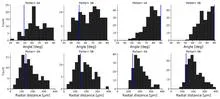
A cell monolayer resembles a crowd of people lined up one behind the other. If there are obstacles in the crowd, say two pillars, people must go around them, and vortices appear in the flow. In living tissue, such vortices are called topological defects, and they are not just a random occurrence but a way for the tissue to adapt to the shape of its surroundings.
A cell monolayer resembles a crowd of people lined up one behind the other. If there are obstacles in the crowd, say two pillars, people must go around them, and vortices appear in the flow. In living tissue, such vortices are called topological defects, and they are not just a random occurrence but a way for the tissue to adapt to the shape of its surroundings.
In a mountain range, there are trails that can be contracted to a point if you walk through a flat valley. But there are also loop routes that cannot be shrunk without crossing a ridge.
In some quantum theories, symmetries intertwine in an unusual way, as if a lock had two keys, but turning one slightly shifted the other. Such intertwined symmetries are called 2-groups. One is an ordinary symmetry acting on point particles (0-form), and the other is a 'linear' symmetry (1-form) governing extended objects like strings or lines.
Two cities with the same average population density. In one, a neat grid of blocks; in the other, a maze of narrow alleys and unexpected squares. On a global map they look like twins, but life inside flows quite differently.
A stone falls into still water — ripples spread across the surface. A black hole behaves similarly when something falls into it or when it merges with another black hole. The hole begins to oscillate, and these oscillations propagate through space as gravitational waves.
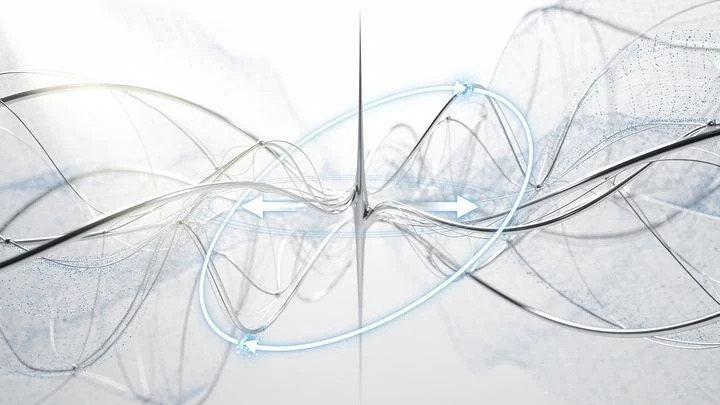
Right after the Big Bang, space cooled unevenly. In some places, folds could have formed — threads of energy as thin as a hair but incredibly dense. Physicists call them cosmic strings. They oscillate, collide, and emit gravitational waves — ripples in the fabric of space itself.
In the first fractions of a second after the Big Bang, the universe was a stage of rapid change. A stretched rubber sheet that cools quickly becomes covered with microscopic cracks. A similar process on a cosmic scale could have given rise to cosmic strings — ultra-thin but super-dense threads of energy stretching across the entire universe.
These strings are not just defects in space.
In the early universe, as it cooled after the Big Bang, defects could have formed, like cracks in ice. One such defect is a global monopole, a tiny clump of field where energy is trapped in a knot.
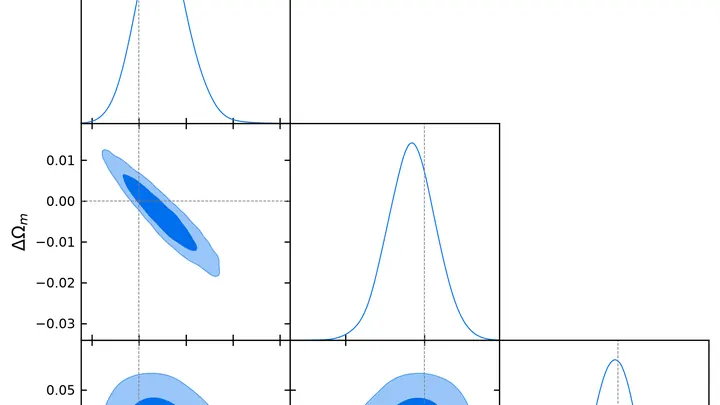
Cosmology has landed in an interesting pickle. The two main ways to look back into the universe's past, via the early glow (the cosmic microwave background) and via later objects like supernovae, yield different numbers for the expansion rate (the Hubble constant) and for how clumpy matter is distributed.
The early Universe was like a rapidly cooling ocean. At colossal temperatures, everything was one — quarks, electrons, forces all blended into a symmetric 'steam.' But as it expanded and cooled, this steam condensed, phase transitions cascading one after another like water turning to ice.
In the first moments after the Big Bang, cosmic symmetry breaking divided the hot plasma into regions with different vacuums — the lowest energy states of a field.
A cold, black mirror — that's what the sea of dark energy, the invisible substance driving the expansion of the universe, looked like for billions of years. But the DESI spectrograph has caught a faint ripple.
Pluck a guitar string, and it will vibrate and quickly fade. Now imagine a cosmic string: an ultra-thin filament of pure energy left over from the Big Bang, trillions of times thinner than an atom and denser than a neutron star. Strike it, and it might sing for billions of years.
Quantum chromodynamics is the theory that describes how quarks and gluons assemble into protons and neutrons. In its equations, there is a strange angle, the parameter θ (theta).
The quantum world loves balance. When a massive particle is forced to split, to go down two paths at once, something must give way in response. That "something" turns out to be the very apparatus that split the particle.
When the cooling cosmos, in the aftermath of the Big Bang, lost its primordial symmetry, tensions arose in the fields, like microcracks forming in solidifying glass. Global monopoles, predicted by Gerard 't Hooft and Polyakov, became such “scars” on the fabric of the universe. Each monopole is a tiny but incredibly massive knot of field.
In the first moments of the universe's life, there was not even a hint of dark energy — the very force that today pushes galaxies apart ever faster. But if you look deeper, down to the Planck scale (billions upon billions of times smaller than an atomic nucleus), spacetime ceases to be smooth.
In water cooled to –40°C, a paradoxical pause sets in: perfect hexagonal ice is in no hurry to form. Instead, a disordered structure with interspersed cubic layers emerges — a real cradle for future symmetry, brimming with disorder yet already charged with hidden architecture.
Two passengers step into an empty car on a ring subway line and take their seats. After one full loop, they are surprised to find themselves in each other’s seats — even though nobody moved. That’s pretty much how monodromy plays out in vineyards — families of persistence diagrams, a method rooted in the work of Henri Poincaré.
The Universe is an orchestra playing the symphony of the Big Bang. For a long time, the conductor was thought to be dark energy — an unwavering metronome setting the pace of expansion.
A topological superconducting nanowire is like a bridge, with two inseparable sentinels — Majorana modes — stationed at its ends. These exotic quasiparticles, predicted back in the 1930s, promise to become the foundation of an error-proof quantum computer.
From childhood, we're used to thinking of space as infinite and isotropic. But Einstein and Lemaître were already asking: could the Universe be closed in on itself, like a Möbius strip or a 3-torus?
Ripples on a pond spread in circles from a thrown stone. Now imagine the pond itself begins to tremble — the water oscillates not only from the stone but also on its own. That's roughly how gravitational waves behave in space where a special scalar field pulsates.
An empty glass on the table seems reliable. But if there's a microcrack in the bottom, one day it will break — not with a crash, but quietly, spreading in a web of lines. So too with the vacuum: it may not be the true vacuum but a false one — temporarily stable, yet ready to transition to a deeper, real state.
A black hole is not just a cosmic vacuum cleaner. It is a region with such strong gravity that even light cannot escape it. But place it in a perfect fluid of dark matter and add a cloud of strings, thin filaments stretched across all of space, and the picture gets more complicated.
Two rulers show slightly different lengths for the same table. That's roughly the situation in cosmology with the Hubble constant — the number that tells how fast the universe is expanding.
In the hot early universe, like in an overcrowded dance hall, magnetic monopoles swirled — loner particles carrying only a north or only a south pole. In an ordinary magnet, poles always come in pairs, but here each one is on its own. Theories that unify all forces of nature predict that such particles should have been produced in vast numbers, yet today we don't see them.
When water freezes in a lake, the ice becomes covered with a network of cracks — boundaries between crystals. A similar process in the first moments after the Big Bang could have spawned enormous structures resembling icy fractures. Scientists call them domain walls.
The early universe resembled a tightly stretched rubber band. In some theories, this band is not just space but enormous oscillating strings whose tension made the world expand at an unimaginable rate. When the band snapped (that is, when inflation ended) the strings collapsed and annihilated like popping bubbles in a boiling pot.
The Universe doesn't just expand — it resonates. After the Big Bang, stretched strings remained in its fabric — thin as a proton, yet heavy as a mountain range. Their oscillations give birth to gravitational waves, and in this radiation, like in a musical score, the history of fundamental symmetries is encoded.
Immediately after the Big Bang, in the seething cauldron of the cooling Universe, much like in unevenly hardening glass, stresses appeared — hairline cracks in reality, cosmic strings. Picture a tightrope walker balancing on an invisible cable stretched across the abyss of warped spacetime.
A taut sheet wrinkles. If you tug a corner, a smooth wave runs across; if you sharply bunch the fabric, a sharp crease forms. Space and time in Einstein's equations behave much the same way. Gravitational waves resemble the gentle ripples of the sheet, while shock fronts are like stiff folds where matter's properties change abruptly.
Sunlight hits a crystal, and inside, a pair is born — a swift electron and a hole. Ideally, they immediately race off to the contacts and produce current. But in the material the authors studied, things go differently. The moment a charge stumbles upon a void, a missing atom in the lattice, a cloud of vibrations tightens around it.
A tightly stretched sheet lies on a table for days. Outwardly it's still, but the fabric fibers retain tension — loosen one edge slightly, and wrinkles will run across it, rearranging the whole pattern. That's roughly how a layer of epithelial cells behaves at rest. It doesn't just freeze; it accumulates mechanical stress — a kind of cellular memory of past movements.
A balloon doesn't deflate all at once: first, dents appear on its surface, which run, merge, and finally the balloon shrivels into a point. Domain walls behave in much the same way — thin partitions that divided space in the first moments after the Big Bang.