Liquidcrystals are a state of matter that flows like a liquid but has molecules oriented in a crystalline order. This unique combination gives them remarkable optical properties: they can transmit, reflect, or polarize light depending on the molecular alignment. They are best known for their use in display screens, but they also appear in biological systems and advanced materials research.
History
The liquidcrystallinestate was discovered in 1888 by Austrian botanist Friedrich Reinitzer, who observed that cholesteryl benzoate had two melting points. The term 'liquid crystal' was coined by German physicist Otto Lehmann in 1889.
How it works
Liquidcrystal molecules are typically rod-shaped and have a permanent electric dipole. When an electric field is applied, the molecules reorient, changing the optical properties of the material. In a display, each pixel contains a thin layer of liquid crystal sandwiched between polarizers; the applied voltage controls how much light passes through, creating images.
In practice
Liquidcrystals are used in LCD screens (televisions, monitors, smartphones), but also in optical switches, temperature sensors, and even in some medical imaging techniques.
Fun fact
Liquidcrystals are also found in living organisms—for example, in the cell membranes of some bacteria and in the silk produced by spiders.
In the dark chamber of the trap, thousands of charged particles dance under electric fields. At first they move freely, like a crowd in a square, but cool the cloud and the dance slows: ions begin to sense each other, their steps become constrained.
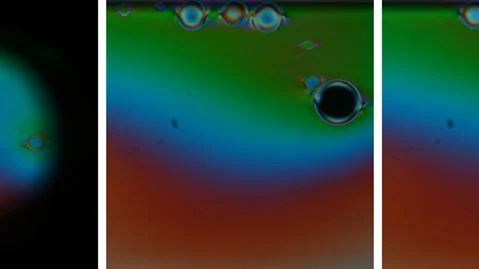
A slice of eucalyptus a tenth of a millimeter thick is placed under a polarized light microscope, and the wood suddenly blooms: blue, yellow, and pink bands twist into spirals, forming rings and swirls. This is not paint but the play of light: the cellulose fibers that make up cell walls transmit light differently depending on their orientation.
In a thin layer of liquid crystal, molecules usually lie like matches in a box — aligned in one direction but randomly oriented: some point up, others down. To make all the matches point the same way, you need a special molecular architecture. Scientists have found a chemical trick that does this almost automatically.
In a thin layer of liquid crystal, molecules usually lie like matches in a box — aligned in one direction but randomly oriented: some point up, others down. To make all the matches point the same way, you need a special molecular architecture. Scientists have found a chemical trick that does this almost automatically.
The laser beam in an optical tweezer is not just a spot of light but a force bag. A particle caught in it usually rolls toward the brightest point, like a ball into a dimple.
A drop of saltwater dries on a table. The salt doesn't settle just anywhere: crystals first appear at the rim, forming a ring, like coffee grounds at the bottom of a cup. Everyone who has seen the stain left by a dried droplet knows this behavior. But what if the droplet contains swimming bacteria?
In a pot of water, microscopic spheres, colloidal particles, are floating. Each sphere is coated with long polymer chains that look like a brush and carries an electric charge. If you get the temperature and solution composition right, the spheres start arranging themselves into ordered patterns — crystals.
A time crystal resembles an eternal clock: its atoms spontaneously perform rhythmic movements. In ordinary clocks, a pendulum is driven by a spring or battery, but here the motion arises without an energy supply — the system simply returns to its initial state at regular intervals. This idea was proposed by Frank Wilczek in 2012.
A drop of water on a table usually sits still. But make the table slightly softer on one edge and stiffer on the other, and the drop will crawl toward the stiffer side. This phenomenon is called durotaxis: the liquid itself chooses where to flow, without pumps or electricity.
This trick works because the surface under the drop is not uniform.
A flock of birds or a school of fish sometimes swirls into a vortex, even though no individual commands 'spin.' Such collective rotation helps the group stay together and mix better. It is usually explained by the individuals being asymmetric, like a screw, or pushing each other with a twist. But a new study finds another route.
In some materials, atomic magnetic moments: their tiny 'arrows'—refuse to freeze even at ultra-low temperatures. Instead of conventional order, they form a spin liquid: a state where spins constantly flicker but do so coherently, like dancers in an intricate routine.
Molecules in a solution behave like a crowd in a square: they can jostle randomly or line up in neat rows. An aqueous solution of disodium cromoglycate is a well-known model for chromonic liquid crystals, where such 'rows' form spontaneously. But if you shine ultraviolet light on the solution, order collapses: molecules start breaking apart.
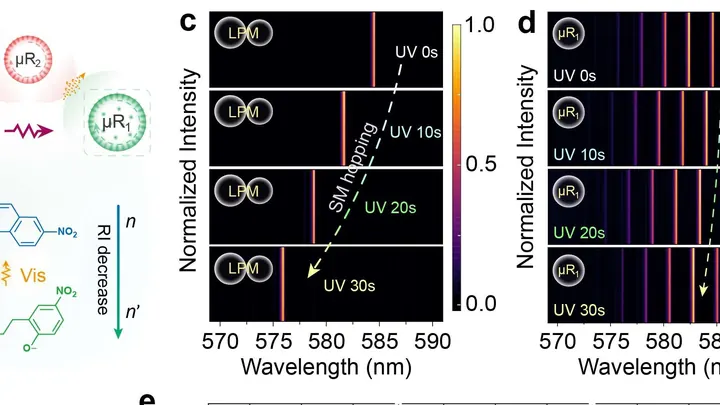
Two liquid droplets hanging side by side begin to sing in unison. One droplet is like a string tuned to a certain pitch, and together they form a laser that shines with a single, pure color. That's how a new type of sensor, a liquid photonic molecule, works.
The secret is that the droplets are slightly different in size.
A laser beam usually travels straight, like a jet of water from a hose. But what if you twist that jet like the thread of a corkscrew? You get a light spring — a beam that, as it moves, also spins around its own axis. At every point in space, its brightness traces a spiral, and if you place a flat screen in its path, you'll see a rotating spot of light.
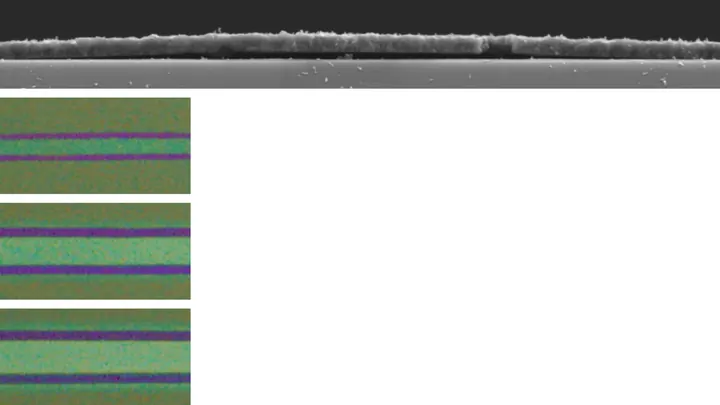
A laser beam passes through glass and touches a thin diamond film. At the point of contact, the film turns into a narrow strip that lifts slightly. We place a second strip next to it, and between them remains an empty corridor. That's the channel: its width can be fifty times its height, like a sheet of paper lying on a table.
Magnetic fields are all around us, from the compass in your phone to the MRI machine at the hospital. To measure them with high precision, you need special materials that respond to the slightest changes in the field. One such material is molecular crystals, where electron spins, think of them as tiny tops, can hold their state for a long time.
In NaAlSi, as it cools, electrons form fleeting ripples — stripes that appear and vanish, like patterns on water stirred by wind. These stripes intertwine with superconductivity, a state where current flows without resistance. Typically, for this, electrons pair up with uniform binding energy.