Microwaves Turn Tantalum into a Transparent Window in Minutes ✛
A tantalum film two hundred nanometers thick sits on a quartz substrate. Within it lies hidden future light: if you heat the metal properly, it turns into a transparent oxide through which light from an implanted LED can pass. The problem is that conventional heating methods are either too harsh or too slow.
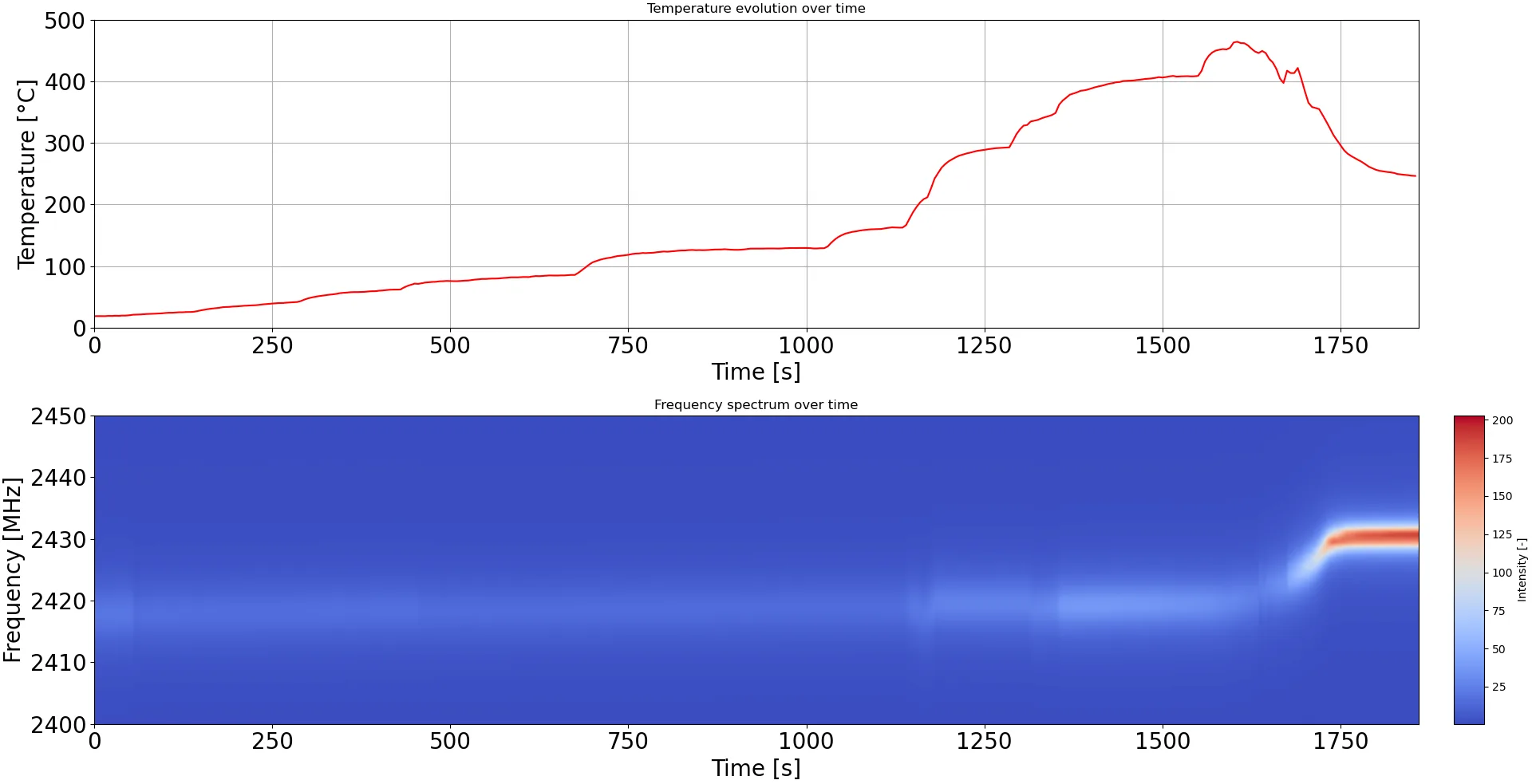
The microwave cavity acts like a keen ear: it not only heats the sample but also hears the metal turning into glass. The film is placed in a quartz tube along the axis of a cylindrical resonator tuned to 2.45 GHz. The electric field oscillates horizontally, and its energy is absorbed by the metal. Power is ramped up in steps to 60 W, and temperature is measured with a pyrometer. After a few tens of seconds at about 50 W, the metal is fully oxidized.
The resonant frequency of the cavity jumps by 10 MHz, and the quality factor Q increases noticeably. This happens because metallic tantalum, which reflects microwaves well, turns into a dielectric oxide that barely disturbs the field. The cavity stops losing energy, and its "voice" becomes clearer. This shift allows real-time monitoring of the thin film's chemical transformation without destroying the sample.
Unlike a laser, which vaporizes the film at the slightest overheating, microwaves heat volumetrically and gently. In a tube furnace, complete oxidation takes an hour at 600 °C, while microwaves do it in tens of seconds. True, the film turns out non-uniform, but the principle works. If a brick house swelled like that, the walls would bulge into the street: the film thickness grows from 200 to 409 nm, meaning the volume more than doubles.
This method will be useful for rapidly creating transparent windows in biocompatible coatings of implants, for example in optogenetics. The microwave oven transforms from a mere heater into a diagnostic platform that itself reports when the metal has become glass. The remaining tasks are to achieve film uniformity and to test a two-step route where a laser defines the pattern and microwaves complete the oxidation.
Complete oxidation increases the film thickness from 200 to 409 nm, meaning the volume grows more than twofold. If a brick house swelled like that, the walls would bulge out onto the street.