A dielectric is an electricalinsulator that can be polarized by an applied electric field. Unlike conductors, dielectrics do not allow free flow of charge, but their constituent molecules or atoms shift slightly, creating bound charges that partially cancel the applied field inside the material. This property is fundamental to capacitors, where dielectrics increase charge storage capacity, and to the behavior of light in transparent materials.
History
The term 'dielectric' was coined by Michael Faraday in the 1830s during his experiments on induction and insulation.
How it works
When an electric field is applied, the positive and negative charges within the dielectric's molecules are displaced in opposite directions, creating tiny dipoles. These dipoles align partially with the field, producing a macroscopic polarization that reduces the net electric field inside the material. The degree of this response is quantified by the dielectric constant (relative permittivity), which determines how much the material can store electrical energy.
In practice
Dielectrics are used in capacitors, electricalinsulation, and as the active medium in many types of sensors and actuators, as well as in the gate oxides of transistors.
Fun fact
The dielectric strength of air is about 3 million volts per meter, which is why lightning can travel through kilometers of it.
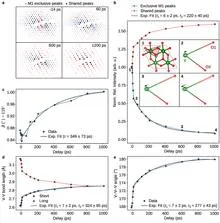
The camera captures not a race but a dance of atoms. In vanadium dioxide, the transition from an insulating to a metallic state occurs within trillionths of a second, yet until now no one had seen exactly how the vanadium and oxygen atoms move. Now, ultrafast electron diffraction has captured this route frame by frame.
In a thin layer of liquid crystal, molecules usually lie like matches in a box — aligned in one direction but randomly oriented: some point up, others down. To make all the matches point the same way, you need a special molecular architecture. Scientists have found a chemical trick that does this almost automatically.
A laser beam focused to the size of a dust speck can hold a single molecule, much like tweezers hold a tiny bead. But filling a hundred such tweezers with exactly one molecule each is like trying to put a single drop of water into every compartment of an egg carton without spilling a drop.
A light switch clicks, and the light comes on. But imagine a switch that, with the same press, can either turn on the lamp or leave the room dark. It also remembers what it did last time, and sometimes it seems to flip a coin to decide whether to light up.
This kind of behavior was found in a crystal of black phosphorus — a semiconductor just a few atomic layers thick.
A highway where opposing flows are separated not just onto different sides, but onto two independent roads: each with its own entrance and exit. Something similar happens to electrons in a new type of topological insulator described by the authors of the study.
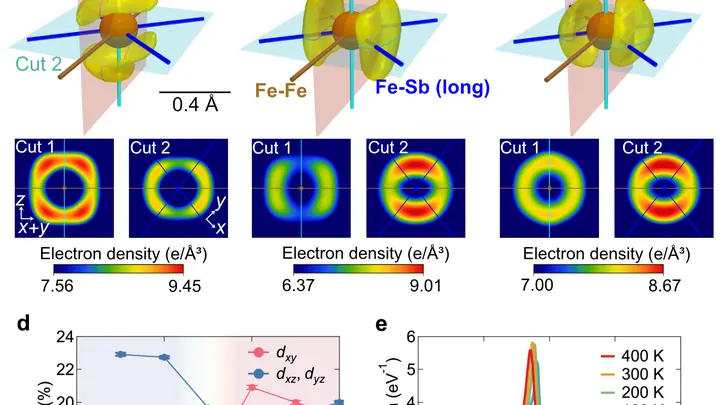
A house with cork walls suddenly gets covered in copper sheets, but only when frost sets in. That's roughly how FeSb₂ behaves when made into a film just a few atomic layers thick. Under normal conditions, it's a narrow-gap insulator: electrons sit tightly in place like spectators in an overcrowded hall.
Usually, light does not turn an insulator into a conductor: that requires powerful laser pulses that break the material's structure. But in twisted bilayer graphene at the magic angle, things are different.
A polar molecule is like a tiny dumbbell with opposite charges at its ends. Normally, such particles quickly stick together or fly apart when they meet — electric forces are too strong. But the authors of the work found a way to turn this aggressiveness into a controlled game.
A thin sandwich made of two different materials. You run an electric current through it, and the top slice magnetizes in one direction, the bottom in the opposite. This isn't a magic trick; it's the layer Edelstein effect, just described by physicists.
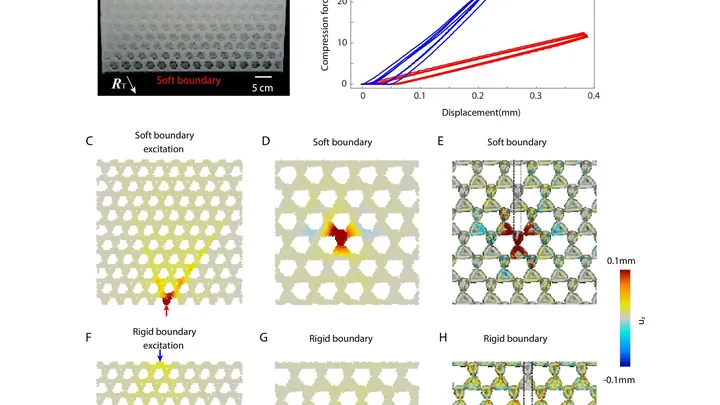
Bending a sheet of paper is easy. But compressing it by pushing from the edge is a different story: the paper will crumple but barely transmit the force further. That's how ordinary elasticity works — deformation depends on where and how you press. The new three-dimensional lattice pushes this contrast to the limit.
A light wave is like a rope that has been shaken: it oscillates in a specific plane. This property, polarization, reveals the shape and composition of objects. But capturing it is not easy, especially when you need to cover a wide range of colors. Usually, this requires bulky systems of lenses and filters.
In a world locked in a crystal lattice and cooled nearly to absolute zero, matter knows how to hide its deepest secrets. A quantum spin liquid is a state where electron spins never freeze, even at zero temperature, remaining in an eternally flickering superposition.
The solar wind rushes from the Sun to Earth, but the magnetosphere bends the flow and sculpts it into plasma tails. The same motif plays out at the heart of galaxies: jets from accretion disks around black holes are twisted by the invisible hand of a magnetic field.
An ordinary microwave cavity resembles a music box: it responds only to strictly defined frequencies: its own notes. But what if you could make it sound different? Scientists changed the rules of the game by making the walls "one-way." Inside such a cavity, a wave can only run forward, never reflecting back.
Two-dimensional worlds never cease to amaze: here even crystal melting is not a symmetry breaking but a vortex drama discovered by Kosterlitz and Thouless. At the heart of this theater are topological сингулярности, whose energy and энтропия bargain for order. This language is common to сверхтекучести и сверхпроводимости.
The thinner the ferroelectric film, the stronger the depolarizing field — a dictate of classical physics. Imagine a pencil balancing on a fingertip: the shorter it is, the harder to keep it upright. Nanoscale polarization likewise strives to vanish.
Imagine a multilayered shell where metal and insulator layers alternate like pages in a book. Such a structure can make an object hidden inside invisible to an observer. Light bends around it as water smoothly flows around a smooth stone: no ripple, no splash — no reflection, no shadow.
A sheet of paper with square grid, one with diamond grid, and one with honeycomb — three different universes for an ant. Change the sheet, and the rules of movement change. That's roughly how electrons experience the crystal lattice: geometry dictates whether they become little magnets, superconductors, or something else. In ordinary materials, the lattice is as rigid as if engraved.
Imagine a carousel with two types of seats: some spin clockwise, others counterclockwise. If you push all of them at once, the carousel jerks but stays in place. That's how a Weyl semimetal crystal works: electrons are born in pairs—'left' and 'right'—and their contributions to current cancel each other, like two identical motors running in opposite directions.
Imagine two immiscible liquids, such as oil and water. Under normal conditions, they tend to separate, forming a clear interface. But introduce microscopic swimmers (bacteria, whose basis is carbon) and the picture changes dramatically.
Even Jocelyn Bell Burnell, who first detected the strict periodicity of radio signals, noticed that some pulses would suddenly vanish. Today we know: variability is not a whim, but the voice of intricate electrodynamics.
Two white sheets lie in the sun — one rough, one smooth. Which one heats up less? The rough one scatters light more strongly, so it seems it would stay cooler. But if the coating is made of many transparent glass beads, the logic changes. Light wanders through it like in a thick fog, and at some point it stops noticing individual droplets.
A rubber band that gets thicker the harder you pull it. In electricity, this behavior is called negative capacitance: the more charge accumulates on the plates, the lower the voltage. A regular capacitor works the opposite way — voltage rises with charge.
Heat a nail in a fire, and it will lengthen — everyone knows that. But heat only the tip and leave the other end cold, and the nail doesn't just get longer: it bends, because hot metal expands more than cold metal. It's this very bending, but at the atomic level, that physicists have turned into electricity.
Two grains of salt fall into a glass of water. They dissolve, and sodium and chloride ions spread throughout the volume. The schoolbook truth is simple: like charges repel, opposite charges attract. But recent experiments with tiny spheres in liquids have revealed a picture that breaks this rule.
A conventional laser is like an orchestra where musicians must warm up before playing in unison. You first need to pump enough atoms with energy so they 'flip' and are ready to emit light: this is called population inversion. Only then does the beam flash. A polariton laser plays by different rules: its 'musicians'—a mix of light and matter — join in almost without preparation.
In the crystal HfTe5, electrons behave almost like light: their mass is so small that they obey the laws of relativity. If you place such a crystal in a strong magnetic field, the electrons start to circle in tiny orbits. Their energy then changes not smoothly but in steps, like floors in a building.
A thin film of soap on your hand conforms to the shape of your palm, but clench your fingers and the tension changes unevenly. A monolayer of molybdenum disulfide on a graphite substrate behaves in a similar way.
On the surface of a thin film of bismuth iron oxide, you can see neat stripes, like furrows in a plowed field. What lies beneath them has remained a mystery until now.
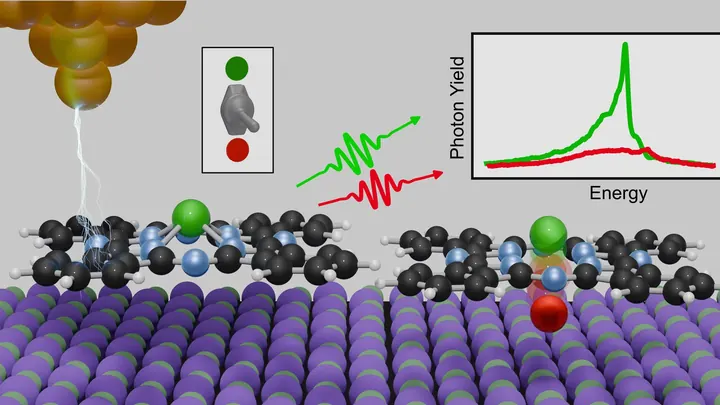
In a molecule resembling chlorophyll and built from carbon, a metal atom at the center acts as a toggle. Shifting it by fractions of a nanometer can make the molecule glow, quench, or boost its brightness a hundredfold.
A sheet of graphene is a mesh of carbon atoms one atom thick. Even the slightest contamination shows up on it, like dust specks on eyeglass lenses. Ten years ago, researchers learned to hide graphene between layers of boron nitride, like placing a fragile sheet between two pieces of plastic wrap.
A rug lies flat, but if you push it from the edge, wrinkles run across it. In a thin film of tantalum sulfide (1T-TaS2), wrinkles made of electrons, charge waves, freeze as if the rug were stuck to the floor. To move them, you need to apply force. Scientists have found a way to control this force using an electric field and a magnet.
A laser beam twisted into a spiral looks like a drain vortex in a sink: light moves not only forward but also in circles. Such vortex beams already help move tiny particles and transmit more data. But once they pass through an inhomogeneous medium, the vortex falls apart, like water from a leaky bucket.
In a thin layer of liquid crystal (a substance that flows like a liquid but has molecules arranged in order, as in a solid) vortices smaller than the thickness of a human hair are born. These vortices resemble tiny spinning tops: they can move without breaking apart and behave almost like real particles.
A sheet of graphene one atom thick is like a flexible metal mesh through which electrons zip almost unimpeded. Stack two such sheets with a slight twist, and the material's properties change dramatically: it can become an insulator that blocks current.
The cell membrane isn't just a wall; it's a turnstile gate. Embedded within it are protein channels that let ions in and out, creating an electric charge, like a battery that powers nerves and muscles.
A sheet of graphene one atom thick is like a perfectly smooth tablecloth on which electron marbles roll. Place an electric barrier in their path, and usually they'll bounce back. But in graphene, it's different: under certain conditions, electrons pass through the barrier without even noticing it, as if the wall were made of mist.
When two different materials are pressed together and then pulled apart, a spark jumps between them. Anyone who has pulled off a wool sweater in the dark or gotten a shock from a doorknob knows the feeling. For a long time, it was thought that charges simply hop from one surface to another due to differences in material properties.
A glowing dot the size of a molecule. Run a current through it, and it flashes like a tiny lightbulb. That's what the experiment with dye molecules on a thin salt film looks like.
When current enters a molecule, one electron hands it energy. The molecule immediately gives that energy back, as light. It's like a swing: give it one push, and it rocks and then stills.