A resonator is a device or structure that naturally oscillates at certain frequencies with greater amplitude than at others. In the context of the provided articles, resonators are often made of layered materials or crystals to enhance the conversion of axions (hypothetical dark matter particles) into detectable photons. They are also used to amplify weak signals, such as gravitational waves or wireless power, by matching the resonator's frequency to the signal's frequency.
History
The concept of resonance has been known since ancient times, but the first mathematical treatment of resonators was given by Hermann von Helmholtz in the 19th century, who analyzed acoustic resonators. The use of resonators in particle physics for axion detection was proposed in the 1980s by Pierre Sikivie.
How it works
A resonator works by storing energy in an oscillating form—mechanical, electromagnetic, or acoustic—and reinforcing it through constructive interference. When an external signal matches the resonator's natural frequency, the amplitude builds up over many cycles, effectively amplifying the signal. In axion detectors, a layered resonator is placed in a strong magnetic field; axions convert to photons, and the resonator enhances the photon signal at a specific frequency, making it detectable above noise.
In practice
Resonators are used in wireless charging systems to increase power transfer efficiency, in gravitational wave detectors to amplify tiny vibrations, and in quantum experiments to create macroscopic superpositions.
Fun fact
A diamond resonator can trap sound waves so effectively that they bounce back and forth trillions of times, creating an extremely long-lived 'echo' that can be used to probe quantum effects.
A guitar string is stretched between two mirrors. A beam of light bounces back and forth between them, and the string shudders at every touch. Sometimes the light loses energy — the string takes it and dissipates it as heat, like a fading sound. Other times, the string shifts the pitch of the light itself, changing its color but barely dimming it.
Astronomers listen to the cosmos like an old radio: they twist the knob not to find a particular station, but to catch any unusual noise. This approach breaks the mold: instead of hunting for gravitational waves using memorized patterns, they catch everything — without bias.
In a dark room, an infrared laser flashes, and a speck of black K3C60 powder conducts electricity without resistance for a split second. The light strikes at 10 terahertz — a thousand times faster than a microwave oven. The effect is a hundred times stronger than at other frequencies. Why this particular frequency?
In 2015, two giant facilities in the United States caught the shiver of space — a gravitational wave from the collision of black holes. Since then, such signals have been caught regularly, but the detectors themselves are enormous: their arms stretch for kilometers.
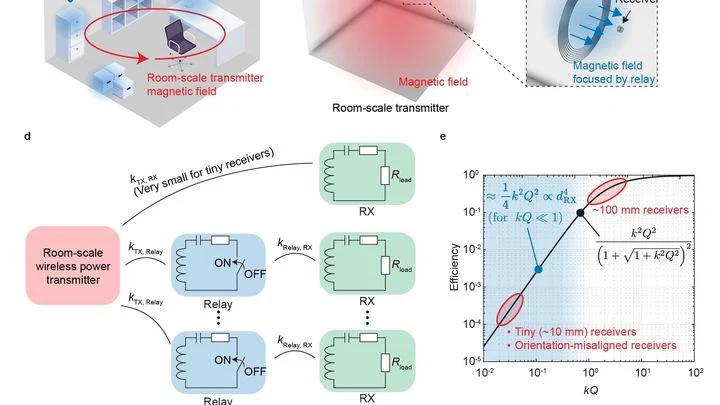
Think of wireless charging in a room as a pool where energy-water is everywhere, and tiny sensor-floats barely bob. Their induction coils are too small to efficiently scoop from this diffuse electromagnetic field. Unlike radio waves, the energy here doesn't travel at the speed of light: it lingers in the near field, waiting to be harvested.
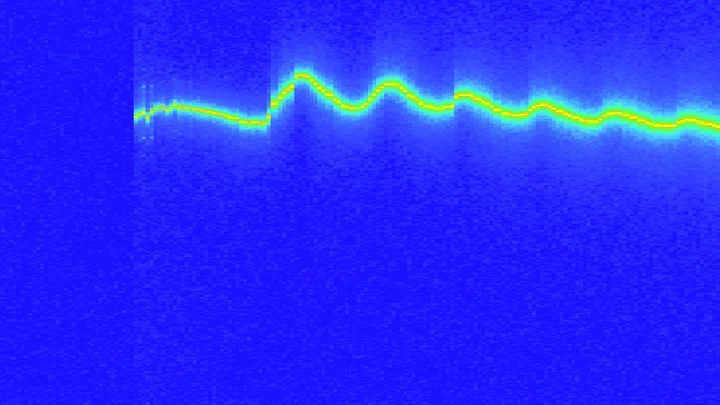
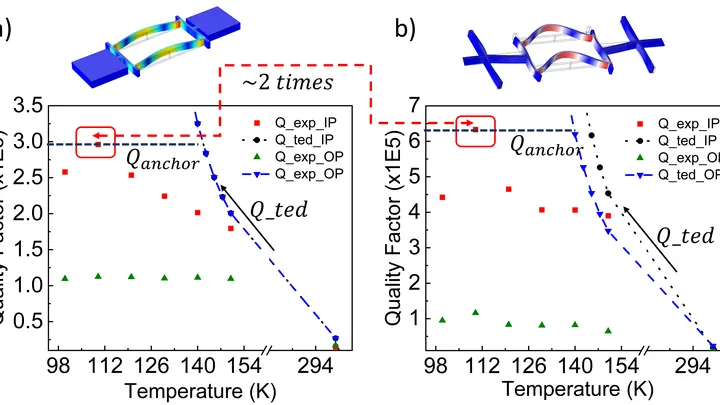
A tiny diamond bridge vibrates so strongly that it starts to 'sing' at many frequencies at once. Previously, such vibrations would dampen themselves: the harder the resonator swung, the harder it was to add energy. Physicists found a loophole in this rule.
They used light to drive the diamond. Light pushes on the bridge, making it tremble.
Sound in a solid is waves of compression and rarefaction rippling through atoms, like ripples across a spring mattress. If you place obstacles with just the right spacing, waves at certain frequencies can't pass: they bounce back. Such a periodic structure is called a phononic crystal, and it works for sound the way a multilayer mirror works for light.
In its infancy, the universe was a hot, plasma-like mixture of particles. Microseconds after the Big Bang, as it cooled, the temperature fluctuated slightly.
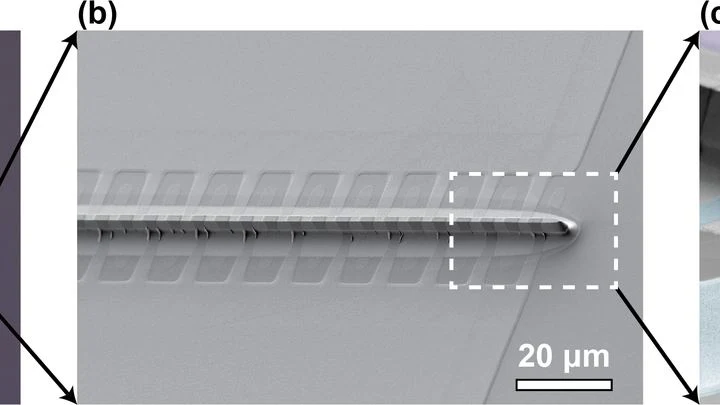
A tiny lithium niobate comb vibrates at a frequency of 300 million times per second. Each tooth is carved from a crystal plate as thin as a human hair, with metal electrodes deposited on its sidewalls. The sound wave bounces inside the tooth like an echo in a narrow stone canyon, unable to escape.
Gravitational waves are ripples in spacetime curvature that imperceptibly stretch and squeeze everything around. But the Moon, like a bell, catches these waves: as a gravitational wave passes through it, it makes our satellite vibrate.
A conductor leads an orchestra of billions of musicians while still hearing each one individually. That's roughly the challenge physicists face when trying to make light and electron spins in solids work together.
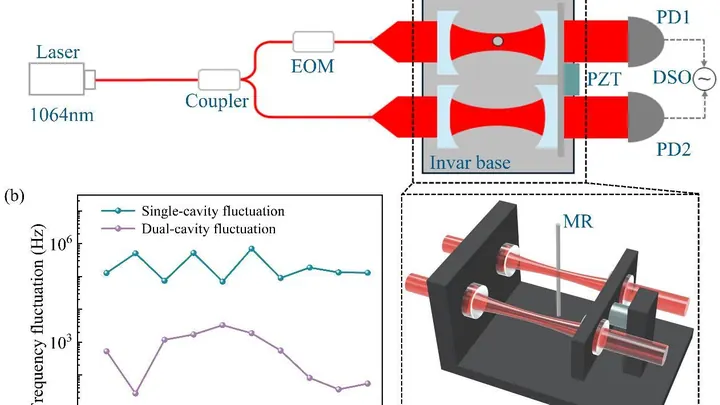
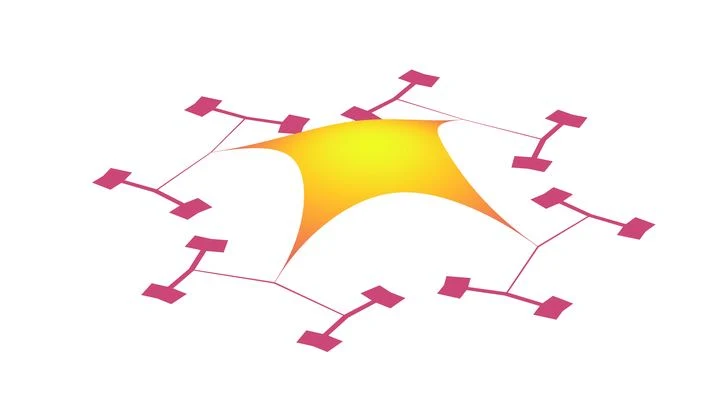
Imagine a membrane stretched like the skin of a drum. It picks up two signals at once: gravitational waves — the trembling of space itself — and elusive particles of dark matter. The membrane is placed between mirrors, and light presses on it like a finger on a string, keeping it under constant tension.
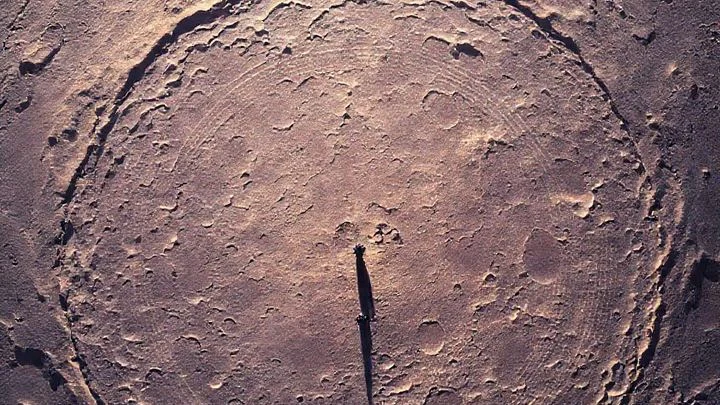
The Moon is not just a rocky sphere, but a giant bell. Passing through it, gravitational waves cause it to vibrate almost imperceptibly. This tremor was predicted by Einstein, and Weber was the first to try to hear it with Earth-based detectors.
Deep inside a cryostat, beneath layers of superconducting coils, lies a stack of hundreds of semiconductor layers. Each layer is just a few nanometers thick: gallium arsenide, then aluminum gallium arsenide. The electrons within these layers are confined to a plane, like ants on a sheet of paper.
The resonator vibrates at 100 megahertz, and its mechanical damping is only 15 hertz. That is like a bell that rings for thousands of years after a single strike. Next to it sits a qubit, a quantum two-level element that decays in milliseconds. It is this contrast in lifetimes that opens the door to Schrödinger's cat.
A laser beam is trapped between two mirrors, one of which trembles under an invisible force. Each vibration of the mirror changes the phase of the light, and from these changes you can infer the force. But the light itself pushes on the mirror, which is quantum backaction, and it imposes a fundamental limit on measurement accuracy.