Microwaves turn tantalum into a transparent window in minutes ✛
Context
Tantalum is valued for its biocompatibility, so it is used to make hermetic capsules for implantable devices, such as those for optogenetic nerve stimulation. Inside such a capsule sits an LED, and light must escape through a transparent window. Turning selected areas of metallic tantalum into transparent Ta2O5 oxide, which has a refractive index of about 2.1 and a bandgap of roughly 4 eV, can be done by localized heating. Alongside this work on the archive are studies of laser processing of superconducting circuits, films for capturing invisible light, and quantum bits in a vacuum cradle, meaning the theme of localized material control at the micro- and nanoscale is actively developing. The problem is that laser heating of a reflective metal is inefficient, and slightly too much energy already evaporates the film.
Methods
A 200 nm thick tantalum film was deposited by ion beam sputtering onto a fused quartz substrate 25 mm in diameter. Three routes were compared: a femtosecond laser with a wavelength of 515 nm and pulse duration of 200 fs, a tube furnace at 550 and 600 °C, and a cylindrical TM010 mode resonator tunable from 2.4 to 2.5 GHz. In the resonator, the sample was placed in a quartz tube along the cavity axis, where the electric field is horizontal. Power was increased in steps up to 60 W, and temperature was measured with a radiation pyrometer on the outer wall of the tube. Resonant frequency and quality factor Q were extracted from vector network analyzer data by fitting a pseudo-Voigt profile. A numerical model was built in COMSOL Multiphysics 6.3 to compare the field distribution with actual oxidation regions.
Results
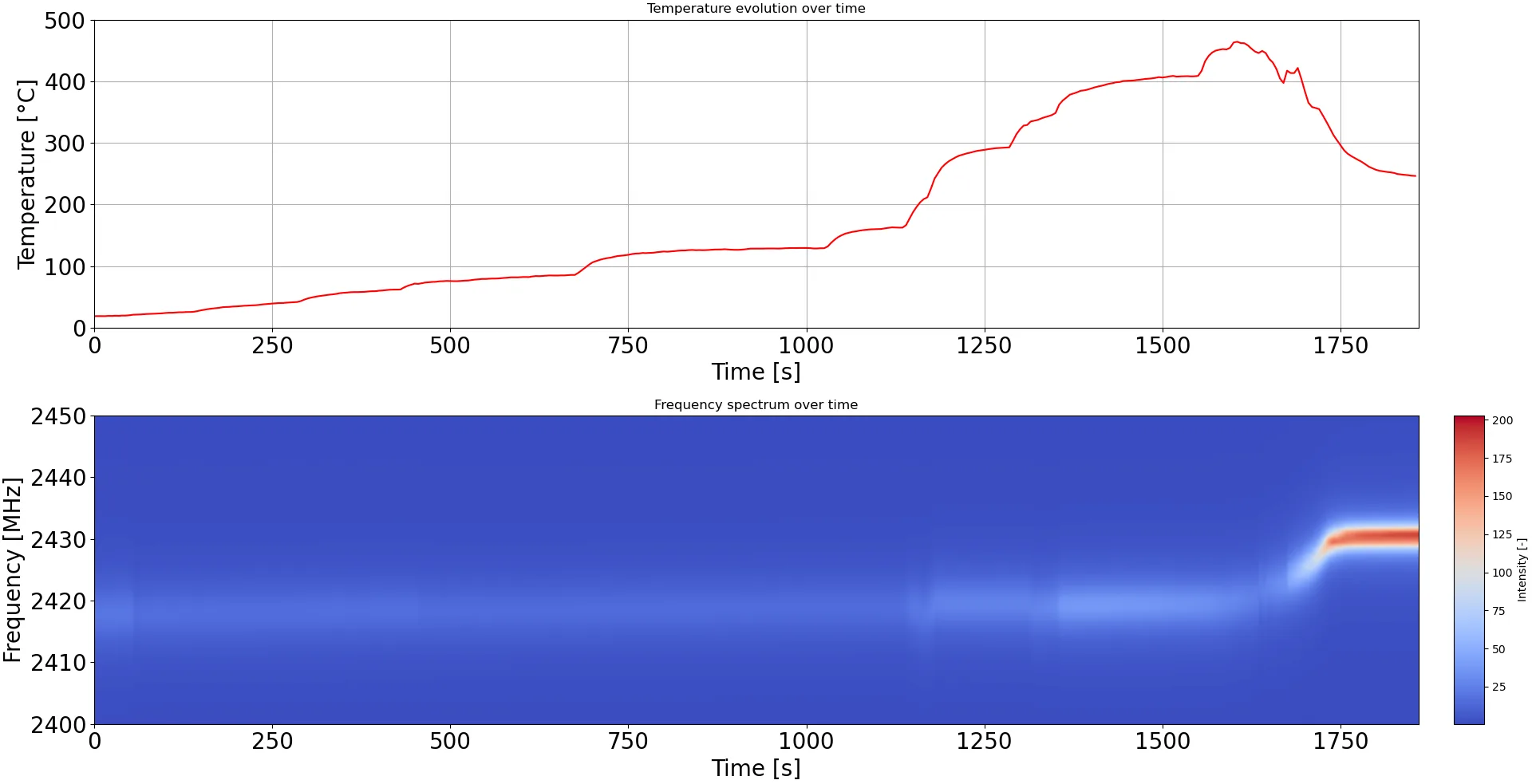
In the furnace, complete conversion of 200 nm tantalum to 409 nm Ta2O5 took one hour at 600 °C, while at 550 °C the visible transmittance did not change. Laser oxidation began at an average fluence of about 0.1 J/cm² with 900 pulses per spot, but the window between oxidation and ablation was too narrow: on the Liu plot, the width of the modified line fell on the same straight line as ablation, without a separate threshold. Microwave oxidation of extended areas took tens of seconds at about 50 W, although the film was non-uniform. Key result: at the metal-to-oxide transition, the cavity resonant frequency jumped by 10 MHz, and the quality factor Q increased noticeably. This reflects the drop in conductivity and microwave losses when metallic tantalum turns into a dielectric oxide.
Implications
This work stands out from neighboring studies because it uses not a laser spot but volumetric microwave heating in a resonator, with the resonator itself acting as a measuring instrument. Neighboring works in the archive more often deal with laser ablation, superconducting circuits, or light trapping, whereas here a metal is turned into a transparent oxide without the risk of surface evaporation. The resonance shift and increase in quality factor provide a non-invasive way to monitor the chemical transformation of a thin film in real time. This turns a microwave oven from a mere heater into a diagnostic platform.
Future development
Microwave annealing could be tried for localized deposition of calcium, barium, or lithium nanoparticles in regions where a femtosecond laser has already written nanogratings inside fluorides. Such materials operate over a wide range from 0.15 to 15 μm, from ultraviolet to mid-infrared. Localized heating could restore the crystal lattice after ion implantation or control the luminescence of F-centers. For quantum optics, rare-earth ions in fluorides are interesting for their long coherence times, and microwaves could anneal defects after laser writing.
Impact
The method will speed up the creation of transparent windows in biocompatible tantalum coatings for implantable optogenetic devices. It is also useful for rapid annealing of thin films in microelectronics and photonics, where localized heating without damaging the substrate is important.
Next steps
One should achieve uniformity of the oxide film by varying the sample geometry and the field distribution in the resonator. Then a two-step route could be tested, where the laser defines the pattern and microwaves complete the oxidation.
Key open problems
For materials science, the mechanism of volumetric microwave heating in thin films remains an open question: which defects and grain boundaries absorb energy at the early stage of oxidation. The link between dielectric losses and oxide growth kinetics is so far described qualitatively, not quantitatively. This limits prediction of uniformity and reproducibility of the process.
The knowledge machine's view
This section is addressed to the author of the paper and their colleagues. Neighbouring works were found by meaning-based search across our archive, not by word overlap. We do not review: we show the field around the work.
What the work does
The author oxidized 200-nm tantalum films in three ways: with a femtosecond laser, in a tube furnace, and in a 2.45 GHz microwave resonator. Laser oxidation turned out to sit too close to the ablation threshold, the furnace needed an hour at 600 °C, and the microwaves got the job done in tens of seconds at ~50 W. Shifts in the resonant frequency and the cavity's quality factor made it possible to track the metal-to-oxide conversion in real time.
Where its strength is
Using a microwave resonator as both a heat source and a measuring instrument paves the way for controlled, real-time local oxidation of metals.
Where it could go next
- It might be interesting to compare microwave oxidation with laser surface modification methods, where ablation thresholds and heat control matter, as in the work on X-ray imaging of metal melting.based on: X-ray captures metal melting at 25,000 frames per second arXiv:2603.14391
- Nearby lies work on optical traps carved out of light: it could be useful for creating optical windows with a given geometry or for local oxidation through optical patterns.based on: Traps Carved from Light arXiv:2601.01038
- The topic of cells that are invisible in transmitted light may resonate with biocompatible transparent coatings: it is worth looking at how they achieve transparency and which materials they use.based on: Seeing the Invisible: A Clear View of Transparent Cells arXiv:2603.02446
Worth trying
- Try using the microwave resonator to oxidize other biocompatible metals, such as titanium or niobium.
- Explore the possibility of local oxidation through a mask or with a focused microwave field to create windows of a given shape.
- Compare the dynamics of the resonant frequency with the oxide microstructure to understand the film's inhomogeneity.
Why this may matter
The rapid creation of transparent windows in sealed biocompatible capsules could speed up the development of implantable optogenetic devices.
Nearby works in our archive
- X-ray captures metal melting at 25,000 frames per secondsimilarity 0.50
- Traps Carved from Lightsimilarity 0.50
- Seeing the Invisible: A Clear View of Transparent Cellssimilarity 0.49
- Invisible Lenses Made of Grasssimilarity 0.49
- Light in a Cryostat: How Imperfect Converters Build Quantum Bridgessimilarity 0.49
- A Laser the Size of an Organellesimilarity 0.49
The archive is sparse around this work: the closest review is only 0.50, against a usual 0.64. It looks like few have drilled nearby.
Complete oxidation increases the film thickness from 200 to 409 nm, meaning the volume grows more than twofold. If a brick house swelled like that, the walls would bulge out onto the street.
Key numbers
- initial film thickness: 200 nm
- oxide thickness after full oxidation: 409 nm
- furnace oxidation time: 1 hour at 600 °C
- microwave cavity oxidation time: tens of seconds at ~50 W
- resonant frequency jump upon oxidation: 10 MHz