A cataclysmic variable is a binary star system where a white dwarf — the dense, Earth-sizedremnant of a Sun-like star — pulls matter from a companion star. This stolen gas forms a swirling accretion disk around the white dwarf, and when enough material piles up, it triggers sudden, dramatic brightening. These outbursts can be brief flickers lasting minutes or full-blown eruptions that increase the system's brightness by factors of thousands, making them 'cataclysmic' in the astronomical sense.
History
The class was recognized in the mid-20th century, with the prototype system U Geminorum discovered in 1855, but the physical mechanism linking binary structure to outbursts was established in the 1970s through the disk instability model developed by Yoji Osaki and others.
How it works
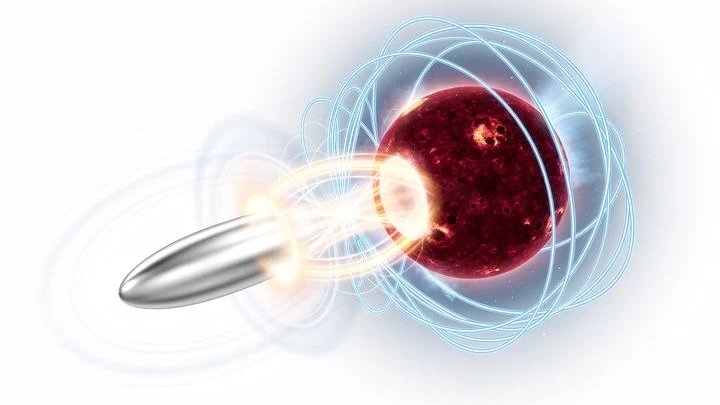
The white dwarf's strong gravity strips hydrogen-rich gas from the companion star, which often fills its Roche lobe — the teardrop-shaped region where material is gravitationally bound to the white dwarf. The gas spirals inward, heating up as it falls, and accumulates in the disk. In systems with a magnetic white dwarf, the flow is channeled to the poles instead, creating pulsed X-ray and optical emission. When the disk reaches a critical density, a thermal instability triggers a rapid dump of material onto the white dwarf's surface, igniting a thermonuclear flash or a disk brightening event.
In practice
Cataclysmic variables serve as natural laboratories for studying accretion physics, which applies to everything from planet formation to supermassive black holes feeding in galactic centers.
Fun fact
Some cataclysmic variables, like the recurrent nova T Coronae Borealis, can undergo thermonuclear explosions on their surface every few decades, making them predictable targets for amateur astronomers.
In a dense cloud of gas and dust where massive stars are born, two young stars recently passed very close to each other. Their dance has lasted only about sixty years, and astronomers have now seen it in detail for the first time.
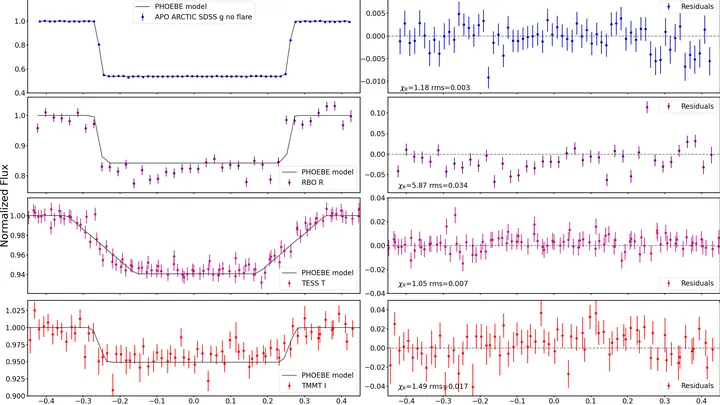
Every five hours in the binary system IPHAS J190812.63+045728.1, one star completely hides the other. For 18 minutes, the white dwarf and its scorching disk vanish from sight, leaving only a modest red neighbor in the dark. This is a natural shutter that switches off the spotlight to reveal what usually hides in its glare.
Every five hours in the binary system IPHAS J190812.63+045728.1, one star completely hides the other. For 18 minutes, the white dwarf and its scorching disk vanish from sight, leaving only a modest red neighbor in the dark. This is a natural shutter that switches off the spotlight to reveal what usually hides in its glare.
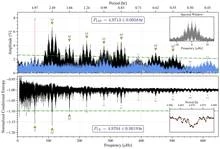
A star blinks every 38 seconds. This is no random twinkle: inside the white dwarf WD 0158−160, steady oscillations run like the beats of an invisible metronome. From the rhythm of those beats and the star's precise distance, astronomers have computed its mass and temperature — without ever looking at its spectrum.
A balloon that lets out air in bursts zips around the room — the jet blasts first one way, then another. A dying star behaves the same way as it sheds its bloated shell. Only instead of air, it's superheated gas, and instead of a balloon, it's a future white dwarf (the dense stellar remnant about the size of Earth).
Five thousand robotic fingers of the DESI spectroscopy reach toward the telescope's focus. In a single night, they record one hundred thousand light signatures. Hidden among these records are binary star systems with white dwarfs — cataclysmic variables.
Two figure skaters on a lake frozen to the horizon. They are so far apart that their silhouettes turn into dots, and their mutual attraction becomes almost an article of faith. By Newton's law, they should circle in an unimaginably slow waltz. But telescopes see otherwise.
The James Webb Space Telescope has peered into a strange binary world. Here, a dead star, a white dwarf, slowly roasts its companion, a brown dwarf. The object, named ZTFJ0038+2030, completes a full orbit in just a few hours. One side of the brown dwarf always faces the white dwarf, much like the Moon faces Earth.
Long-period radio transients (LPTs) are a mysterious class discovered only recently. Their pulses last minutes or hours, and their nature was completely unknown. ASKAP J1745-5051, caught by the Australian telescope ASKAP, became the first to get a full explanation.
Light passes through a crumpled film — and comes out slightly altered. In much the same way, gravitational waves born in the early universe feel the lumpy distribution of galaxies and dark matter.
A blob of cold helium swoops dangerously close to a black hole. But this isn't just a blob: it's a dead star the size of Earth, yet with a mass comparable to the Sun's.
A pendulum swings on its own, but sometimes it suddenly starts swinging so violently that it nearly breaks free from its mount. That's roughly how the white dwarf GD 1212 behaves — a star the size of Earth but with a mass almost like the Sun's.
In 1963, Maarten Schmidt unraveled the nature of quasars — distant active nuclei outshining entire galaxies. Since then, we've learned that at their hearts lurk supermassive black holes, converting infalling matter into blinding light.
In 2022, astronomers began discovering strange cosmic beacons — long-period radio transients. Unlike fast pulsars, discovered by Jocelyn Bell Burnell in 1967, these objects flared with periods of tens of minutes and hours.
Two burned-out stars, each about the size of Earth but heavier than the Sun, spiral ever closer until one crashes into the other. The impact triggers a thermonuclear explosion, giving birth to a type Ia supernova. Such flashes serve as cosmic beacons for measuring distances across the universe. Yet the details of their origin remain hotly debated.
When a neutron star and a black hole merge, they send out gravitational waves — ripples in spacetime that reach Earth. These ripples carry the imprint of their final dance: the orbit before the collision is often elongated, like an ellipse.
A lighthouse blinks steadily once per second. If it moves in a circle, its flashes arrive sometimes a bit early, sometimes a bit late, and they give away an invisible companion. That's exactly how astronomers exposed the hidden partner of the star IY Lyrae.
IY Lyrae is a pulsating variable star in the thick disk of the Galaxy.
Every 15 hours, in a constellation 57 light-years away, a miniature solar eclipse takes place. A tiny white dwarf — a star the size of Earth but heavier than the Sun — ducks behind the disk of a red dwarf. For astronomers, this is not just a pretty coincidence but a way to peek into the pair's past.
Double stars lose speed like a figure skater who slows their spin by extending their arms. In a close pair, one star transfers mass onto a white dwarf. The magnetic field of the donor star, consisting mostly of hydrogen, entangles the outflowing gas and flings it away, as if the skater's arms were pulling the spin outward.
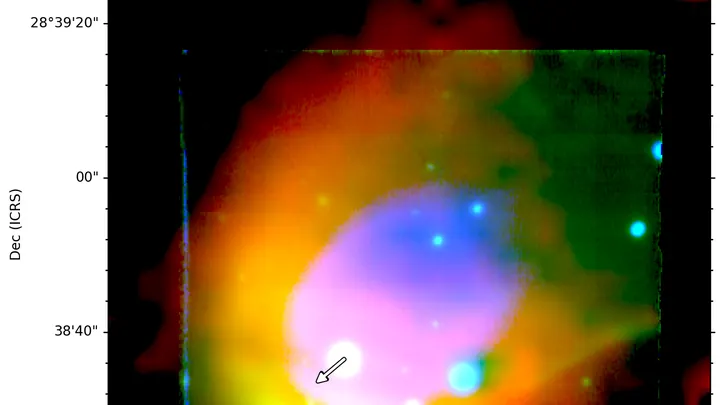
Around certain close binary stars, where a white dwarf siphons matter from its companion, astronomers have seen a glowing arc. They took it for a shock wave — the place where a fast stellar wind slams into interstellar gas. But new observations show: there's more than one arc.
The white dwarf WDJ165335.21-100116.33 is the cooled core of a star, about the size of Earth but with the mass of the Sun. On its surface, there is an unusual hot spot that appears and disappears. Astronomers long puzzled over why the star's brightness changes every 80 hours.
In the mid-20th century, astronomer Vera Rubin discovered that stars on the outskirts of galaxies were moving too fast — held by an invisible mass. Thus the mystery of dark matter was born. It doesn’t emit light but reveals itself through gravity. The big question: why is there exactly as much as we see?
Eclipses in binary stars are like clockwork: a white dwarf (the dense remnant of a star) regularly passes in front of its companion, and the light briefly dims. But for most such pairs, the clock runs fast or slow by seconds over years. Astronomers measured these glitches in 43 systems and found a pattern.
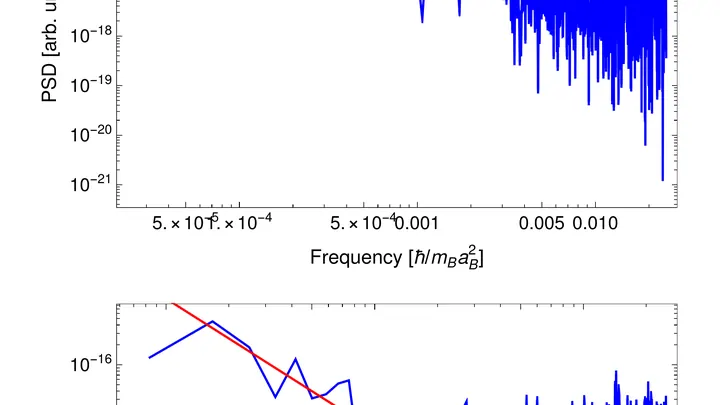
A red giant in the constellation Cygnus has swelled so much that its outer layers are spilling onto a small but heavy neighbor — a white dwarf. The gas swirls around the dwarf like water down a bathtub drain, falling onto it. But in CH Cygni, this flow is not calm: every 682.5 seconds, the X-ray emission flares and fades.
In the dense core of the globular cluster NGC 6397, where stars jostle like commuters at rush hour, astronomers have spotted a peculiar pair. One star is a white dwarf with a surface temperature of 16,000 K, the scorched remnant of a star that has been cooling for billions of years, and circling it is an unseen companion.
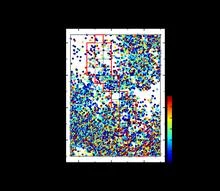
Someone has thrown an invisible stone into the stellar pond of the Milky Way. The ripples spread not through water but through the motion of stars: in a region 200 by 50 parsecs across, their average vertical velocity is 7 km/s lower than that of their neighbors. The deviation is statistically significant at the 6σ level, so chance cannot explain it.
Four hours and fifty-eight minutes. With a rhythm like a metronome, something passes in front of the white dwarf ZTF J1944+4557, dimming its light by a third, sometimes almost by half.