Quark matter is a state of matter in which protons and neutrons — the particles that make up atomic nuclei — dissolve into their constituent quarks. Under normal conditions, quarks are permanently confined inside hadrons by the strong force, but at extremely high temperatures or densities, this confinement breaks down. The result is a dense, interacting sea of quarks and gluons, often called quark-gluon plasma.
History
The concept of quark deconfinement was proposed in the 1970s, with early theoretical work by John Collins and Malcolm Perry (1975) and independently by others, suggesting that at sufficiently high density, matter might exist as a quark gas. The term 'quark-gluon plasma' was coined later, and experimental searches began in the 1980s.
How it works
At ordinary energies, the strong force binds quarks into triplets (baryons like protons and neutrons) or pairs (mesons). When energy density exceeds a critical threshold — roughly a few hundred MeV per cubic femtometer — the vacuum itself changes, and quarks become deconfined. This transition is analogous to the melting of a solid into a liquid: the hadrons 'melt' into a plasma of their constituents.
In practice
Quark matter is studied in heavy-ion colliders like the LHC and RHIC, where gold or lead nuclei are smashed together to recreate conditions from the early universe, helping physicists understand the strong force and the evolution of the cosmos.
Fun fact
Neutron stars may have cores made of quark matter, making them the densest observable objects in the universe.
A ship in a bottle is assembled from the inside, not the outside: masts and sails are pulled through the narrow neck, and once inside the glass they settle into the right pose on their own. Chemists have done something similar with a single cobaltocene molecule, which they pulled into the gap between layers of a two-dimensional crystal.
At accelerators, by smashing heavy nuclei, physicists briefly create a quark-gluon plasma — a state of matter where quarks and gluons are not confined inside particles but are free. For a long time, it was imagined as a gas, but experiments showed it's an almost perfect liquid.
Inside a neutron star, matter is squeezed so hard that atomic nuclei stop being separate clumps. Neutrons and protons get closer together, and their innards, quarks, begin to feel their neighbors through the walls of their 'bags'.
A neutron star is a sphere about the size of a small city but with a mass of one and a half Suns.
If you try to break a proton apart and pull out a quark, you're in for a surprise. Ordinary forces, like the electric force, weaken as particles fly apart. Here, it's the opposite. The farther a quark gets from its neighbors, the harder it's pulled back.
A magnetar is a neutron star with a magnetic field hundreds of millions of times stronger than Earth's. If you brought an ordinary magnet near such a field, it would instantly lose its magnetism, and atoms would stretch into thin filaments.
Ten microseconds after the Big Bang, the Universe resembled a pot of boiling broth. Floating in it were quarks and gluons — the particles that would later assemble into protons and neutrons. As the broth cooled, at some point the quarks clumped together into lumps — the very protons and neutrons that make up all visible matter.
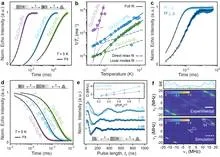
In a laboratory at Purdue University, a laser beam strikes a crystal of hexagonal boron nitride, and in response, a single point of light flashes. This is not just luminescence; it is a signal from a spin defect, a pair of electron spins, one of which is coupled to a carbon-13 nuclear spin.