A femtometer, also known as a fermi, is a unit of length equal to 10^-15 meters, or one quadrillionth of a meter. It is the natural scale for measuring the sizes of atomic nuclei and the distances between nucleons (protons and neutrons) within them. For example, a proton's diameter is about 1.6 femtometers, and the nucleus of a heavy atom like uranium spans roughly 15 femtometers. This unit is essential for describing the strong nuclear force, which binds nucleons together, and for interpreting experiments that probe nuclear structure.
History
The unit was named after Enrico Fermi, the Italian physicist who pioneered nuclear physics in the 1930s. The term 'fermi' was formally adopted in the mid-20th century, and 'femtometer' became the standard SI-derived name later.
How it works
At the femtometer scale, the strong force dominates over electromagnetism, which is why nuclei can hold positively charged protons together. Physicists use scattering experiments—firing particles like electrons or pions at nuclei—to map out charge and matter distributions at this scale. The results are often expressed in femtometers, allowing researchers to compare theoretical models of nuclear forces with precise measurements.
In practice
Femtometer-scale measurements are used in nuclear medicine for designing radiation therapies, in particle physics for calibrating detectors, and in astrophysics for modeling neutron star interiors.
Fun fact
The femtometer is so small that a single human hair is about 50 billion femtometers wide.
Systems:SIDefined as exactly 1e-15 meters, accepted for use with SI.
Inside an atomic nucleus, protons and neutrons don't sit still like peas in a pod. Each particle occupies its own orbit — a region of space where it can be found. The larger the orbit, the more 'smeared out' the particle is.
An electron beam is a stream of tiny particles carrying an electric charge. When such a beam hits a material, it doesn't just heat it or knock out atoms: it also gives the surface a slight push, like a jet of water pushing against your palm.
The neutron is one of the most neutral particles in nature. But if you add a special parameter to the laws of physics, called the theta term Standard Model, a tiny charge imbalance appears inside the neutron. One edge becomes slightly positive, the other slightly negative.
A stone falls into water, and ripples spread in all directions. Throw a handful of stones at once, and the ripples overlap: you can no longer tell which ripple came from which stone. A neutron beam hitting a detector looks much the same: a bright spot blurred by many causes.
Atomic nuclei are rarely perfect spheres. More often, they resemble a slightly squashed ball — the electric charge inside is unevenly distributed, and protons may shift a bit, creating a tiny 'pear-shaped' bulge.
The James Webb Space Telescope peered into the era when the expansion of the Universe stretched the light of distant objects into the red, and found a scattering of strange sources — 'little red dots'. Their spectra broke the usual patterns: they are blue in the ultraviolet, but deep red in the optical, as if seen through a cherry veil.
An invisible fence blocks the strait. You can't climb over it or dive under it: it's not made of steel, but of a stream of particles penetrating the water column. That's one way to describe the idea of detecting nuclear submarines by their antineutrino emission.
Two tin nuclei collide at about two-thirds the speed of light. For an instant, a hot, dense cloud forms, and protons fly out in all directions. If you catch pairs of protons and measure how often they fly off in the same direction, you can work out the size of that cloud. This method is called femtoscopy: it works like a microscope for nuclear scales.
Neutrinos are the most abundant massive particles in the universe. Trillions of them pass through us every second, yet they leave barely a trace. Their collective gravity, though tiny, can influence the motion of entire galaxies. Think of two people approaching each other on a busy street; invisible passersby alter their speed.
A uranium nucleus is like a tight wallet snapped shut on two halves. To make it burst and release energy (that is, to make the nucleus split) you have to climb over an energy barrier. The height of this threshold determines whether a substance is stable or ready to fall apart at any moment.
A giant sphere filled with liquid flashes when an elusive particle, a neutrino, flies through it. Inside the sphere, like fireflies on a Christmas tree, hang thousands of tubes that catch these flashes. To pinpoint exactly where the flash occurred and how much energy arrived, you need to know the position of each tube to within a millimeter.
Light twisted in one direction hits a proton. The particle can absorb the photon or deflect it — depending on how its own spin, a tiny internal top, is oriented. In the experiment at the MAMI accelerator in Mainz, a beam of polarized photons struck targets of polarized protons and deuterons (nuclei of heavy hydrogen).
A neutral-atom quantum computer is like a library where books not only need to be read but also quickly returned to the shelf. Slow readout of results is like a sluggish librarian holding up the entire queue. Scientists have found a way to speed up this process by adding helpers.
Neutrinos are tiny particles that pass through the planet's bulk like light through a windowpane. Every second, billions of them fly through your pinky fingernail, but catching even one is no easy feat. To do it, scientists dug a two-kilometer-deep mine in Canada and installed the SNO+ detector.
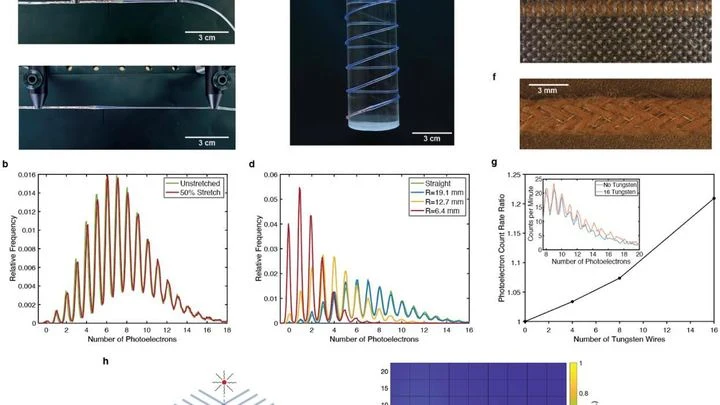
Inside an ultra-thin polymer thread are microscopic crystals — scintillators. When an invisible radioactive particle hits, they flash for a moment, like fireflies. A sensitive sensor catches each flash, turning the thread into a flexible detector.
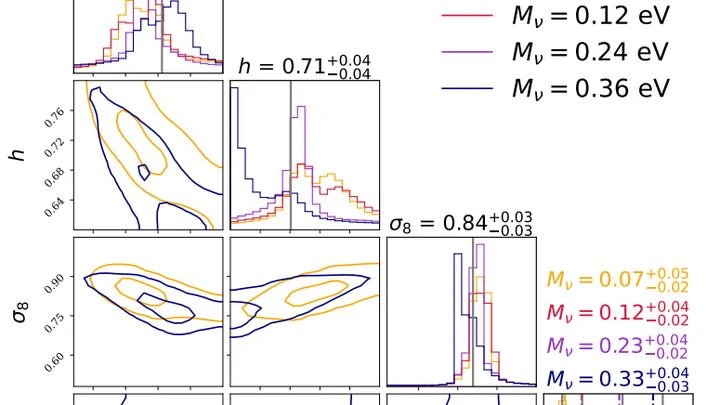
The Universe is a colossal web of invisible dark matter and galaxies, stretched by the expansion of space. Neutrinos, nearly intangible ghost particles, barely cling to the threads, but their collective mass subtly shifts the tension of the entire network.
The atomic nucleus is not just a ball of protons and neutrons. Inside it, like a tiny magnet, there is its own distribution of magnetization. Until now, it has been difficult to see: nuclei live for tiny fractions of a second, and their magnetic field is weak. Now physicists at CERN have found a way to look inside.
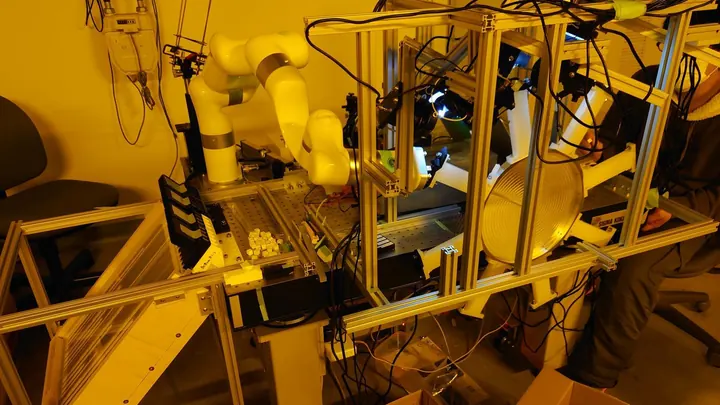
The future neutrino detector will contain millions of tiny plastic cubes: each the size of a die. They flash when a ghostly particle passes through, and that flash must be captured and measured. But if a cube is warped, has a burr, or a hole in the wrong place, the signal gets distorted, and the detector starts lying.
Checking each cube by hand is like sifting through sand on a beach.
A tiny ghostly particle zips through a piece of germanium. Usually it leaves no trace, but sometimes, like a billiard ball, it smacks into an atom's nucleus. The nucleus recoils, and that jolt can be detected. At Oak Ridge National Laboratory, the Ge-Mini detector caught such recoils for two years.
Neutrinos are the most elusive of known particles.
A customs officer can't take a suitcase apart to see what's inside. They shine X-rays through it and, from the shadows on the screen, tell: here's metal, here's organic matter. In much the same way, an inspector for future nuclear disarmament treaties should be able to check a warhead — without opening it or seeing its secret internals.
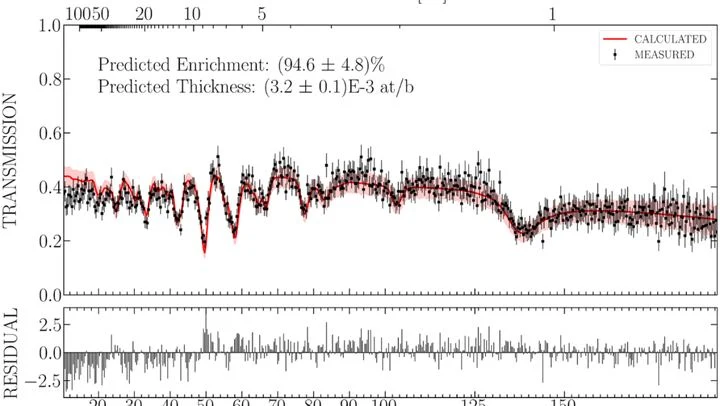
Neutrons are better suited for this than X-rays.
The proton is not a solid ball. Its charge, mass, and other properties are distributed differently in space, and each property has its own radius. Physicists have long been able to measure where the proton's charge is concentrated and where its mass lies.
When a proton beam enters a patient's body, it slows down and generates a stream of neutrons, like a pebble thrown into water scattering droplets. Doctors use these neutrons to check at what depth the protons stopped, ensuring the irradiation hits the tumor precisely and spares healthy tissue.
Neutrinos are the most elusive of all known particles. Every second, trillions of neutrinos from the Sun fly through your body, but you never notice: they barely interact with matter. To catch even one, physicists build giant detectors — pools of water or liquid argon deep underground.
The theory of gravity by Einstein — general relativity — rarely intersects with quantum physics in direct experiments. Here, scientists built a 50-kilometer glass labyrinth on a table and sent single photons through it.