Anisotropy is the property of a material or physical system where a certain quantity—like elasticity, electrical conductivity, or optical response—depends on the direction in which it is measured. In everyday life, wood is a classic example: it is much easier to split along the grain than across it, and its stiffness differs accordingly. Carbon fiber composites are engineered to be strong along the fiber direction but weaker perpendicular to it, making anisotropy a design feature rather than a flaw. In physics, anisotropy appears across scales, from the layered structure of two-dimensional crystals to the behavior of light in anisotropic media, where the refractive index varies with polarization and propagation direction.
History
The concept of anisotropy in elasticity was formalized in the 19th century, notably by Augustin-Louis Cauchy and George Green, who developed the tensor description of elastic constants. The term itself derives from the Greek 'anisos' (unequal) and 'tropos' (direction).
How it works
Anisotropy arises when the underlying structure of a material—its crystal lattice, molecular alignment, or internal geometry—has a preferred direction. For example, in a layered crystal, atoms are tightly bonded within planes but weakly bonded between them, so mechanical and electronic properties differ dramatically along versus across the layers. Mathematically, anisotropic properties are described by tensors rather than simple scalars: for elasticity, a fourth-rank tensor relates stress to strain, and its components change when the material is rotated. This directional dependence can be exploited to control wave propagation, as in optical crystals where birefringence splits a light beam into two polarized components traveling at different speeds.
In practice
Anisotropic materials are used in aerospace and automotive components (carbon fiber composites), in optical devices like waveplates and polarizers, and in seismic imaging, where the anisotropic propagation of waves through the Earth's crust must be accounted for to locate oil or earthquakes accurately.
Fun fact
Wood's anisotropic elasticity is why it is used in musical instruments: the directional stiffness of spruce, for instance, allows sound waves to travel fast along the grain but slow across it, shaping the instrument's tone.
A crowd at the entrance to a narrow corridor behaves differently than in a spacious hall: some people get pressed against the walls, others are pushed forward. Roughly the same happens when an elongated particle finds itself in a fluid teeming with self-propelled dumbbells. Until now, it was unclear why such a particle moves faster along its long axis than across it, and how the crowd density affects its speed.
The night sky looks serene, but it is actually pierced by an invisible rain of charged particles: cosmic rays. Scientists have long tried to figure out where the most energetic ones are born. Until recently, it was thought that our Galaxy supplies particles up to about 4 EeV, the so-called "ankle" in the spectrum.
Light born when a fast electron enters a material is usually assumed to be the same in all directions. But in crystals where optical properties depend on direction, that's not the case. Run your hand over velvet: one way it's smooth and shiny, the other — dark and rough. Similarly, a crystal responds differently to light depending on how it's oriented.
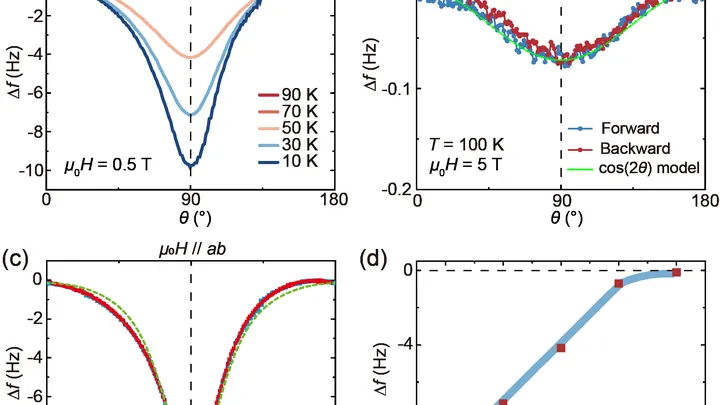
The crystal is like a city with different streets: on some, cars drive fast and far, on others, they crawl and get stuck. In the layered material CrPS₄, magnetic waves that carry spin (a particle's intrinsic angular momentum) behave the same way.
Toss a handful of sand onto a table — the grains scatter equally in all directions. But if a magnet is hidden under the table and the sand is iron, the trajectories get trickier: an invisible structure overlays the chaos. That's roughly how molecular motion works inside a living cell.
Two cities with the same average population density. In one, a neat grid of blocks; in the other, a maze of narrow alleys and unexpected squares. On a global map they look like twins, but life inside flows quite differently.
The cell membrane is not a calm boundary but an arena of relentless Brownian motion. Water molecules, ions, and small metabolites collide chaotically, creating constant pressure on the cell's surface. A new model shows that it is this molecular jostling, not just chemical affinity, that triggers particle uptake, a process known as endocytosis.
The cosmological principle, the axiom that the Universe looks the same in all directions on large scales, is like a quiet bass hum that sets the tone for the entire symphony of structures.
Spacetime is like a giant sheet of paper. Fold it, and distant corners come together. Poke a pencil through, and you get a wormhole, a short tunnel through the folds. But the paper wants to spring back flat, snapping the passage shut. To keep it open, you need a rare “gasket”—matter with negative energy.
Gravitational waves are the trembling of spacetime itself. Usually we only catch their overall hum, but each wave also has a direction of oscillation – polarization. Old maps were built only from signal loudness, which led to errors. It's like trying to see the bottom of a pond through sun glare.
Cosmology holds that on large scales, the Universe is a calm ocean without storms or currents. This is the cosmological principle, the foundation of the standard ΛCDM cosmological model.
Imagine a vast lake at night, perfectly still. You can't see waves, but you hear them lapping evenly on the shore from all sides. That's what astronomers call the gravitational-wave background — a constant hum from distant black hole mergers. But what if the splashing were slightly louder on one side?
Shine light on an FePS3 crystal, and it responds with its own glow, like a neon sign, but much fainter and in the infrared range. This glow is not random: it depends on how the crystal is oriented. The scientists took samples from a thick chunk down to a single-atom layer and observed four emission bands — at 1.24 electronvolts, 1.79, 2.3, and 2.56.
A thin film for a solar cell or display is like a dense crowd in a square: each person faces a different direction, and whether light passes through the crowd or gets stuck depends on which way everyone is looking. In organic electronics, molecules play the role of passersby. Until now, instruments could only measure the crowd's overall direction — the average head tilt and its spread.
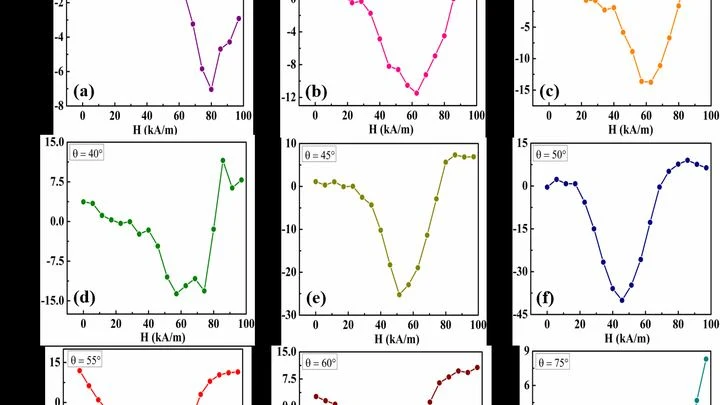
A piece of zinc oxide film lies on a table. A magnet is brought near, and slowly rotated around the film. The film, thinner than a human hair, begins to change its dimensions: now contracting, now stretching. This property is called magnetostriction — the ability of a material to deform under a magnetic field.
A magnet, like a compass needle, likes to point in a certain direction. But what if the material is layered, like a stack of pancakes? Scientists took just such a magnet made from a compound of chromium, germanium, and tellurium and set out to find out how stubbornly it resists having its magnetization turned.
A river flows in one direction, but a wave on its surface travels in the opposite direction. The same splitting happens in hyperbolic materials: the energy of a light wave and its fronts diverge, preventing a sharp lens from being created.
When you press your finger on a piece of soft putty, it obediently dents and then slowly returns to its original shape. But if you press on a window pane, it either holds or cracks — no smooth deformation. Both materials are amorphous: their atoms are not arranged in a strict crystal lattice like in metal. Yet they behave completely differently.
In a thin layer of a crystal, electrons behave differently than in an ordinary piece of metal. They are cramped, collide with each other more often, and feel the shape of the lattice more strongly. Usually, such states are created artificially by stacking layers of different materials. But sometimes nature does it all by itself.
Light passing through a window pane refracts the same in all directions. But in thin layered crystals, it's a different story: light traveling along the layers sees the material differently than light traveling across them. It's as if a sheet of paper were transparent but transmitted light differently along and across its fibers.
Water in a puddle after rain swirls differently than in a deep lake. A thin layer of fluid feels the bottom, and that changes the nature of its vortices. Scientists created such a layer in the lab: they poured in an electrolyte, ran a current and a magnetic field, and the fluid began to move.