Permittivity is a material property that quantifies how an electric field affects and is affected by a dielectric medium, influencing charge interactions and electronic behavior.
Dielectric permittivity (ε) characterizes the ability of a medium to polarize under an electric field and weaken it. In vacuum, the electric constant ε₀ ≈ 8.85·10⁻¹² F/m. The relative permittivity εᵣ = ε/ε₀ shows how many times weaker the interaction of charges in the medium is compared to vacuum. For water, εᵣ ≈ 80, which explains water's high dissolving power for ionic compounds.
History
Ideas about dielectric permittivity date back to Henry Cavendish's experiments (late 18th century) and systematic studies by Michael Faraday (1837), who introduced the concept of 'specific inductive capacity'. The term 'dielectric permittivity' was proposed by William Thomson in 1845. James Clerk Maxwell (1862) mathematically linked ε and the speed of light c = 1/√(ε₀μ₀), demonstrating the electromagnetic nature of light. Later developments in quantum theory of polarizability (by Hans Bethe, Lars Onsager) allowed computation of ε from molecular properties.
How it works
An applied electric field E causes displacement of charges in the dielectric: electron shells deform (electronicpolarization), ionic lattices shift (ionic polarization), permanent dipoles orient (orientational polarization). Each mechanism creates a dipole moment, and the macroscopic polarization P is the sum of moments per unit volume. Dielectric permittivity ε relates electric displacement D = ε₀E + P = ε₀εᵣE. In alternating fields, a phase shift occurs between displacement and field, leading to dielectric losses. The Lorentz oscillator model or the Debye relaxation model is used for description.
In practice
A capacitor in electronics stores charge better the higher the dielectric permittivity of the insulator between the plates; without it, smartphones would be the size of a suitcase.
Fun fact
Thanks to the huge dielectric permittivity of water (about 80 at room temperature), table salt readily dissolves into ions — water seems to pull the ions apart, weakening their bond by a factor of 80.
The electron beam of a microscope usually flies through emptiness, like a courier on an empty highway. Any air molecule is a bump that makes it bounce and lose direction. So before, to examine a sample, you had to freeze it, dry it, or coat it with metal—and still you could only look in a vacuum.
A plastic film as thin as a hair, and inside it — platinum dots smaller than a millionth of a millimeter. These dots sit at the boundary between two transistor layers and catch electric charge like a sponge catches water. As charge accumulates, the transistor changes its resistance, and remembers that state.
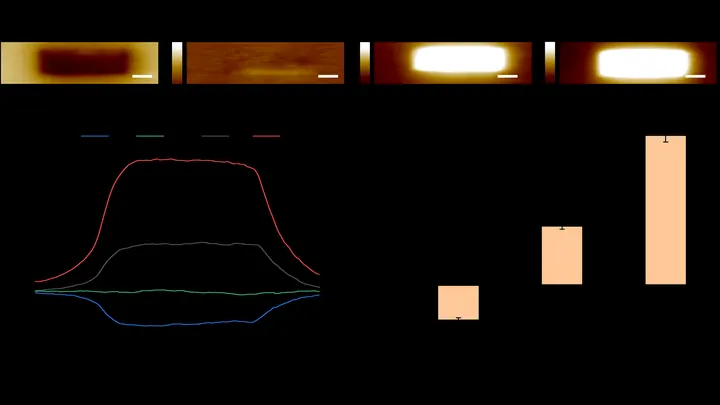
An electron beam is a stream of tiny particles carrying an electric charge. When such a beam hits a material, it doesn't just heat it or knock out atoms: it also gives the surface a slight push, like a jet of water pushing against your palm.
A perovskite solar cell is like a young athlete: it performs brilliantly at first, but tires with age. Over eight hours, its performance drops noticeably, with no visible cause like cracks or dust. Scientists took one cell and recorded its performance at 0, 90, 280, and 480 minutes of its life.
Water is not just a wet substance. On a picosecond scale, it resembles a dance floor where molecules continuously break and form bonds with each other. Usually, this dance is described by one main movement — collective relaxation, as if the whole crowd simultaneously slows down after the music stops.
A rubber band that gets thicker the harder you pull it. In electricity, this behavior is called negative capacitance: the more charge accumulates on the plates, the lower the voltage. A regular capacitor works the opposite way — voltage rises with charge.
Two grains of salt fall into a glass of water. They dissolve, and sodium and chloride ions spread throughout the volume. The schoolbook truth is simple: like charges repel, opposite charges attract. But recent experiments with tiny spheres in liquids have revealed a picture that breaks this rule.
Two paper-thin sheets of a semiconductor are stacked and slightly rotated — by about three to four degrees. The atomic lattices don't match, creating a large-scale pattern — a moiré, like the ripples from two washboards shifted by a small angle. In this pattern, electrons move quite differently than in a regular crystal.
A palm hovering over a hot stove feels the heat even when the surrounding air seems cool. Something similar happens to electrons in the Aharonov–Bohm effect: the particle senses an electric voltage even though it enters a region where the field has already been switched off.
Light leaves a trace even when there is almost none of it. A single photon, a tiny bundle of energy, strikes a silicon wafer and knocks out a handful of electrons. The trouble is that the handful is too small to notice. You need an amplifier.
Usually, the signal is amplified by applying a voltage to metal contacts on the detector's surface.
An ordinary phone battery breathes — not with air, but with contact. Inside a solid body, where there are no liquids, lithium presses against the electrolyte (the ion-conducting substance) during charging and pulls away during discharging, like a lung on inhale and exhale. This 'breathing' is not poetry but physics: each cycle creates and destroys the contact points through which current flows.
A drop of water stretches in a strong electric field. The deuterium nucleus, a bound pair of a proton and a neutron, behaves the same way, except here the field comes from a passing gamma ray, and instead of just stretching, the nucleus can simply fall apart.
Inside a piece of metal, electrons don't sit still: they move like water in a river. But you can't see this motion directly; it's too fast and too small. Scientists devised a workaround: they take 'frozen snapshots' of the electron liquid at different temperatures, then reconstruct how the electrons moved from those snapshots.
Inside a glass capsule the size of a pea, rubidium atoms float. A laser beam puts them into a special state — Rydberg — where the electron flies far from the nucleus, making the atom extraordinarily sensitive to external fields.
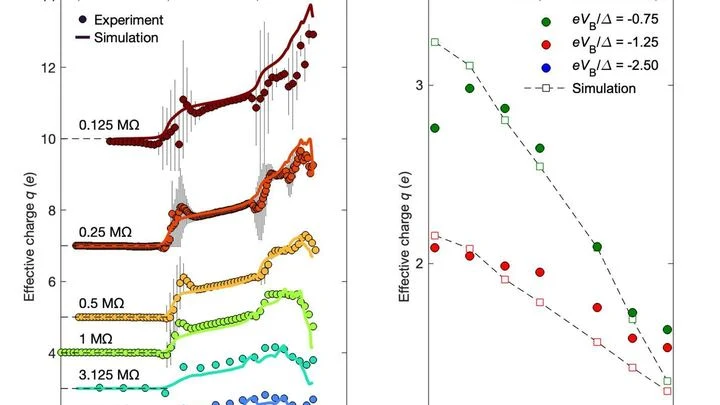
Current flowing through a wire is never perfectly smooth. If you listen closely enough, you hear a rustle — shot noise. It arises because charge is not carried as a continuous stream but in discrete portions, like raindrops on a roof. From the character of this noise, you can tell how much charge each 'drop' carries.
A thin semiconductor layer at low temperatures behaves like a pot of honey: electrons flow not as individual particles but as a thick liquid. If you run an alternating current through such a layer, the resistance responds with a smooth curve.
A water droplet on a leaf disappears faster under the sun than heat calculations would predict. A few years ago, a hypothesis emerged: light itself, without heating, could knock water molecules off the surface. This was dubbed the photomolecular effect. If it exists, clouds, climate, and even everyday clothes drying could work differently.
When two different materials are pressed together and then pulled apart, a spark jumps between them. Anyone who has pulled off a wool sweater in the dark or gotten a shock from a doorknob knows the feeling. For a long time, it was thought that charges simply hop from one surface to another due to differences in material properties.
Light hits a thin film, and an electric current instantly appears in it. This is how a pair of two materials works: molybdenum disulfide and cobalt. The first is a semiconductor, the second is a magnet. Between them, as it turns out, an invisible intermediary layer is born.
An electron beam can be compared to the light from a laser pointer: if it diverges, the spot on the wall quickly spreads out. In the lab, physicists created such a narrow beam that it remained thin over a long distance, like the beam of a good pointer.
In a thin sandwich of gallium arsenide, electrons don't behave like individual balls but like a single quantum liquid. If the layer is made just 70 nanometers thick, this liquid separates into two nearly independent flows, like oil on water.
A flexible screen as thin as a human hair is glass you can bend. But this marvel has a quirk: touch it, and an invisible electric charge lingers on the surface. Like dust on polished furniture, it builds up and interferes with operation.
In a lithium-sulfur battery, sulfur tends to dissolve and drift toward the other electrode — the battery loses charge within dozens of cycles. To hold the runaway in check, a separator film is placed between the electrodes. A standard polyethylene film lets lithium ions through, but sulfur molecules slip along with them.
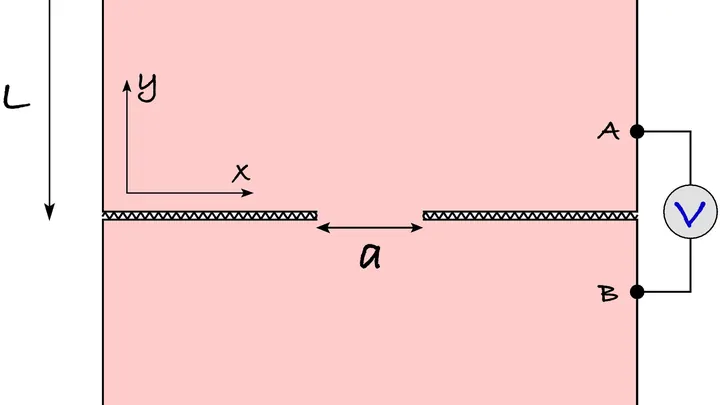
If you force water through a narrow neck, the flow speeds up right at the edge, and a whirlpool forms behind the obstacle. Electrons in ultra-clean two-dimensional materials, such as a thin layer of graphene, behave in much the same way.
The electron is a tiny particle, but inside a crystal it behaves as if it had a different mass. Physicists call this the effective mass. To measure it, they make electrons run in circles in a magnetic field, like a speed skater on an ice rink who is kept from leaving the orbit.
According to the laws of the microworld, an electron obeying the Dirac equation trembles even at complete rest. This is Zitterbewegung — an oscillation with an amplitude of trillionths of a millimeter, like a spinning top on an invisible axis.