Scientist

Georg Ohm

1789–1854 · Physics, Electrical engineering
German physicist who discovered the fundamental law of electric circuits—Ohm's law, relating voltage, current, and resistance. His work laid the foundation for quantitative analysis of electric circuits.

Biography

Georg Simon Ohm was born in Erlangen, the son of a locksmith. He received home education, then studied at the University of Erlangen, but did not complete the course due to financial difficulties. He worked as a mathematics and physics teacher in various schools. In 1826 he published his main work, “Determination of the Law According to which Metals Conduct Contact Electricity,” in which he formulated Ohm's law. His discovery was not immediately recognized; it was only in 1841 that the Royal Society of London awarded him the Copley Medal. From 1849 he was a professor at the University of Munich.

Key discoveries

💡 Initially, the scientific community rejected Ohm's law, and he had to resign from his school position. Recognition came only years later, after experiments by other scientists confirmed his conclusions.
Concepts
electromagnetismsuperconductivity
Laws
Ohm's law
Scientists
James Clerk MaxwellShuji NakamuraWilhelm WienSatyendra Nath BoseAlbert A. MichelsonRichard FeynmanJ. J. ThomsonLise Meitner

Related articles

Mesoscale2026-03-221 minarXiv:2603.21346express
Electron liquid heats up and thickens
A thin semiconductor layer at low temperatures behaves like a pot of honey: electrons flow not as individual particles but as a thick liquid. If you run an alternating current through such a layer, the resistance responds with a smooth curve.
eess.SY2026-07-151 minarXiv:2607.13889express
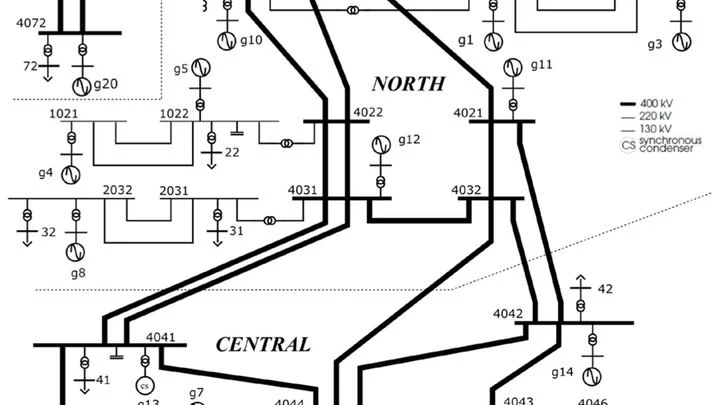
How a Simple Equation Saves the Power Grid
The power grid can be pictured as a water supply system: pipes are the lines, and pumps are the converters. When pressure (voltage) drops in some district, powerful pumps can send extra water (power) there. The trouble is, too strong a flow causes overload, and too weak a flow doesn't help. You need to know exactly how far to open the valve. Engineers found the answer.
Materials2026-07-262 minarXiv:2607.23484express
Two Channels for Electric Current in Actinides
The river splits in two. One branch is wide and fast, with water flowing smoothly, but as temperature rises, the flow slows: eddies and waves appear. The second branch is narrow, with rapids, where water leaps from rock to rock. This flow, on the contrary, becomes more lively with warming.
Superconductivity2026-08-162 minarXiv:2608.15911express
The Switch That Won't Turn Off
Inside an MRI magnet, current flows through a closed superconducting loop, like water circling in a bucket after you give it a spin, it just keeps going on its own. To change that current, you heat the loop with a small heater: it stops being superconducting, becomes an ordinary resistor, and then an external source can 'top up' or 'draw off' current.