Conservation of electric charge is one of the fundamental pillars of physics, alongside conservation of energy. The idea that electricity is not created from nothing was first clearly expressed by Benjamin Franklin in the mid-18th century while studying static electricity. Later, Michael Faraday confirmed this in electrolysis experiments: the mass of substance deposited depends strictly on the passed charge. Modern physics explains the law through gauge symmetry (a certain kind of mathematical symmetry of the world), as proved by Emmy Noether.
History
The idea of conservation of electricity arose in the work of Benjamin Franklin in 1747. He introduced the concept of positive and negative charge and postulated that during friction, one body transfers an 'electric fluid' to another. Michael Faraday in the 1830s experimentally proved the constancy of charge in electrolysis: the mass of substance released at an electrode is proportional to the passed charge. In the early 20th century, the law gained theoretical justification thanks to Emmy Noether's theorem, which linked it to the gauge invariance of electrodynamics.
How it works
The law is applied in all areas of physics and engineering where electrical phenomena occur. It underlies Kirchhoff's first rule (the sum of currents at a node is zero), explains the impossibility of annihilation of a single electron without a positron, and also guarantees that batteries, generators, and lightning only transfer charge, not create it. No violation of the law has been detected in any experiment, including high-energy particle collisions, although theoretically under extreme conditions (e.g., black hole evaporation), the creation of charged particles is possible but balanced.
In practice
This principle underlies all electronic circuits: the current at a node sums to zero (Kirchhoff's law), and also explains why a battery does not lose charge but merely transfers it from one electrode to another.
Fun fact
The most vivid example is the birth of an electron-positron pair from a photon. The particles appear from 'nothing', but the total charge remains zero: -1 for the electron and +1 for the positron.
In the Moon's polar craters, where sunlight never reaches, regolith may accumulate electric charge for decades, buried deep below the surface. It's like a bank account where deposits and balance don't match: a particle delivers energy, but the charge doesn't always stay put.
In some crystals, electrons are not spread uniformly but arrange themselves into a strict checkerboard: one cell has more electrons, the neighboring cell has fewer. Such a pattern is called charge order, and for a long time it was considered something frozen, like a pattern on frosty glass.
Inside an MRI magnet, current flows through a closed superconducting loop, like water circling in a bucket after you give it a spin, it just keeps going on its own. To change that current, you heat the loop with a small heater: it stops being superconducting, becomes an ordinary resistor, and then an external source can 'top up' or 'draw off' current.
The Kerr-NUT black hole is not just a cosmic vacuum cleaner. It's a solution to Einstein's equations where the hole has mass, rotation, and a strange NUT parameter. This parameter behaves like a magnetic charge for gravity: seemingly invisible, yet it alters the properties of surrounding space.
Electric charge is a slippery thing. You can measure how much there is in the entire universe or in a single particle, but try to point your finger and say, 'Right here, in this cubic centimeter, there is exactly this much charge right now,' and you hit a fundamental wall.
The issue is that total charge, which physicists denote by the letter Q, is nonlocal.
Ordinary electric current heats up wires — anyone who has touched a phone charger knows that. But there's another kind of current: instead of electrons rushing in a crowd in one direction, they spin in sync, like figure skaters in a pairs routine. This coordinated rotation is called a spin current, and it produces almost no heat.
A stable system behaves like a ball in a bowl: give it a push, and it rolls back to the bottom. The spread of possible trajectories, uncertainty, shrinks over time. But the speed depends on the slope of the bowl's walls. In complex systems, this 'bowl' has sections of varying steepness.
A runner on the middle of a track suddenly switches to a walk — not speeding up or slowing down, but maintaining a constant pace. Something similar may have happened to the universe itself shortly after the Big Bang.
Electric charge is not like a number chiseled in stone. In the vacuum around any charged particle, pairs of particles and antiparticles are constantly born and annihilated, like the foam in a glass of champagne. The bubbles screen the true charge, making it appear smaller or larger depending on how close we get.
Quantum batteries harness quantum effects to circumvent the limitations of ordinary devices imposed by entropy — a measure of disorder and energy losses. Imagine a bucket under a powerful jet: filling is lightning-fast. But the bucket has holes: the environment constantly drains the energy.
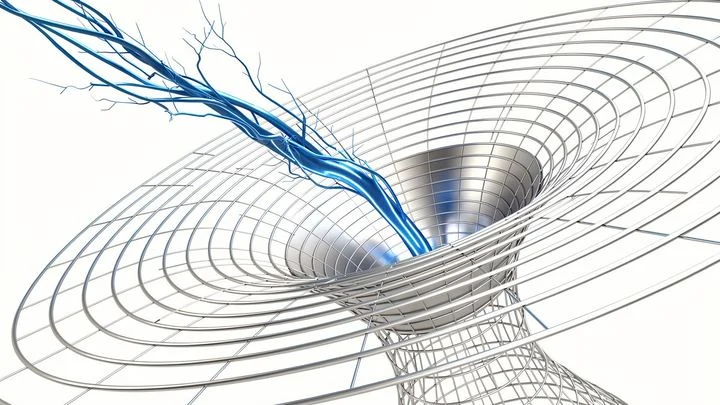
Since time immemorial, physicists have dreamed of tunnels piercing the cosmos — wormholes, capable of connecting far-flung corners of the Universe in an instant.
On the table sits a glass of water. For each molecule, all directions are equivalent: it doesn't distinguish north from south. That's symmetry. But if you freeze the water, the molecules align into an ice lattice, and symmetry breaks: a preferred direction emerges.
The quantum world breaks symmetry more cunningly. The glass freezes, yet each molecule still tumbles randomly.
A stone falls into a pond — near the shore, the ripples are barely visible, while the water churns at the point of impact. The electric field around a charge behaves similarly: close in, it's sharp and tangled, but at a distance it stretches into a smooth wave that carries energy away. Physicists call this distant region the radiation zone.
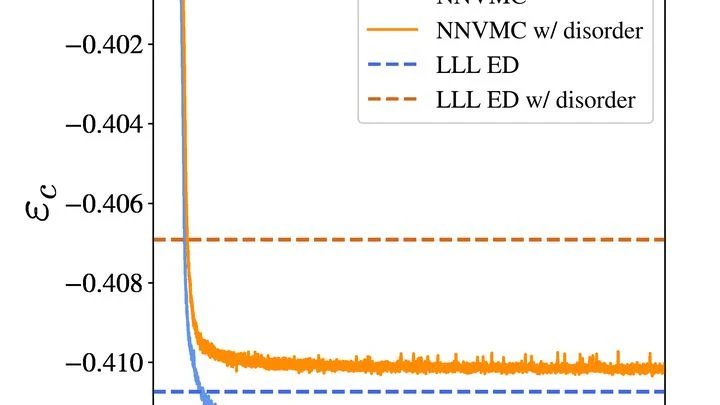
In a strong magnetic field, electrons trapped in a thin layer sometimes arrange into a regular pattern, like guests at a crowded party who find a spot where no one jostles them. This order is called a crystal, although it is not ice or salt, but the electrons themselves, frozen in place.
Water boils at 100 degrees Celsius, but if you squeeze it hard enough, it behaves differently. Similarly, quarks and gluons, the building blocks of protons and neutrons, change their properties in a strong magnetic field.
An electron flying through a gas is like a swimmer trying to cross a crowded pool. Each collision with an atom changes its course and speed. In dense argon gas, there are so many collisions that a simple description no longer works.
Physicists measured electron mobility — how easily electrons drift under an electric field.
A thin semiconductor layer at low temperatures behaves like a pot of honey: electrons flow not as individual particles but as a thick liquid. If you run an alternating current through such a layer, the resistance responds with a smooth curve.
A lithium battery is like a house with a storage room: during charging, lithium goes inside; during discharging, it comes out. But if the storage room gets cluttered, some lithium stays inside forever. How much lithium returns depends on the metal the walls are made of.
The authors of the study took four metals: aluminum, magnesium, silver, and copper.
According to ordinary mechanics, an electron in an atom should spiral into the nucleus and crash into it, like a surfer losing speed and falling off the board. But atoms live for billions of years. Because space isn’t empty. Even in absolute vacuum, an invisible electromagnetic sea ripples — the zero-point field. Its waves continuously nudge the electron.
Quantum entanglement works like a leash: it ties particles together, but the length of this tether is strictly limited. In a chain of particles, heat plays the role of an impatient dog tugging at the leash — the hotter it gets, the shorter the distance over which the connection holds.
Run a current through a wire, and the wire heats up. Anyone who has ever touched a phone charger knows this. Physicists call this heating Joule heating, after James Joule, who in the mid-19th century measured how much heat electricity produces. Since then, the formula has been simple: the greater the resistance and the current, the hotter the wire.