Resonancia fatal: cómo las estrellas expulsan planetas exprés
Dos estrellas, acercándose en una danza cósmica, experimentan un balanceo adicional, consecuencia de la curvatura del espacio-tiempo (efecto predicho por Einstein). El planeta que las orbita también se balancea. A veces los ritmos coinciden: los empujones gravitacionales de las estrellas dan en el compás de la órbita planetaria, como manos que mecen un columpio. Esto es resonancia: la órbita se estira y el planeta sale despedido.
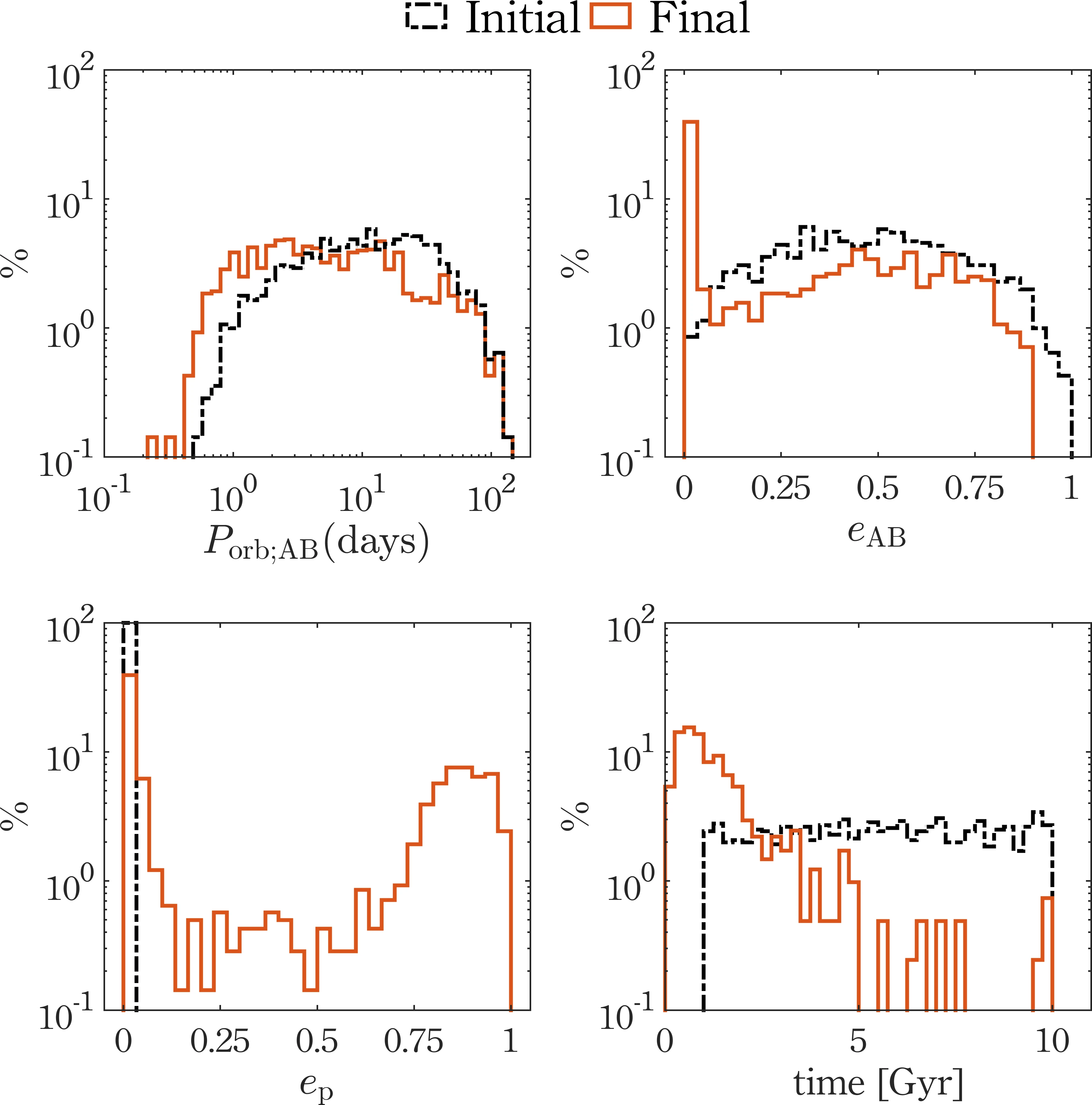
Así nacen los planetas errantes: ocho de cada diez planetas en binarias que se acercan caen en esta resonancia mortal, y tres cuartos perecen. Los restantes se esconden en la distancia. Por eso, en las parejas estelares con un período orbital menor de siete días no se ha encontrado ni un solo planeta: su misma convivencia cercana barre sin piedad todo a su alrededor.
Resumen original
tal como lo escribieron los autores, en inglés arXiv:2512.03940
Transiting circumbinary planets (CBPs) are conspicuously rare, and entirely absent around stellar binaries with periods $$\leq 7$$ days. Here, we exploit a secular resonance to stimulate the orbit of a CBP into strong, disruptive interactions with the host binary. The process requires no tertiary companion and is triggered when the general-relativistic precession of a tightening binary matches the Newtonian precession it induces in its companion planet. Adiabatic capture in this resonance sees the binary draining angular momentum from the CBP's orbit which grows steadily in eccentricity until destabilization, and eventual ejection or engulfment. We map this resonance in phase space, then investigate the dynamical outcomes of encounter in the course of tidally shrinking binaries. With the help of orbit averaged simulations of a suite of systems, we find that, around tightening binaries: eight out of ten CBPs encounter and are captured in the resonance; three out of four are `destroyed'; and survivors lurk on remote, low-transit-probability orbits. This suggests that the very process which forms tight binaries effectively clears the region where transiting CBPs could reside.
Algunas estrellas binarias completan una órbita en pocas horas: sus «días» son más cortos que una jornada laboral. Y la distancia entre ellas es menor que la del Sol a Mercurio.