Un magnetar polariza los rayos X hasta un 47% exprés
Las estrellas de neutrones son restos superdensos de supernovas del tamaño de una ciudad. En los años 1930, Fritz Zwicky propuso su existencia, y más tarde Jocelyn Bell Burnell descubrió los púlsares, estrellas de neutrones que giran rápidamente. Los magnetares son una variedad extremadamente rara, cuyo campo magnético es miles de millones de veces más fuerte que el de la Tierra. Es capaz de afectar al propio vacío.
Recientemente, el telescopio de rayos X IXPE captó la radiación del magnetar 1E 1547.0‑5408 y descubrió una propiedad inusual: casi la mitad de la luz oscilaba estrictamente en un mismo plano, como después de pasar por unas gafas de sol polarizadas. Pero si en la vida cotidiana la polarización la crea un filtro, aquí ese papel lo desempeñó el propio espacio. El campo magnético de la estrella convirtió el vacío en una especie de cristal que ordenó las ondas de rayos X. Este «cristal cósmico» ayudó a precisar la inclinación del eje magnético de la estrella: resultó que gira casi en ángulo recto.
Resumen original
tal como lo escribieron los autores, en inglés arXiv:2601.15452
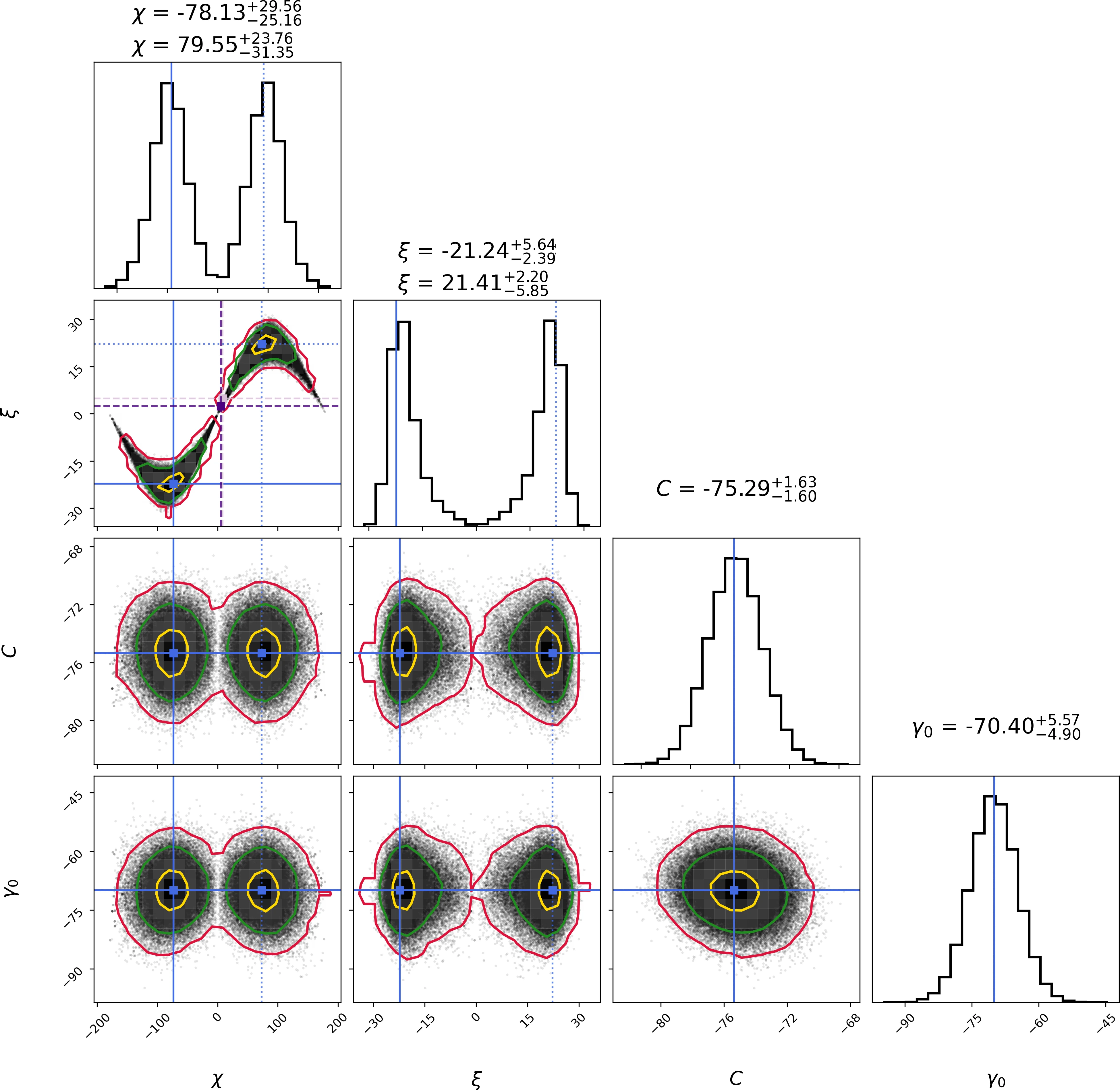
Magnetars are now known to be among the most strongly polarized celestial sources in X-rays. Here we report on the $$500\,\mathrm{ks}$$ observation of the magnetar 1E 1547.0-5408 performed by the Imaging X-ray Polarimetry Explorer (IXPE) in March 2025. The IXPE spectrum is well reproduced by a single thermal component with blackbody temperature $$kT_\mathrm{BB}\sim 0.67\,\mathrm{keV}$$ and emission radius $$R_\mathrm{BB}\sim 1.2\,\mathrm{km}$$. The source exhibits a high linear polarization degree in the $$2$$--$$6\,\mathrm{keV}$$ band ($$\mathrm{PD}=47.7\pm2.9\%$$) with polarization angle $$\mathrm{PA}=75^\circ.8 \pm 1.^\circ8$$, measured West of celestial North. While $$\mathrm{PA}$$ does not appear to vary with energy, there is some evidence (at the $$1\sigma$$ confidence level) of a minimum in $$\mathrm{PD}$$ between $$3$$ and $$4\,\mathrm{keV}$$, compatible with what is expected by partial mode conversion at the vacuum resonance in a magnetized atmosphere. Phase-resolved spectral and polarimetric analyses reveal that X-ray thermal radiation likely originates from a single, fairly small hot spot with a non-uniform temperature distribution. Fitting the phase-dependent $$\mathrm{PA}$$ measured by IXPE with a rotating vector model (RVM) constrains the source geometry and indicates that both the dipole axis and line-of-sight are misaligned with respect to the spin axis. Under these conditions, the high polarization of the source cannot be regarded as compelling evidence for the presence of vacuum birefringence in the star magnetosphere. Nevertheless, the fact that the RVM successfully reproduces the modulation of the X-ray polarization angle and the behavior of $$\mathrm{PD}$$ with the energy hint once more to the presence of QED effects in magnetars.
Un magnetar del tamaño de una ciudad tiene un punto caliente a millones de grados, más caliente que el núcleo del Sol.
En la ciencia ficción, los magnetares son guardianes temibles de las profundidades: su radiación invisible puede inutilizar una nave estelar a millones de kilómetros.