Los agujeros negros entonan canciones gravitacionales exprés
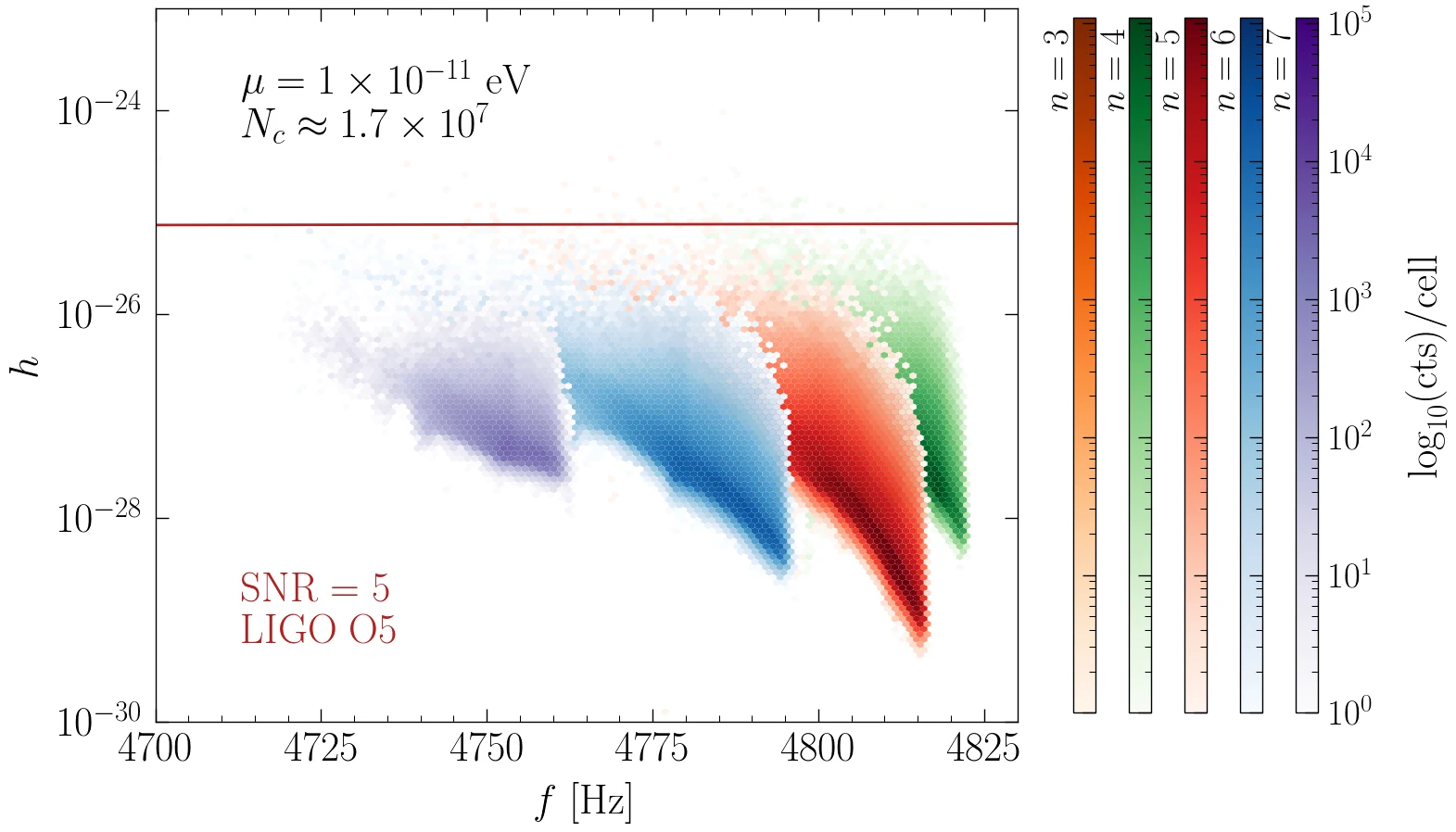
Los agujeros negros no son abismos silenciosos, sino diapasones naturales. Su rápida rotación, predicha por Roger Penrose, hace cantar al propio espacio-tiempo, generando una corriente de las partículas más ligeras: los axiones. Estos se acumulan alrededor del agujero, como el sonido en una sala de conciertos, y comienzan a oscilar al unísono. Así surge una nube que emite ondas gravitacionales de una sola nota constante: un diapasón cósmico que suena durante millones de años.
Antes, los científicos intentaban captar esta canción de agujeros individuales, monitoreando su rotación. Ahora han considerado que solo en nuestra Vía Láctea hay unos cien millones de estos diapasones. Su coro colectivo crea un zumbido que ya pueden captar los detectores creados por Rainer Weiss (LIGO). La próxima generación de instrumentos, como el Einstein Telescope, podrá distinguir las notas de axiones aún más ligeros, acercándonos a la solución del misterio de la materia oscura.
Resumen original
tal como lo escribieron los autores, en inglés arXiv:2603.15734
Black hole superradiance is a powerful probe of ultralight axions. If nature contains a boson with a mass of order $$10^{-12}\,$$eV, $$\textit{mere vacuum fluctuations}$$ will lead to its efficient production around spinning stellar mass black holes, forming a gravitational atom that both drains the black hole spin and decays to produce near-monochromatic gravitational waves. Existing superradiance constraints derive primarily from spin measurements of a handful of identified black holes. Here we instead present a detailed study of the population level effect: gravitational waves arising from both the 100 million black holes in the Milky Way and the stochastic signal from axion clouds throughout the universe. We study the impact of a broad range of systematic uncertainties on the black hole properties and compute the projected axion sensitivity for LIGO, as well as the future instruments Einstein Telescope, Cosmic Explorer, and a high-frequency Magnetic Weber Bar. We demonstrate that LIGO can robustly probe axion masses from roughly $$10^{-13}\,$$eV to $$4 \times 10^{-12}\,$$eV. If the black hole population extends to masses slightly below $$5\,M_{\odot}$$ - as hinted for by LIGO inspiral observations - LIGO would approach $$10^{-11}\,$$eV. Under that same assumption we show that a future high-frequency detector could push considerably higher, potentially beyond $$10^{-10}\,$$eV in the most optimistic scenarios, reaching towards the lowest masses within the projected sensitivity of axion dark matter searches.
Las ondas gravitacionales de los axiones son sorprendentemente puras, como la nota de un diapasón que suena durante millones de años sin una sola falla.
En 'Interestelar', las ondas gravitacionales servían como puente a través del tiempo, pero aquí captamos la verdadera melodía que cantan los agujeros negros.