Cuasiestrellas: agujeros negros dentro de gigantes exprés
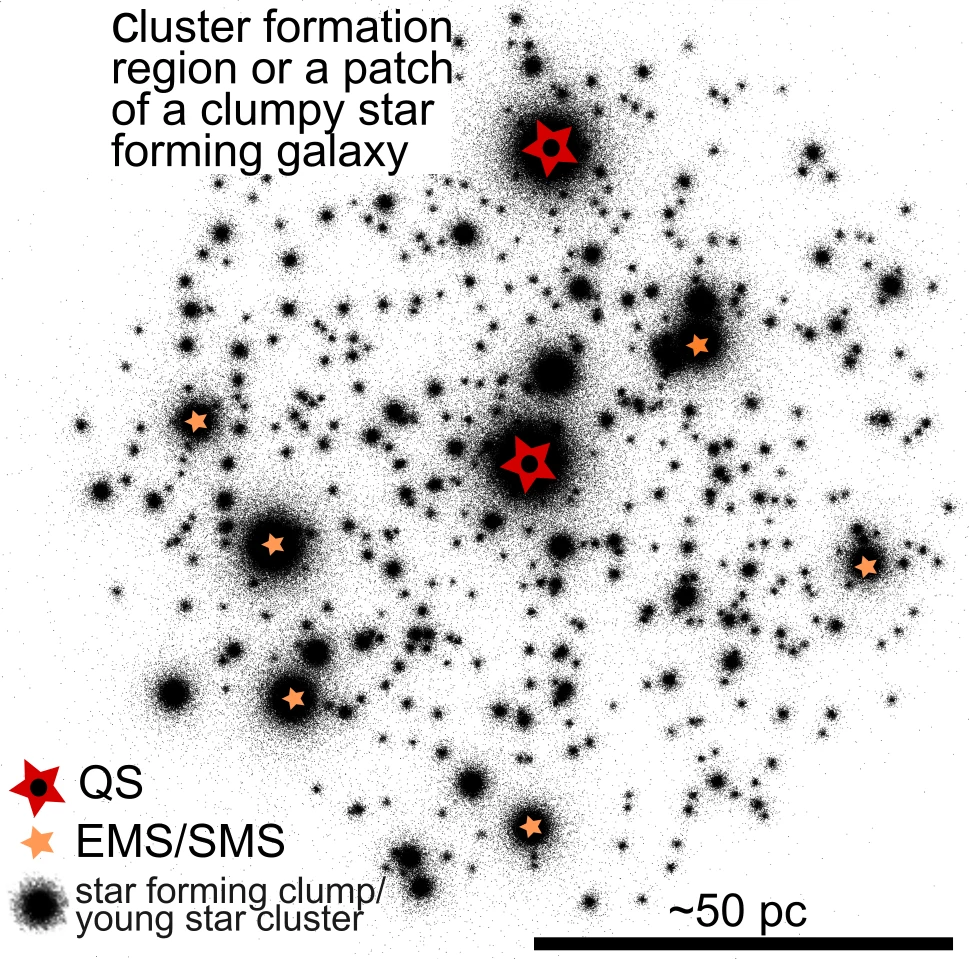
En el Universo temprano, los cúmulos estelares eran tan densos que nacían gigantes del tamaño del Sistema Solar. Si uno de estos colosos estuviera en lugar del Sol, su borde llegaría hasta Júpiter. A veces, estas estrellas engullían pequeños agujeros negros. El agujero descendía a las entrañas y empezaba a crecer, convirtiendo la estrella en un resplandor fantasmal: una cuasiestrella. He aquí una paradoja inesperada: la cuasiestrella pesa como diez mil soles, pero sus capas exteriores son tan tenues que es casi transparente.
Este fantasma cósmico puede vivir cientos de miles de años, mientras el agujero negro en su interior acumula una masa colosal. Estos raros objetos explican los misteriosos puntos rojos que el telescopio James Webb ha descubierto en galaxias lejanas. Si varias agujeros negros caen en una misma estrella, su fusión genera ondas gravitacionales: vibraciones del espacio-tiempo que captan los detectores en la Tierra. Así, la antigua luz de las estrellas fantasma revela los secretos del nacimiento de agujeros negros supermasivos.
Resumen original
tal como lo escribieron los autores, en inglés arXiv:2604.22924
Numerical simulations have established that star clusters with densities comparable to the high redshift ($$z>6$$-$$10$$) James Webb Space Telescope (JWST) proto globular clusters may build up extremely massive (EMSs; $$m_\mathrm{\star}>1000 M_\odot$$) or even supermassive stars (SMSs; $$m_\mathrm{\star}>10000 M_\odot$$) and potentially intermediate mass black holes (IMBHs) through runaway stellar collisions. Using direct simulations of assembling star clusters including post-Newtonian black hole dynamics and stellar evolution, we demonstrate that in such dense environments ($$\Sigma_\mathrm{h} \gtrsim 10^6 M_\odot$$pc$$^\mathrm{-2}$$) stellar BHs ($$m_\bullet \lesssim 60 M_\odot$$), driven by rapid mass segregation and relaxation effects within the sphere of influence of the EMSs/SMSs, may strongly interact with the extremely massive stars and become embedded within their gaseous layers. We suggest that this quasi-star (QS) like embedded BH phase is a natural outcome of the runaway formation of EMSs/SMSs in the densest star clusters. The QS phase is orders of magnitude longer in duration than the lifetime of the SMS, enabling an extended growth period by stellar collisions, and allows the formation of embedded gravitational wave sources if the QS captures more than a single stellar BH. The star cluster assembly region sizes ($$\sim100$$ pc), QS masses ($$\gtrsim 10^4 M_\odot$$) and their proximity to young, massive blue star forming clumps are consistent with the faint population of multiple little red dots (LRDs) recently discovered by the JWST.
Una cuasiestrella pesa como 10 mil soles, pero sus capas exteriores son tan tenues que es casi transparente: un auténtico fantasma cósmico.