Des fils souples transforment les vêtements en détecteurs de radiation express
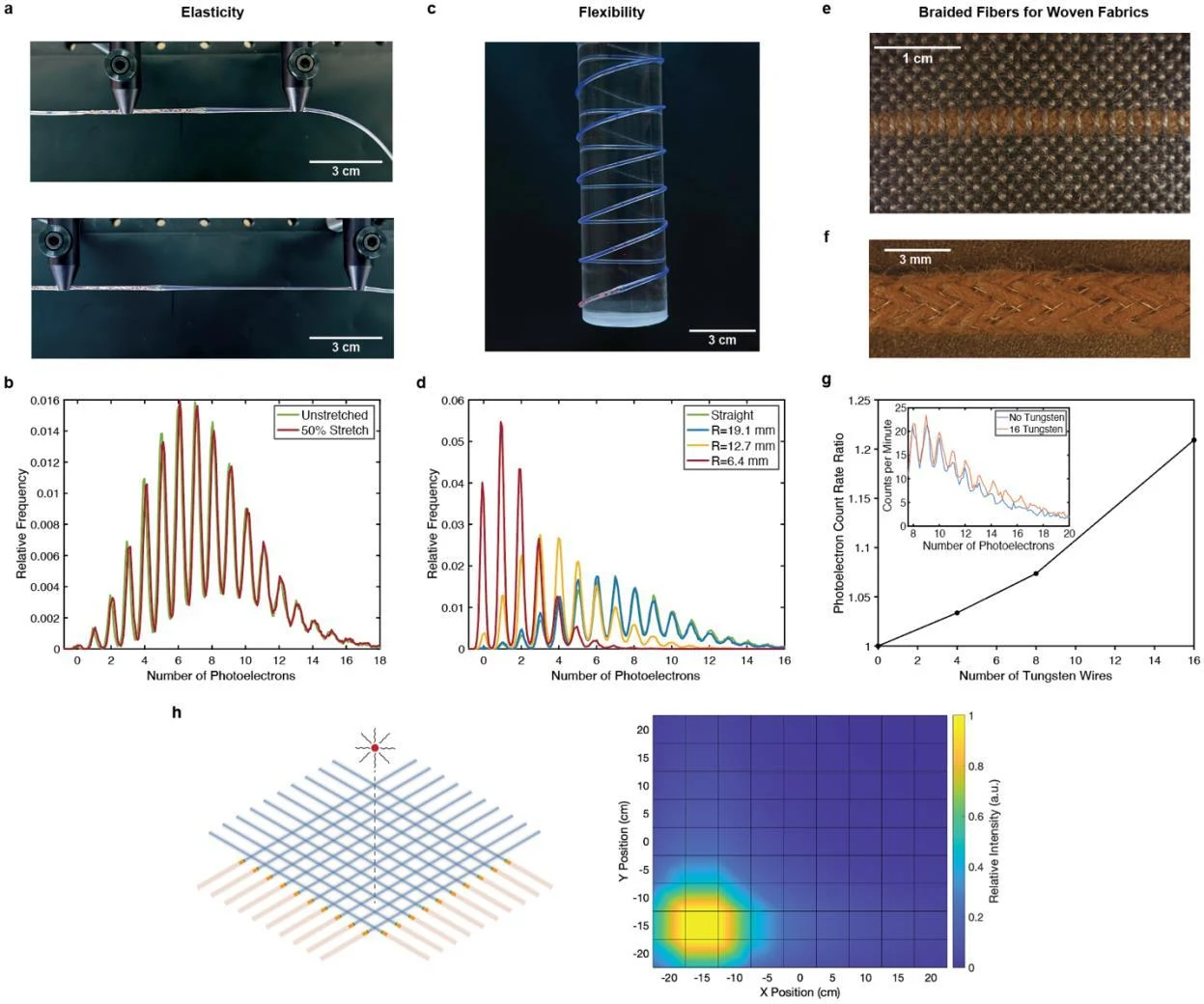
À l'intérieur d'un fil de polymère ultrafin se trouvent des cristaux microscopiques, des scintillateurs. Lorsqu'une particule radioactive invisible les frappe, ils s'illuminent brièvement, comme des lucioles. Un capteur sensible capte chacun de ces éclats, transformant le fil en détecteur flexible.
Des tests avec le strontium-90, le césium-137 et le cobalt-60 ont montré que le tissu perçoit même le bruit de fond naturel. Pour amplifier le signal, du tungstène et de la laine mérinos ont été ajoutés à la gaine — ce voisinage inattendu du métal et de la laine douce a augmenté la sensibilité de 20 %. Le tungstène convertit les rayons gamma en une pluie d'électrons que les cristaux capturent plus facilement. Cela aide aussi à distinguer les types de rayonnement, ouvrant la voie à des recherches portables sur les particules fondamentales et à des vêtements intelligents qui alertent en cas de danger dans les centrales nucléaires et en radiothérapie.
Résumé original
tel que rédigé par les auteurs, en anglais arXiv:2604.05061
Nuclear radiation detectors play a key role in applications spanning nuclear and particle physics, nuclear engineering, security, and medicine. With the expanded global interest in nuclear power, discreet, inconspicuous, and readily deployable nuclear detection capabilities are increasingly important. However, conventional dosimeters are often rigid, bulky, or lack spatial resolution, limiting their use for mobile, conformal, or large-area distributed mapping of dynamic fields. Here, we present flexible, radiation-sensitive optoelectronic fibres with up to 50% elasticity for real-time gamma dosimetry. Silicon photomultipliers are thermally drawn into the core of fibres composed of a scintillator waveguide, enabling electronic-photonic integration and detection of scintillation light with single-photon resolution. We show that these fibres are sensitive to localized nuclear radiation exposure from collimated 0.5 {\mu}Ci Sr-90 {\beta}-sources and 10 {\mu}Ci Cs-137 and Co-60 {\gamma}-sources, with extended responsivity measured over 30 cm, and estimated lower detection limits approaching near- background radiation levels (~14-41 nSv/hr). Co-locating the scintillator and detectors in the fibre eliminates past length limitations driven by optical losses and enabling a greater collection cone through capture of transient non- guided modes. We further enhance radiation sensitivity and mechanical robustness by covering the fibres with a tungsten-merino wool composite braid, enabling us to machine-weave them into fabrics alongside common textile yarns. The tungsten wires function as a gamma-electron converter, increasing the detection efficiency of the assembly by ~20%. Distributed woven arrays of fibres formed in this way present an opportunity to create large-area, conformal fabrics capable of real- time dosimetry of gamma radiation fields with high spatial resolution.
Les premiers détecteurs de radiation utilisés par Marie Curie et Ernest Rutherford nécessitaient des laboratoires entiers. Aujourd'hui, un détecteur peut se porter comme un pull.
Dans le roman d'Isaac Asimov « Fondation », il est question de dosimètres personnels, mais les détecteurs tissulaires sont déjà une réalité.