Звёзды-тяжеловесы меняют состав в паре экспресс
В звёздных яслях массивные светила рождаются не поодиночке, а парами. Две звезды кружатся вокруг общего центра, и та, что потяжелее, первой раздувается и начинает сбрасывать внешние слои. Часть этого вещества не улетает в космос, а перетекает на соседку — как вода из переполненной чаши в подставленную. В результате звезда-получатель обогащается гелием, который накопился в недрах донора.
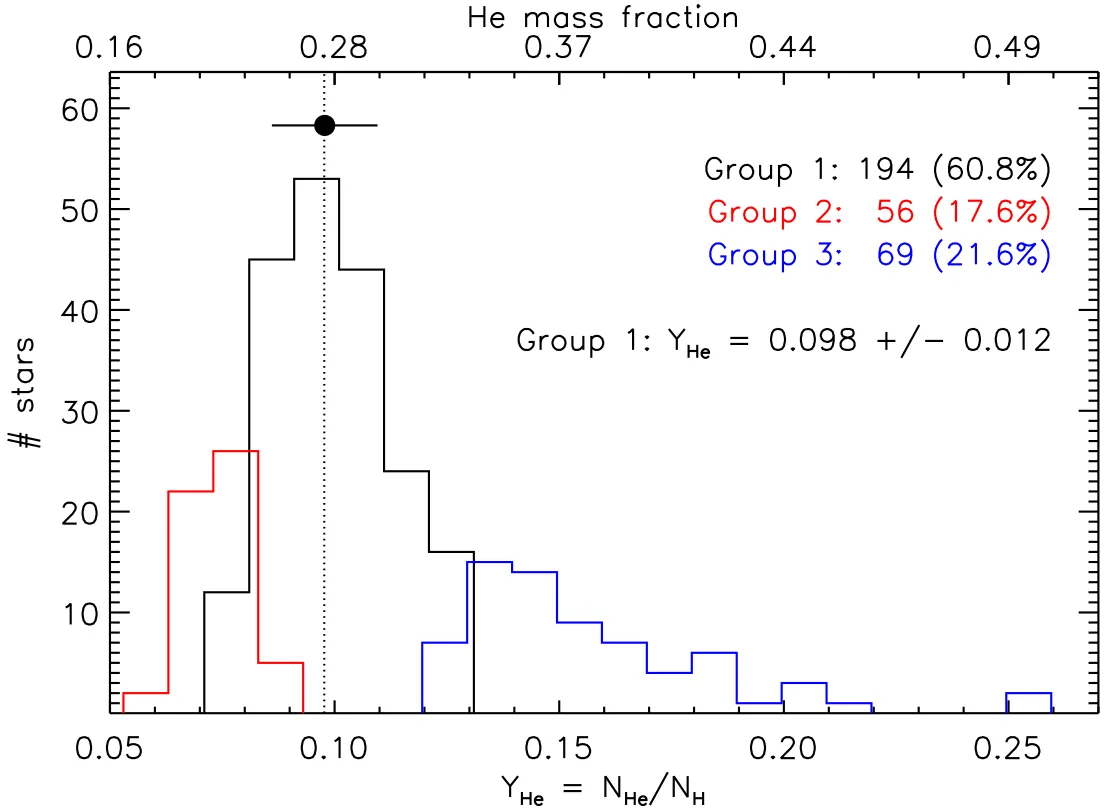
Астрономы из проекта IACOB проверили эту картину на большой выборке: 318 массивных звёзд спектрального класса O в нашей Галактике. У 22% из них гелия в атмосфере оказалось заметно больше, чем положено по космическому стандарту (около 0,098 по отношению к водороду). Причём у большинства таких звёзд есть признаки соседства: либо рядом виден компаньон, либо звезда летит сквозь Галактику с необычно высокой скоростью — след былого взаимодействия.
Это важно для понимания судьбы самых горячих и короткоживущих звёзд. Массивные звёзды взрываются сверхновыми, оставляя после себя нейтронные звёзды или чёрные дыры. Если значительная часть из них прошла через стадию обмена массой, то и сами взрывы, и их остатки будут другими. Одиночная на вид звезда может оказаться продуктом бурной парной истории.
Оригинальная аннотация
как её написали авторы, на английском arXiv:2601.20698
The presence of massive O-type stars with surfaces enriched by CNO-cycle products has been known since the early 1980s. For many years, internal rotational mixing was assumed to be the dominant mechanism responsible for this chemical contamination. However, accumulating evidence now suggests that binary interaction -- particularly mass-transfer episodes -- may play an equally important, if not dominant, role. We aim to carry out a large-scale investigation of surface helium (He) abundances in Galactic O-type stars, based on the results from the analysis of high-quality spectroscopic data from the IACOB project. We perform a homogeneous spectroscopic analysis of 318 Galactic O-type stars with the IACOB-BROAD and FASTWIND/IACOB-GBAT tools, deriving rotational velocities, atmospheric parameters, and He abundances. We also account for the influence of binarity, runaway status, and parameter degeneracies (e.g., microturbulence, wind properties, diagnostic lines, and companion contamination) on the abundance determinations. We present homogeneously determined surface He abundances (YHe=N(He)/N(H)) for the so far largest, statistically significant sample of Galactic O-type stars. About 78% of the stars show He abundances consistent with the previously proposed cosmic abundance standard of YHe=0.098$$\pm$$0.002. The remaining 22% display clear He enrichment (YHe>0.13). We also provide observational evidence indicating that most of these He-enriched stars are likely the products of binary interaction. Our study highlights how large spectroscopic surveys are gradually opening robust observational avenues to identify the products of massive binary interaction. It also emphasizes the need for caution when interpreting the spectroscopic properties of apparently single O-type stars. A significant fraction may in fact be the outcome of binary evolution rather than isolated stellar birth.
У 22% массивных звёзд гелия в атмосфере больше 13% по числу атомов — это как если бы в стакане воды вместо одной ложки сахара оказалось полторы.