Черная дыра в непустой Вселенной экспресс
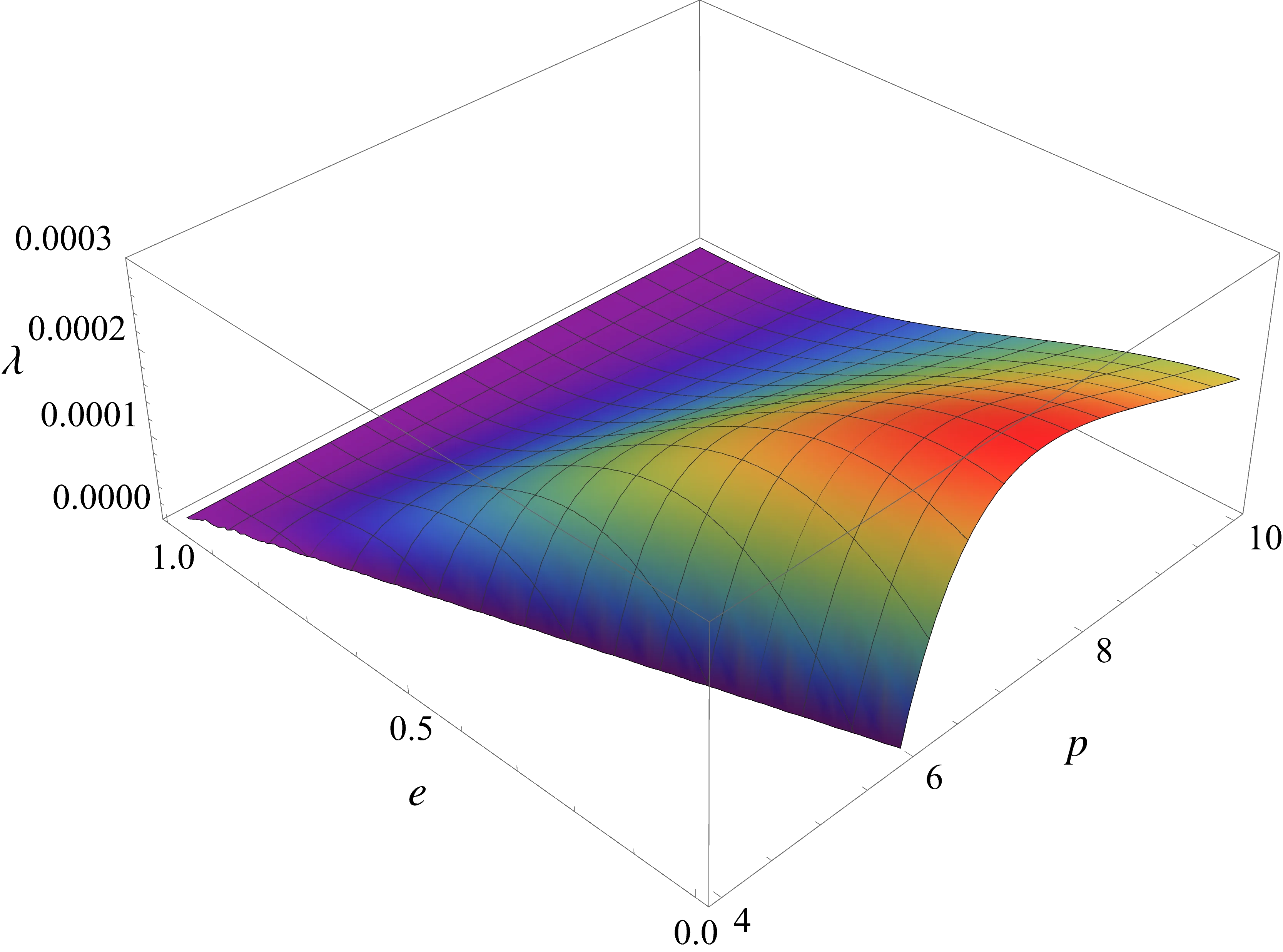
Палка, брошенная в пруд, идет ко дну по прямой. Но если вода в пруду медленно прибывает, палка задержится и утонет не там, где ждали. Так и с черными дырами: обычно считают, что вокруг них — пустота, но вся Вселенная потихоньку растягивается. Это растяжение, как прибывающая вода, слегка меняет путь всего, что кружит рядом с дырой.
Авторы взяли простую модель: черная дыра в расширяющейся Вселенной. Оказалось, что из-за расширения звезда или маленькая черная дыра теряет энергию чуть быстрее. Ее орбита быстрее становится круглой, а потом — падение. Время до падения сокращается. Если расширение очень слабое, как в реальном космосе, эффект почти не заметен. Но если рядом есть скопление галактик, оно действует похоже и может ускорить падение заметно.
Для будущих детекторов в космосе это важно. Они будут ловить гравитационные волны — дрожь пространства от таких падений. Если не учесть расширение, можно ошибиться в числе событий и неправильно понять сам сигнал. Прибывающая вода в пруду меняет не только судьбу палки, но и круги на воде.
Оригинальная аннотация
как её написали авторы, на английском arXiv:2602.17154
The inspiral of a compact object into a black hole is a key source of low - frequency gravitational waves for future space-based detectors like LISA. While models of this process have advanced considerably, they typically focus on asymptotically flat spacetimes. In this paper, we investigate how departures from asymptotic flatness, whether driven by cosmic expansion or large-scale galactic environments, alter adiabatic orbital evolution. Using the Schwarzschild - de Sitter (SdS) metric, we parametrize these deviations via an `SdS parameter' ($$\lambda$$) and analyze its impact on bound orbits. We calculate how $$\lambda$$ shifts the separatrix between bound and plunging states and modifies the relationship between a binary's energy, angular momentum, and orbital geometry. By applying a modified quadrupole formula in the weak-field limit, we investigate the effect of $$\lambda$$ on circularization, plunge times, and orbital trajectories. We show that a positive SdS parameter accelerates eccentricity decay and shortens inspiral timescales. We also generate adiabatic waveforms from inspirals evolving under radiation reaction, exhibiting an increase in amplitude and a cumulative phase advance induced by $$\lambda$$. While these effects are negligible if $$\lambda$$ is strictly cosmological, they become observationally relevant if the parameter serves as a proxy for astrophysical environments that induce $$\sim r^2$$ potential corrections. Our results suggest that such environmental coupling could meaningfully bias event rate estimates and waveform templates for space-based gravitational-wave astronomy.
Расширение Вселенной заметно даже на расстоянии от Земли до Луны — оно добавляет около 3 сантиметров в год.
В фильме «Интерстеллар» герои летят к черной дыре, не думая о расширении Вселенной — а оно могло бы сбить их расчеты.