Тёмный пузырь и микромир: гравитация на миллионных долях метра экспресс
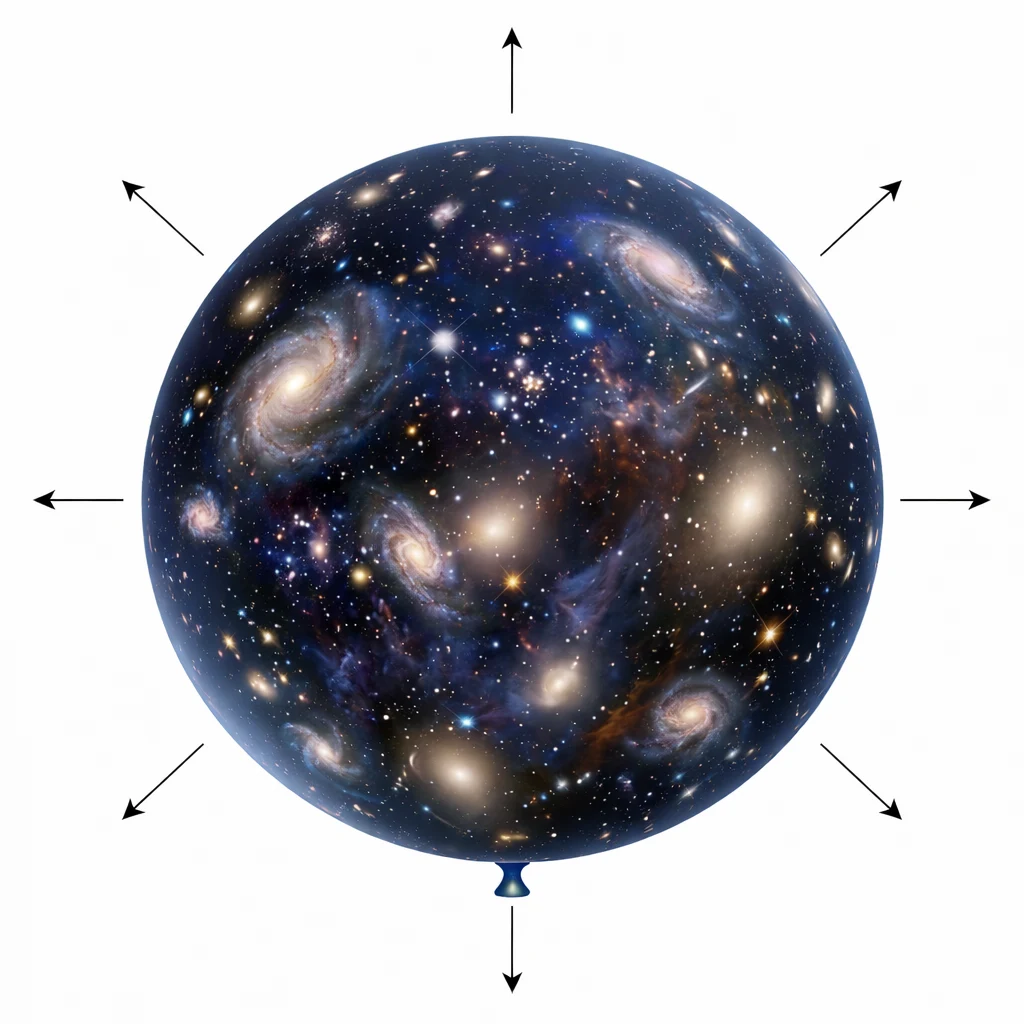
Вселенная ведёт себя как мыльный пузырь, раздувающийся в многомерной пене. Модель тёмного пузыря объясняет, почему он расширяется всё быстрее: пузырь пространства-времени растёт, и его плёнка обретает крошечную толщину — около микрона, как у бактерии. На таких дистанциях гравитация 'расплывается' в этой толщине и слабеет.
Проверить это можно, измерив притяжение микроскопических частиц. На расстоянии в микрон сила окажется на пару процентов меньше, чем предсказывает закон Ньютона из учебника. Это ослабление неразрывно связано с ускоренным расширением космоса — и то и другое проявления одного феномена. Модель также указывает на лёгкую искривлённость пространства, которую астрономы надеются зафиксировать.
Оригинальная аннотация
как её написали авторы, на английском arXiv:2606.20942
The dark bubble model explains the existence of a positive cosmological constant by making explicit use of the instabilities underlying the de Sitter swampland conjectures to make the accelerated expansion of the universe inevitable. A distinctive consequence of the construction is a unique hierarchy connecting cosmological, gravitational, string, and higher-dimensional scales. In particular, the model naturally predicts the existence of a dark dimension of micron size, an idea that has been argued for on independent grounds in the literature. The same framework also predicts a weakening of gravity at distances of order the dark-dimension scale, leading to a fading of the gravitational force at micron distances. We argue that the dark bubble therefore provides a concrete realization of both the dark dimension proposal and Sundrum's fat graviton scenario, in which gravity effectively ceases to probe shorter distances. Additional predictions include a string scale of order tens of TeV and a measurable positive spatial curvature of the universe. We review these key aspects of the model, discuss their implications for gravity and cosmology, and highlight its key predictions.
Микрон (миллионная доля метра) — типичный размер бактерии. Если бы такое измерение существовало, оно было бы буквально у нас под микроскопом.