Тепло под давлением: как измерить невидимое экспресс
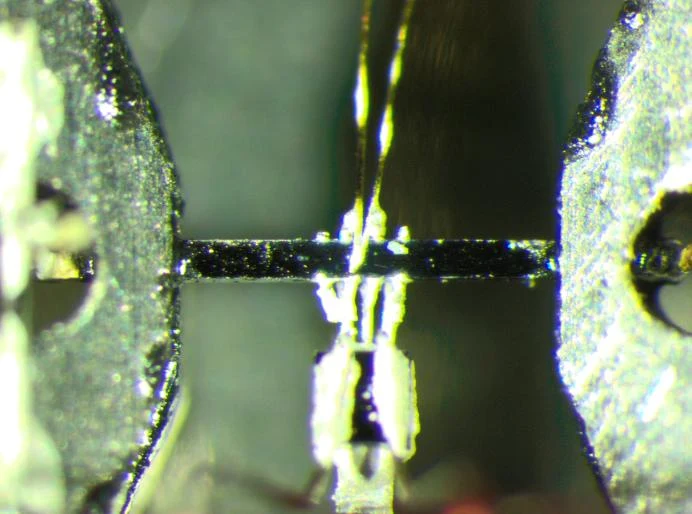
Сверхпроводник — это материал, в котором электричество течёт без потерь, как вода по идеально гладкой трубе. Но если его слегка сжать, как пружину, свойства меняются. Учёные давно хотели измерить, сколько тепла поглощает такой сжатый материал, но приборы не помещались в тесную установку. Теперь они придумали способ обойти это препятствие.
Они измеряют не само тепло, а крошечные колебания температуры, когда материал быстро сжимают и отпускают. Это как следить за дыханием человека, не прикасаясь к нему. Соединив измерения при медленном и быстром сжатии, они получают точную карту тепла по всему образцу. Для сверхпроводника Sr₂RuO₄ такая карта показала удивительную вещь: при определённом сжатии внутренний порядок вещества становится самым прочным.
Это открытие помогает понять, как управлять сверхпроводниками с помощью давления. Возможно, в будущем такие материалы будут работать при более высоких температурах, что приблизит нас к проводам без потерь в наших домах.
Оригинальная аннотация
как её написали авторы, на английском arXiv:2608.17777v1
Uniaxial pressure is a powerful tuning parameter for quantum materials, but conventional thermodynamic probes such as specific heat are difficult to realize in the constrained geometries of strain apparatus. We develop a quantitative analysis framework for a.c. elastocaloric effect measurements that enable the reconstruction of the absolute entropy and hence specific heat across complex phase diagrams. The absolute accuracy is achieved by combining measurements in the strong coupling regime at low frequencies with high signal-to-noise measurements in the quasi-adiabatic regime at high frequencies. Applying the approach to the correlated superconductor Sr$$_2$$RuO$$_4$$, we obtain an absolute entropy map across the phase diagram including across phase transitions deep into the superconducting state. We demonstrate that from such data one can derive the absolute specific heat which is currently not possible through other approaches. This data reinforces the finding that the quenching of entropy within the superconductor Sr$$_2$$RuO$$_4$$ is strongest at the critical strain consistent with the superconducting gap being maximized at the Van Hove singularity (VHs). Furthermore, we demonstrate that, although $$\Delta c /(\gamma T) $$ does increase at the VH strain, this increase is much weaker than previously inferred from more indirect caloric experiments.
Сжатие, о котором идёт речь, меньше одной сотой доли толщины человеческого волоса, но оно меняет свойства материала сильнее, чем нагрев на несколько градусов.