المجرات القنديلية: رياح فوق صوتية تشعل النجوم سريع
تدخل المجرة إلى عنقود كثيف مثل عداء يندفع وسط حشد. التيار الغازي المعاكس – الذي يُسمى الوسط داخل العنقود – يجردها من غازها، ممددًا ذيلًا مضيئًا طويلًا. أطلق علماء الفلك على هذه المجرات اسم "قناديل البحر": فهي تمتلك جسمًا وأذرعًا متموجة من المادة الممزقة. لكن في القليل منها فقط تتوهج نجوم جديدة في هذه الأذرع. لماذا يكون ذيل بعض القناديل حيًا بينما يكون ذيل البعض الآخر مجرد أثر غازي؟
أمعن علماء الفلك النظر في المجرة JO147 – وهي قنديل بحر ذو تكوين نجمي ضعيف. أظهر التلسكوب الراديوي MeerKAT أن الإشعاع المستقطب (وهو أثر المجال المغناطيسي المنتظم) موجود فقط في عُشر الذيل. سرعة المجرة بالنسبة للغاز المحيط ليست كبيرة – فقط 1.3 إلى 1.6 ضعف سرعة الصوت. للمقارنة: طائرة مقاتلة فوق صوتية تطير أسرع من الصوت في الهواء، لكن هنا "الصوت" هو اهتزازات في الغاز الساخن للعنقود.
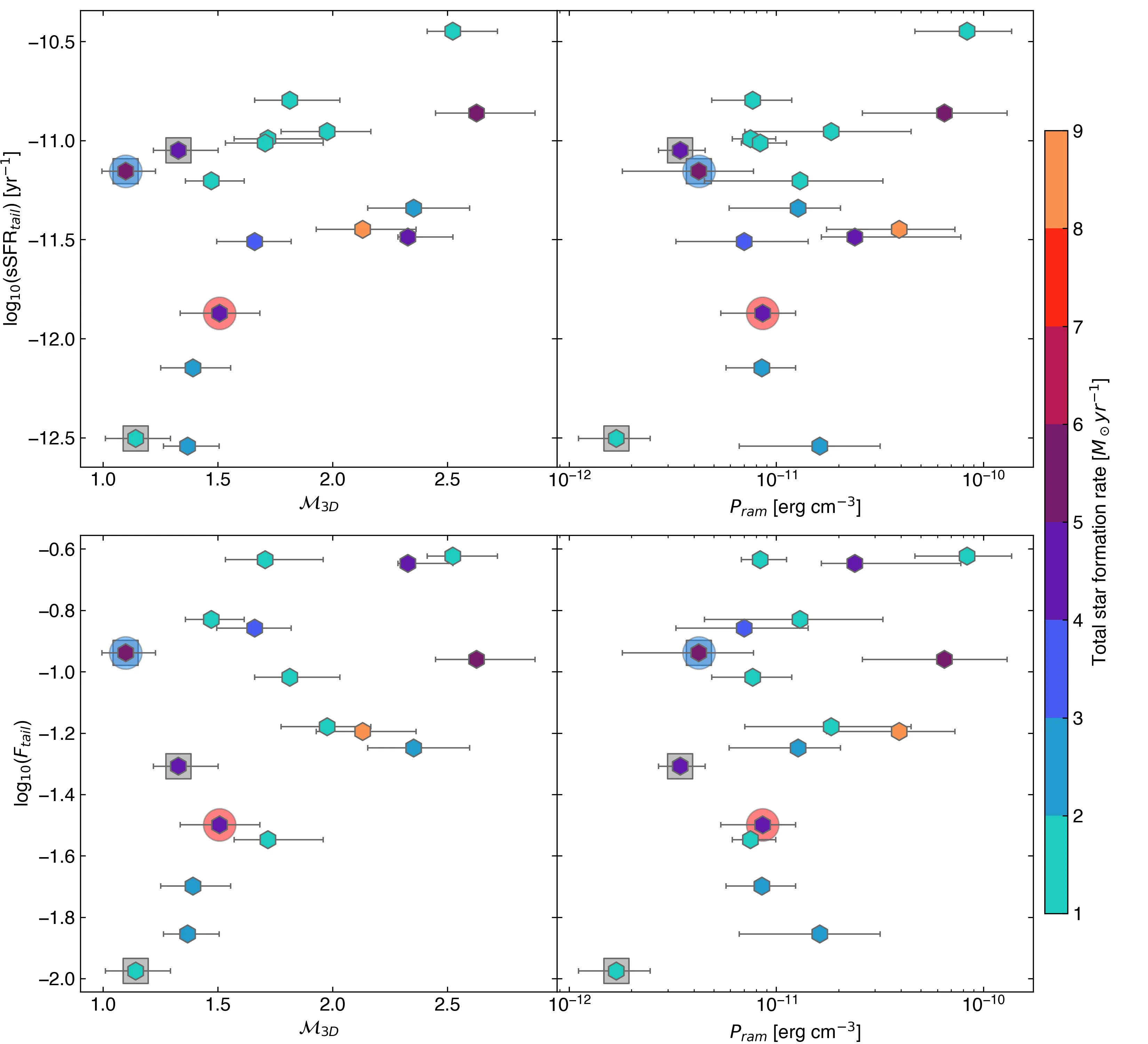
ثم اختبر العلماء هذه الفكرة على 17 قنديلًا من مشروع GASP. لكل منها، بنوا نموذجًا للمدار داخل العنقود، وأخذوا في الاعتبار درجة حرارة الغاز، وحسبوا رقم ماخ – نسبة سرعة المجرة إلى سرعة الصوت. اتضح أنه كلما تحركت المجرة أسرع، زاد نشاط تكوين النجوم في ذيلها. الحركة فوق الصوتية شرط ضروري. موجة الصدمة تضغط الغاز الممزق وتمنعه من التبدد، بينما يلتف المجال المغناطيسي المعزز حوله مثل بطانية، محافظًا على الوقود للنجوم الجديدة.
الملخص الأصلي
كما كتبه المؤلفون، بالإنجليزية arXiv:2602.21821
All gas-rich galaxies in cluster environments are expected to experience ram-pressure stripping from the intra-cluster medium. However, only a fraction of these develop ongoing star-formation in their stripped tail, becoming the so-called ``jellyfish'' galaxies. In this work we provide observational evidence that magnetic fields can signal differences in the extraplanar star formation and explore what are the physical conditions that lead to the formation of a jellyfish galaxy. We first focus on JO147, a jellyfish galaxy that features weak star formation activity in its tail. Using MeerKAT radio continuum observations, we discover polarized emission only in a small fraction of its tail, with an average fraction of $$~10\%$$, and a low Mach number $$\mathcal{M}=1.3-1.6$$, which suggests a possible association between magnetic field draping, shock-compression of the gas, and extraplanar star formation activity. Then, we test this scenario in a sample of 17 jellyfish galaxies from the GASP project. We combine dynamical models for their orbits within the host clusters with realistic cluster temperature profiles to infer their Mach number, and we find a positive correlation between it and the star formation activity in their tail. We conclude that supersonic motion is a necessary condition for triggering star formation in the stripped tails of jellyfish galaxies. Our findings provide empirical evidence that the critical factor preventing the stripped gas evaporation is the shock compression induced by the supersonic motion through the cluster. This process likely enhances the magnetic field surrounding the galaxy and the properties of the stripped material.
يمكن أن يمتد ذيل المجرة القنديلية لمئات الآلاف من السنوات الضوئية – أي عدة أضعاف قطر درب التبانة.
في رواية "أعمدة الخلق" لتيري غودكايند، يسافر الأبطال عبر مناطق تولد فيها النجوم من الغاز المضغوط – وهو ما يشبه العمليات في أذيال المجرات القنديلية.