Record CO₂: When the Planet's Lungs Held Their Breath ✛
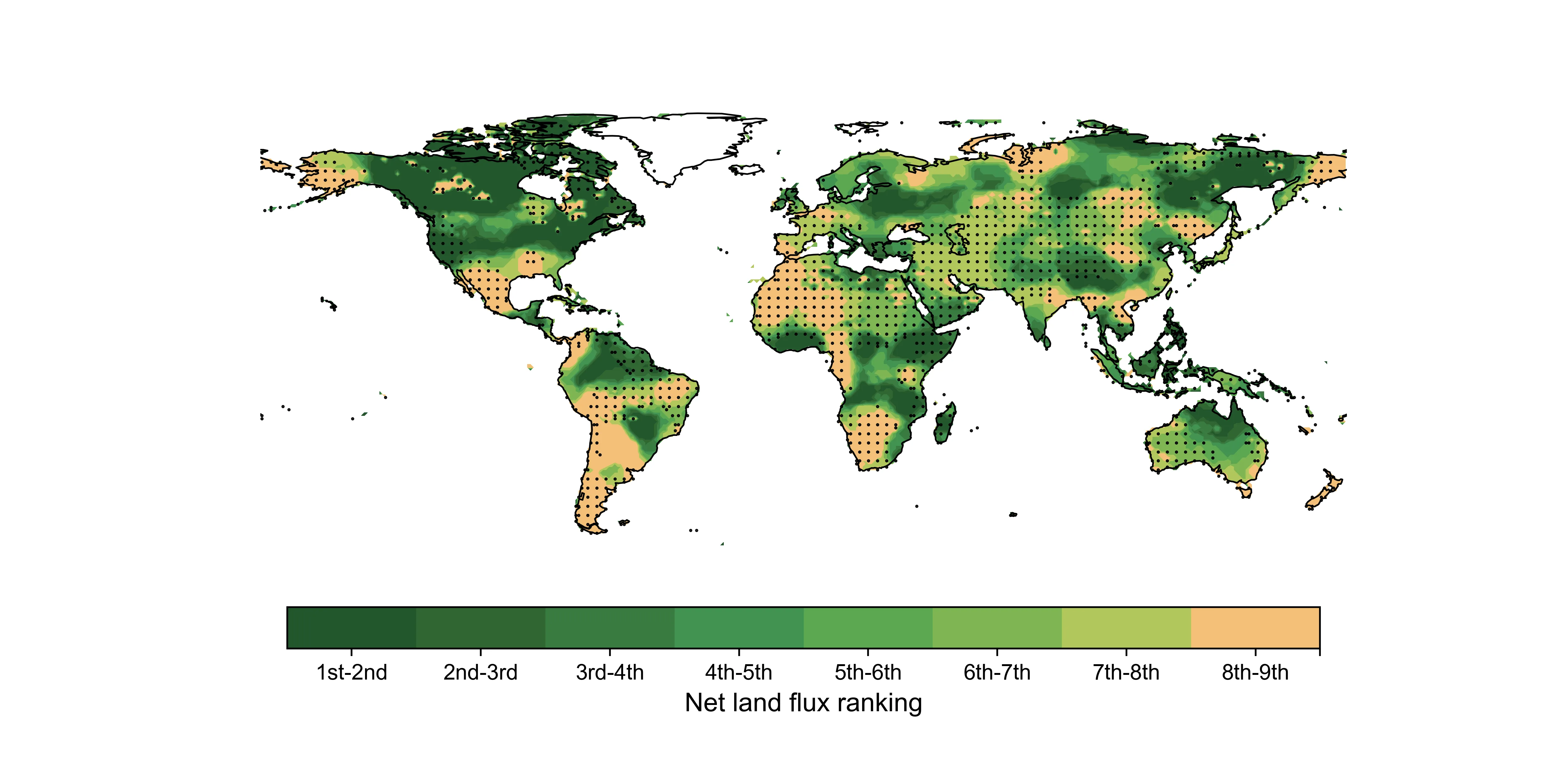
The carbon cycle is like the planet's breathing. Forests and oceans inhale carbon dioxide, while industry and wildfires exhale it back. In 2023, that inhale became gasping and shallow. At the Mauna Loa station, instruments recorded that CO₂ concentrations rose by 3.37 parts per million over the year, 86% faster than the year before. Meanwhile, emissions from coal, oil, and gas increased by only 0.6%. So the issue isn't that we burned more fuel. The issue is that the planet stopped taking excess gas out of the air.
Land is the main carbon sink, its green lungs. But in 2023, they worked at half strength. Satellite observations and computer models that simulate plant growth showed that the global net land carbon sink dropped to 0.44 gigatons per year. For comparison, over the previous decade, land absorbed an average of 2.04 gigatons annually. It's as if a person who normally takes full breaths suddenly started breathing shallowly, barely filling their lungs.
The ocean, the second half of the respiratory system, took a deeper breath instead. It absorbed 0.10 gigatons more than in 2022, thanks to the warm El Niño current, which weakened the upwelling of cold waters off South America's coast. But the ocean couldn't compensate for the land's shortfall. As a result, the atmosphere accumulated excess carbon, and the climate continued to warm faster.
This work is the first to assemble a fast carbon budget for a single year, combining satellite measurements, plant growth models, and simplified ocean simulations based on machine learning. Previously, such estimates came with a lag of several years; now scientists can diagnose the malfunction almost in real time. And the diagnosis is grim: if heat and droughts become more frequent, land will cease to be a reliable ally in the fight against climate change. The planet's lungs have already shown they can hold their breath. The question is for how long.
In 2023, the CO₂ growth rate at Mauna Loa was 86% higher than in 2022, even though fossil fuel emissions rose by only 0.6%. This is the largest gap between emissions and concentration growth in the entire observational record.
A scenario where natural carbon sinks stop working is explored in Kim Stanley Robinson's novel 'The Ministry for the Future': there, heat waves and droughts lead to massive forest dieback and a sharp acceleration of CO₂ rise. The 2023 study shows that such a scenario may already be starting to unfold.