The land carbon sink is the net absorption of carbon dioxide (CO₂) from the atmosphere by terrestrial ecosystems — forests, grasslands, soils, and other vegetation. Through photosynthesis, plants take in CO₂ and convert it into biomass, while respiration and decomposition release some back. The 'sink' refers to the balance: when uptake exceeds release, land acts as a net reservoir for carbon, slowing the rise of atmospheric CO₂ caused by fossil fuel burning. In 2023, this sink weakened, meaning land absorbed less CO₂ than in previous years, a concerning development for climate change mitigation.
History
The concept of a land carbon sink emerged in the 1980s when scientists realized that atmospheric CO₂ was rising slower than expected from fossil fuel emissions, implying an unidentified terrestrial uptake. This led to the 'missing sink' puzzle, later attributed to forest regrowth and CO₂ fertilization.
How it works
The sink operates on multiple timescales. In the short term, plants grow faster with more CO₂ (the CO₂ fertilization effect) and with longer growing seasons in a warming climate. Over decades, carbon accumulates in wood and soil organic matter. However, the sink is not guaranteed: droughts, fires, and heatwaves can kill vegetation or accelerate decomposition, turning land from a sink into a source. The 2023 weakening likely resulted from such stressors, possibly linked to an El Niño event that brought dry conditions to tropical regions, reducing photosynthesis and increasing respiration.
In practice
Quantifying the land sink is critical for carbon budgets and climate policy, as it determines how much emission reduction is needed to meet temperature targets.
Fun fact
The land carbon sink absorbs about 30% of human-caused CO₂ emissions, but its future is uncertain — if it weakens further, the pace of global warming could accelerate beyond current projections.
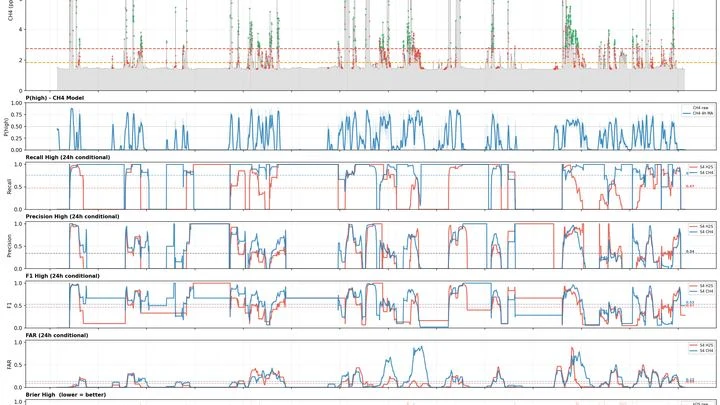
At a landfill on the outskirts of town, the wind shifts direction, and a couple of hours later the nearest village smells of rotten eggs. That's hydrogen sulfide — a gas produced when waste decomposes, and in large doses it's hazardous to health. Usually, authorities only learn about the problem after residents have already breathed it in and called to complain.
The mystery of the radius valley — a sharp drop in the number of exoplanets with radii ~1.8 Earth — haunts astronomers. JWST, transit surveys like Kepler and TESS draw a clear gap: rocky super-Earths and gaseous sub-Neptunes are separated by almost a chasm.
Every year, the food we eat costs humanity tens of millions of years of life due to unhealthy diets. At the same time, a third of all greenhouse gases warming the planet are produced along the journey from farm to plate. It seems obvious: switch to healthier eating, and we'll save the climate and improve our health. But new research shows these two goals don't always go hand in hand.
A mosaic of large colored tiles. Each tile is the average precipitation over an entire month for an area the size of a small country. For a general understanding, the picture is fine, but if you need to know whether a downpour hit a specific city yesterday, it's useless.
Drylands are like skin cracking from dehydration. When rainfall decreases, plants don't vanish overnight: they rearrange, leaving bare patches of soil between them. These patterns are visible even from space.
Scientists compared satellite images of eight arid regions, from the Sahel in Africa to Australian deserts.
At the center of galaxy PDS 456 shines a quasar — a black hole devouring gas that glows brighter than hundreds of billions of stars. The X-ray telescope XRISM peered into this light and saw a picket fence of dark bands, like shadows cast by a fence at sunset.
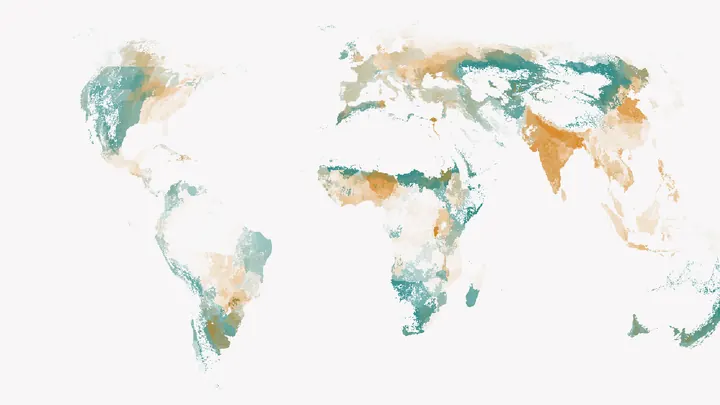
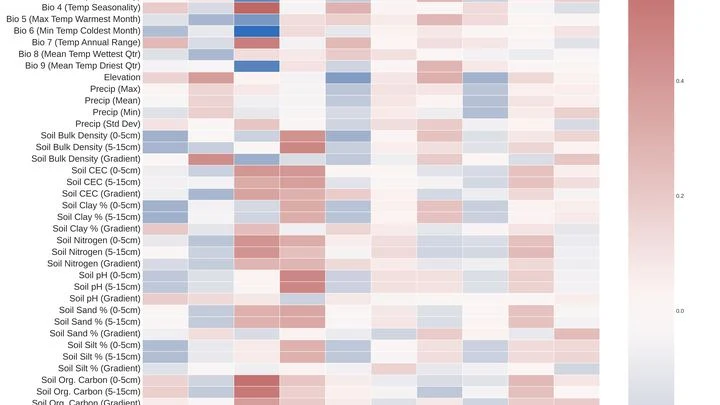
Beneath your feet in the forest, a quiet life unfolds: fungi weave around tree roots and trade nutrients with them. But how do you count how many fungal species are in the soil without digging up the whole forest? It turns out the answer can be seen from space.
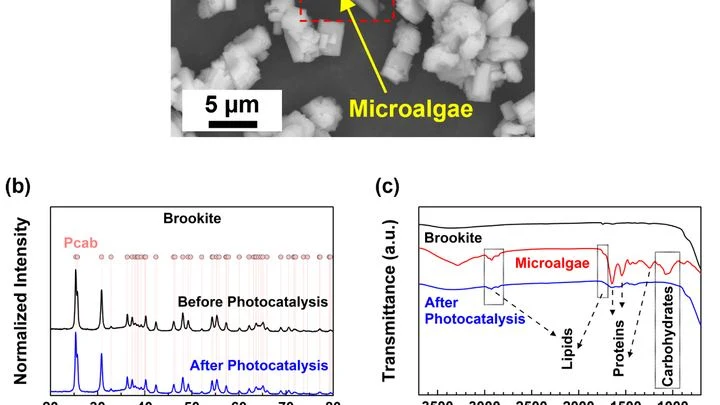
Conventional solar panels convert light into electricity, but here light splits water into hydrogen and oxygen. Hydrogen is a clean fuel, but the process is slow. To speed it up, helper substances that donate electrons are added. Often this is alcohol, but it's a shame to waste it.
Today's Martian surface is a cold, nearly airless home. Many dream of a full renovation: warming the planet, filling it with air from carbon dioxide and nitrogen.
An ice core from Antarctica is a time machine that recorded the climate for 130,000 years straight, year after year, with no gaps. Air bubbles trapped in the ice preserve the carbon dioxide of those ancient eras.
The Sun is slowly brightening, and in hundreds of millions of years its heat would become lethal for Earth. Fortunately, the built-in planetary thermostat — the carbon cycle — when overheating triggers rocks to absorb carbon dioxide faster, cooling the climate.
From July 2023 to July 2024, Earth's atmosphere gained carbon dioxide at a rate of 3.66 parts per million per year. That is the fastest pace since 1979. The reason is not that factories and cars suddenly started emitting more CO₂. The planet's lungs—forests and soils—took a shallower breath.
The planet breathes through its green cover.
The carbon cycle is like the planet's breathing. Forests and oceans inhale carbon dioxide, while industry and wildfires exhale it back. In 2023, that inhale became gasping and shallow. At the Mauna Loa station, instruments recorded that CO₂ concentrations rose by 3.37 parts per million over the year, 86% faster than the year before.
Picture an orchestra where each instrument plays at its own tempo: violins speed up, woodwinds slow down, and percussion keeps losing the beat. That's roughly what Earth's climate looks like, with the ocean, the Sun, volcanoes, and human activity pulling temperature in different directions.
In 2019, 16,000 villages in the Indian state of Maharashtra ran dry, and authorities began distributing water by ration coupons. In response to such crises, the government plans to transfer water from water-rich river basins to arid ones through a network of canals stretching 15,000 kilometers.
The orchestra of world weather is playing a tune we didn't expect. The first violin is not carbon dioxide but chlorofluorocarbons—gases that until recently hid in refrigerators and aerosol cans. They trap heat ten thousand times more effectively than CO₂, and for decades they have been quietly warming the planet.
In spring 2020, Earth's atmosphere seemed to hold its breath. Transport ground to a halt, factories fell silent, and carbon dioxide emissions from burning fuel dropped by nearly eight percent. But spotting this "carbon echo" on a global scale proved tricky: the atmosphere is constantly mixing, forests and oceans breathe, and weather adds its own noise.
In 2008, drought hung over South America. Rivers shrank, pastures yellowed, and farmers stared at the sky waiting for rain that never came. Meanwhile, 450 kilometers above, two satellites flying 220 kilometers apart continued their invisible work: they were weighing the continent.