Wei Li

6 articles · 30 co-authors · latest: 2026-05-15
33 citations · h-index 4 · 12 papersData: Semantic Scholar

We have retold 6 papers by this author. 2 of them with a full read. most often about: carbon dioxide, oxygen, carbon. 30 co-authors across our retellings.

Links in the knowledge graph
Record CO₂: When the Planet's Lungs Held Their Breath
The carbon cycle is like the planet's breathing. Forests and oceans inhale carbon dioxide, while industry and wildfires exhale it back. In 2023, that inhale became gasping and shallow. At the Mauna Loa station, instruments recorded that CO₂ concentrations rose by 3.37 parts per million over the year, 86% faster than the year before.
The Planet's Breath Stumbles: How El Niño Stilled Earth's Lungs
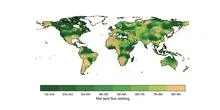
From July 2023 to July 2024, Earth's atmosphere gained carbon dioxide at a rate of 3.66 parts per million per year. That is the fastest pace since 1979. The reason is not that factories and cars suddenly started emitting more CO₂. The planet's lungs—forests and soils—took a shallower breath. The planet breathes through its green cover.
Mesoscale2026-02-102 minarXiv:2602.09660express
Frictionless Current: How a Bismuth-Bromide Crystal Conducts Electricity at Room Temperature
A thin nanowire of α-Bi₄Br₄ — a compound of bismuth and bromine — conducts current not like an ordinary wire. Inside, electricity moves only along the edges, like water in a trough, not touching the bottom or sides. This behavior is called topological insulation: the interior does not conduct, but electrons glide losslessly along the surface or edges.
Strongly Correlated2026-04-172 minarXiv:2604.16293express
Lone Electrons and Pairs with a Twist: A New Look at Superconductors
Picture a packed bus where every passenger is an electron. In a superconductor, passengers pair up and move in sync, losing no energy. But in high-temperature superconductors like cuprates, this idyll only works when extra passengers are added. If you drop some off, the pairs start acting strangely.
Materials2026-04-251 minarXiv:2604.23259express
Taming Light: Growing a Perfect Optical Crystal on Silicon
Barium titanate is an electro-optic material that can control the speed of light with an electric voltage. This property has long attracted developers of optical chips, but creating a perfectly flat epitaxial film on silicon remained an unsolved challenge.
Quantum Physics2026-05-152 minarXiv:2605.15784express
Quantum Compression: Measuring a Signal Without Extra Samples
In 1948, engineer Claude Shannon laid the foundations of information theory. The Nyquist–Shannon theorem gave the first answer: to avoid losing a signal, you need at least twice as many measurements as the fastest feature in the signal. In 2006, the method of compressed sensing relaxed this requirement.