Record CO₂ Rise in 2023: Why the Land Carbon Sink Weakened ✛
Context
This work sits on the fringe: almost nothing nearby, the nearest neighbor at a distance of 0.468, with 0 works in immediate proximity. The thematic group on the map: moon, planetary_migration, exomoon, carbon_dioxide (2 of 2 neighbors). This is a measurement, not an opinion. Nearby in the archive are works about plant life over a billion years and about the climatic seesaw of ancient Mars, which look at the carbon cycle on geological timescales. This article, in contrast, captures an acute annual disruption in the modern carbon balance. In 2023, the CO₂ growth rate at the Mauna Loa station reached 3.37 ppm per year, 86% higher than the previous year and a record since 1958. Meanwhile, fossil fuel emissions rose by only 0.6%, meaning natural carbon sinks, land and ocean, weakened sharply. Understanding where and why this happened is critical for climate projections.
Methods
The authors assembled the fast carbon budget for 2023 by combining several independent approaches. For land, they used three dynamic global vegetation models (ORCHIDEE, JULES, OCN), calibrated against an ensemble of 21 models from previous assessments. For the ocean, they applied machine-learning-based emulators trained on 5 biogeochemical models and 8 data products to extend the time series to the end of 2023. Additionally, they performed a high-resolution atmospheric inversion (about 1°) assimilating OCO-2 satellite measurements, which allowed independent estimates of CO₂ fluxes. Fire emissions were taken from the GFED4.1s and GFAS satellite databases, adjusting model estimates. This hybrid approach ensured consistency with past budgets and full-year coverage with minimal delay.
Results
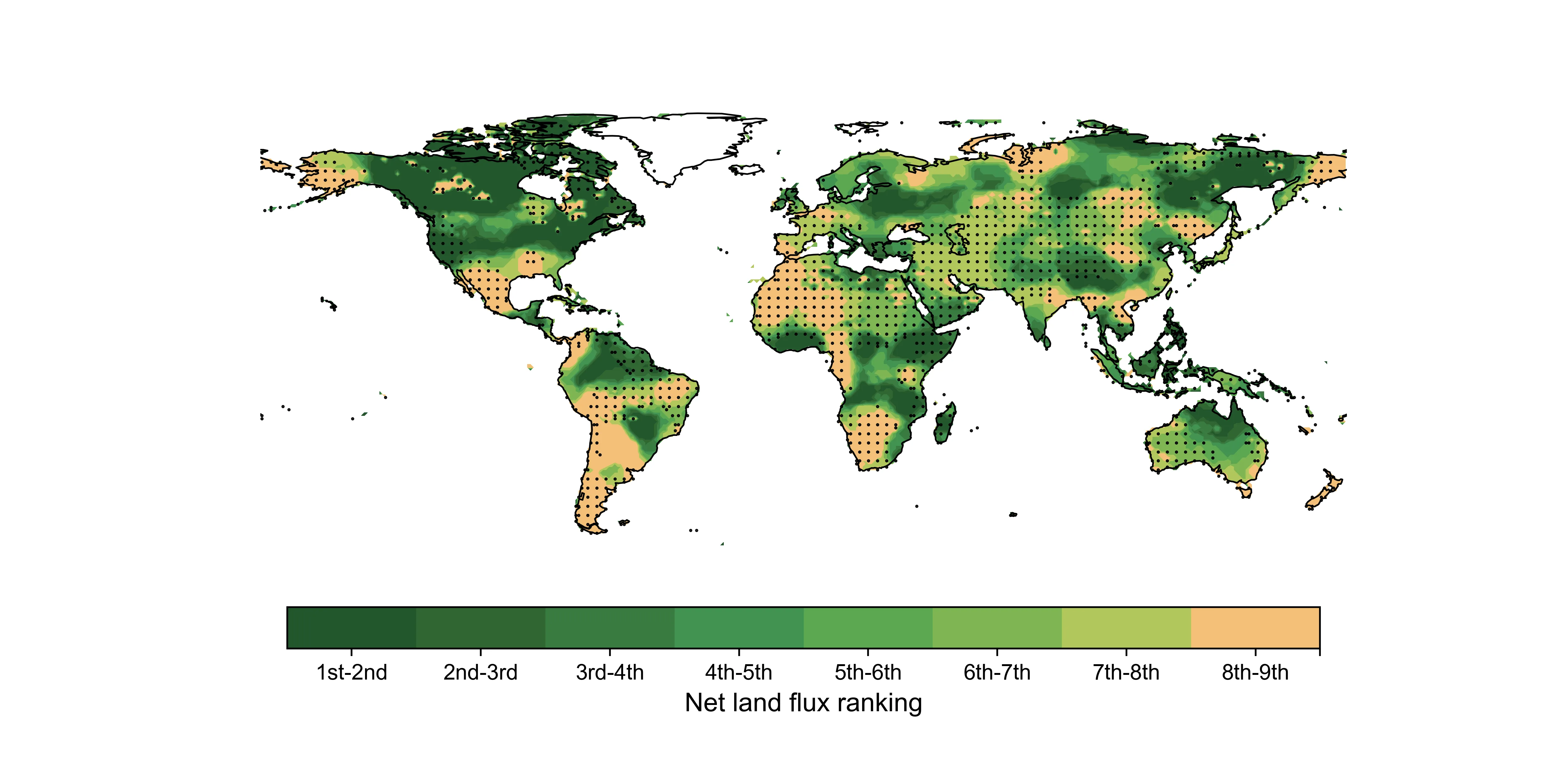
The global net land carbon sink in 2023 was 0.44±0.21 GtC/yr, the weakest since 2003. For comparison, the average for 2010–2022 was 2.04 GtC/yr. The ocean sink, by contrast, strengthened by 0.10 GtC/yr compared to 2022, reaching 2.60±0.72 GtC/yr, mainly due to weakened upwelling in the tropical Pacific as El Niño developed. Regional analysis identified the main sources of anomalies: an extreme drought in the Amazon in the second half of the year led to a loss of 0.31±0.19 GtC/yr, record fires in Canada emitted 0.58±0.10 GtC/yr, and Southeast Asia lost 0.13±0.12 GtC/yr. Carbon uptake north of 20°N halved since 2015, to 1.13±0.24 GtC/yr in 2023. The tropics, which had recovered after the 2015–2016 El Niño, became a carbon source again in 2023 (0.56±0.23 GtC/yr). Notably, anomalously hot areas (above the 95th percentile) caused a gross carbon loss of 1.73 GtC/yr, even though they covered only 8.61% of the land surface.
Implications
This work stands apart from its archive neighbors: they consider the carbon cycle over millions of years, while here we have a real-time annual disruption. This is the first operational assessment of the 2023 carbon budget, combining satellite data, models, and emulators for a rapid diagnosis. The results show that record warming can sharply weaken the land carbon sink even under a moderate El Niño. This is a warning sign: if such anomalies become frequent, natural ecosystems will no longer absorb half of anthropogenic CO₂ emissions, as they have so far.
Future development
The topic could evolve toward more detailed real-time monitoring of the carbon cycle. Improving the spatial resolution of inversions, integrating new satellite data (for example, high-resolution missions), and refining machine-learning emulators will allow faster and more accurate detection of anomalies. It is also important to study ecosystem recovery after extreme events: Canadian forests will take decades to rebuild carbon stocks, and the resilience of Amazon forests to repeated droughts remains uncertain.
Impact
The results will directly affect climate modeling and carbon budget projections. They are also relevant for climate mitigation policy, as they show that natural carbon sinks cannot be considered a reliable buffer as extreme events intensify.
Next steps
The analysis needs to be extended to 2024 to assess whether the sink weakening was temporary or the start of a long-term trend. Fire and tree mortality models in land surface models should also be improved, as they currently reproduce extreme events poorly.
Key open problems
This work is directly connected to a key unresolved problem in climatology: how resilient is the land carbon sink to climate change? It shows that extreme temperatures and droughts can cause rapid carbon losses that are not captured by current models. This raises the question of revising estimates of the remaining carbon budget to meet the goals of the Paris Agreement.
The knowledge machine's view
This section is addressed to the author of the paper and their colleagues. Neighbouring works were found by meaning-based search across our archive, not by word overlap. We do not review: we show the field around the work.
What the work does
The authors compiled the operational carbon budget for 2023 by combining vegetation models, ocean emulators, and OCO-2 satellite data. They showed that the global land carbon sink dropped to 0.44 GtC/yr, the lowest value since 2003, due to drought in the Amazon, fires in Canada, and weakened uptake at northern latitudes.
Where its strength is
This work provides the first operational estimate of a year-long disruption in the carbon balance at high spatial resolution, making it possible to pinpoint anomalies and link them to specific extreme events.
Where it could go next
- It might be interesting to compare the weakening of uptake at northern latitudes with the long-term vegetation dynamics described in the work on extending plant life by a billion years, to see how current changes fit into evolutionary trends.based on: Plant Life Could Last Over a Billion Years arXiv:2512.24538
- Related work on Antarctica's response to carbon dioxide in the geological past lies nearby; perhaps its approach to analyzing feedbacks in the carbon cycle could help assess whether the 2023 anomalies are a harbinger of more persistent changes.based on: Ice Has a Memory: How Antarctica Responds to Carbon Dioxide arXiv:2601.06986
Worth trying
- Test how well the regional anomalies of 2023 are reproduced when vegetation models incorporate mechanisms that reflect long-term ecosystem adaptation to rising CO₂.
- Use methods from analyzing ancient Martian climate swings to identify thresholds beyond which the carbon sink may fail to recover.
- Compare the obtained estimates with data on warming caused by Earth itself to separate the anthropogenic signal from natural variability.
Nearby works in our archive
- Earth Can Heat Itself Upsimilarity 0.48
- Reflation: When a Planet Inhales After Exhalingsimilarity 0.48
- Ice Has a Memory: How Antarctica Responds to Carbon Dioxidesimilarity 0.47
- Plant Life Could Last Over a Billion Yearssimilarity 0.47
- The Universe's Hidden Gas Oceansimilarity 0.46
- How a Desert Remembers Its Historysimilarity 0.45
The archive is sparse around this work: the closest review is only 0.48, against a usual 0.64. It looks like few have drilled nearby.
In 2023, the CO₂ growth rate at Mauna Loa was 86% higher than in 2022, even though fossil fuel emissions rose by only 0.6%. This is the largest gap between emissions and concentration growth in the entire observational record.
A scenario where natural carbon sinks stop working is explored in Kim Stanley Robinson's novel 'The Ministry for the Future': there, heat waves and droughts lead to massive forest dieback and a sharp acceleration of CO₂ rise. The 2023 study shows that such a scenario may already be starting to unfold.
Key numbers
- CO₂ growth at Mauna Loa in 2023: 3.37 ppm/yr
- global land carbon sink: 0.44 GtC/yr
- fire emissions in Canada: 0.58 GtC/yr
- carbon loss in the Amazon: 0.31 GtC/yr
- share of land area with extreme heat: 8.61%