Light as an Artist: Optical Fiber Learns to Recognize Digits ✛
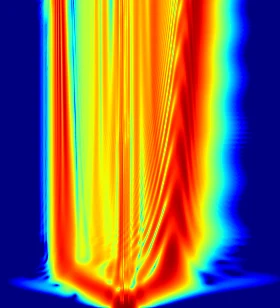
A laser pulse enters an optical fiber, and within 70 meters it becomes a computing machine. Light passing through the fiber is like an artist mixing paints on a palette: each spectral component, each nonlinear effect adds its own hue to the final picture. This is exactly how a photonic extreme learning machine recognizes handwritten digits.
At the heart of this machine lies the generalized nonlinear Schrödinger equation, which describes the propagation of ultrashort pulses. It accounts for dispersion up to fourth order, Kerr nonlinearity, and the Raman response of fused silica. A 28×28 image is reduced to a vector of length M (for example, 10×10=100) and encoded into the spectral phase or amplitude of a pulse with a spectral width of 30 nm. After passing through the fiber, the output spectrum is convolved with a Gaussian response function of width 1 nm, and a noise floor of -30 dB is added. Training the ELM reduces to a Moore–Penrose pseudoinverse of the hidden layer matrix, which does not require backpropagation.
The numbers speak for themselves. With anomalous dispersion (solitonic regime), testing accuracy reaches 90.9% for N=10 and a fiber length of 70 m, while with normal dispersion it reaches 92.9% for N=10 and 40 m. Normal dispersion gives a gain of about 3% due to lower sensitivity to noise. An ideal model without quantum noise and readout noise shows an upper limit of 96.7% (normal dispersion) and 95.0% (anomalous). Adding only quantum noise reduces accuracy to 94.8% and 91.9%, respectively, revealing an unavoidable penalty. Increasing nonlinearity (parameter N) and fiber length initially improves performance, but beyond the soliton fission threshold accuracy can drop. The optimal phase modulation depth is 0.25π, and the optimal amplitude modulation depth is 0.5. Even when the image is reduced to 7×7 pixels, accuracy approaches 90%.
Quantum noise, which arises from random fluctuations due to the discreteness of photons, turns out to be not a technical detail but a fundamental limitation. This places the work alongside attempts to use nonlinear optics as a computational resource, but with unprecedented detail. For the first time, the contributions of nonlinear dynamics, encoding parameters, and noise to the performance of a fiber-based ELM are quantitatively separated. Previously, it was unclear how these factors affect accuracy and which regimes are optimal; now there is a complete parameter map for practical implementation. The results are directly applicable to the development of photonic accelerators for classification and regression tasks.
The path forward is clear. The model can be extended to the vector GNLS equation with polarization, which would allow an additional degree of freedom for encoding. Multimode propagation opens the way to spatial encoding and readout, although it will require significant computational resources. Reading out the spectral phase using a local oscillator is also promising, as it could increase encoding density. These directions promise to improve accuracy and expand the class of solvable problems. Light passing through the fiber is like an artist mixing paints on a palette, and the richer the palette, the more accurate the portrait of a digit.
A 70-meter fiber under anomalous dispersion is equivalent to roughly eight characteristic soliton fission lengths. The pulse energy is only 20.7 picojoules, which is less than the energy of a single photon of visible light multiplied by the number of photons in the pulse.
The idea of using a physical medium for computation echoes Greg Egan's novel "Permutation City," where consciousnesses run on unconventional computational substrates. Here, the optical fiber serves as such a substrate, transforming light into answers.