An upper limit is the maximum value a physical quantity can take while still being consistent with experimentalobservations, typically used when a signal is not detected. It defines the boundary of what is possible given the data, often expressed as a confidence interval (e.g., 95% upper limit). This concept is crucial in searches for rare or hypothetical phenomena, such as new particles, gravitational waves, or dark matter interactions, where absence of evidence is quantified rather than taken as proof of nonexistence.
History
The formal concept of upper limits in particle physics emerged in the mid-20th century with the development of statistical methods for hypothesis testing, notably by Neyman and Pearson. It became standard practice in high-energy physics during the 1960s and 1970s, particularly in searches for new particles.
How it works
When an experiment looks for a signal, it records background events and compares them to the expected signal. If no excess is found, scientists set an upper limit by determining the maximum signal strength that could be hidden within the statistical fluctuations of the background. This involves statistical methods like the CLs technique or Bayesian inference, which account for uncertainties and produce a limit that can be compared across experiments.
In practice
Upper limits are used in particle physics (e.g., LHC searches for supersymmetry), astrophysics (e.g., limits on gravitational wave backgrounds), and cosmology (e.g., constraints on dark matter cross-sections).
Fun fact
The strongest upper limit on the electron's electric dipole moment is so small that it would be like measuring a displacement of less than a thousandth of the width of a proton on an object the size of the Earth.
A hunter sets snares in the woods. They know the animal's habits but not whether it will ever show up. In much the same way, physicists set up detectors in hopes of catching particles of dark matter — the invisible substance thought to make up most of the Universe's mass.
A new study offers hunters an unusual tool: not a trap, but a measuring tape.
An engineering blueprint of a skyscraper always includes a number: the maximum load on the foundation — say, 500 kilopascals. Einstein's field equations in curved spacetime impose a similar limit on the 'force load' inside stars, planets, and any other clumps of matter.
The weak equivalence principle, silently tested since the time of Galileo and laid at the foundation of general relativity, states: all bodies fall equally, regardless of their internal composition.
An ice cube in a glass of water doesn't just float: it gets pushed. Water molecules bombard it from all sides, and this bombardment gives rise to a force you can measure. In physics, there's a similar force, but it acts not on ice but on anything with mass, and it arises not from molecular jostling but from information. It's called entropic force.
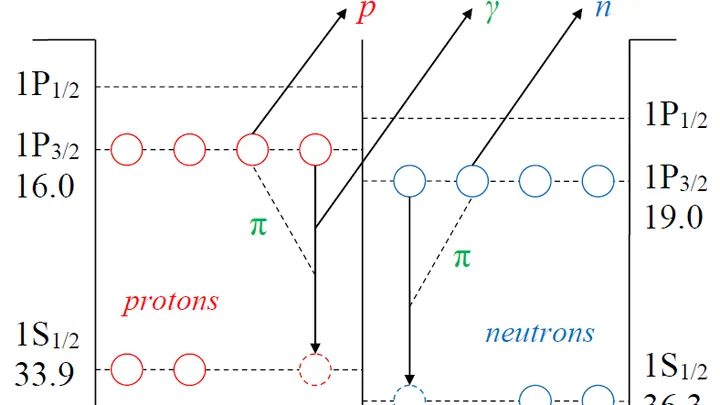
In a carbon atom's nucleus, particles occupy their own 'apartments'—like residents who cannot share the same room. Physicists call this rule the Pauli exclusion principle: two identical inhabitants of a nucleus cannot be in the same state. But what if the rule is sometimes broken?
Atomic clocks are pendulums that tick at the frequency of light. Inside a trap, an aluminum ion hangs, and a laser probes it like a tuning fork. If the laser's frequency matches the atom's natural frequency, the atom responds. The clock's rate is checked against this response.