Light in Glass: Optical Fiber Learns to Read Digits ✛
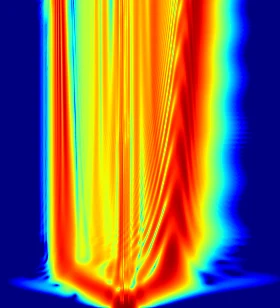
Light carrying an image of a digit is injected into the glass strand at nearly the speed of light. Inside, like water in a rapid river, the light flow mixes itself: vortices and collisions transform the image into a chaotic pattern. That's precisely the computation — without a single transistor. At the output, a rainbow of splashes (the spectrum) is collected, and we measure the brightness of each hue to decode the result with a simple algorithm.
Thousands of handwritten digits from the MNIST database were passed through such a setup. The result: 93% correct answers. The entire system: a piece of ordinary internet cable and a couple of lasers. And deliberate temporal stretching of the light (dispersion, which usually spoils the signal) only improved recognition.
The fine grain of quantum noise, like ripples from raindrops, slightly blurs the picture but doesn't stop the fiber 'brain' from working. Intriguingly, to erase all learning, a single powerful light pulse is enough — like a wave washing away drawings in the sand, the system is ready to learn anew.
Ordinary telecom fiber lying on the ocean floor for internet can be turned into a trainable computer by simply passing cleverly encoded light through it. And to forget everything it learned, a single bright flash is enough — the fiber is ready to learn from scratch.