Limits of Nonlinear Propagation in Optical Fiber for an Extreme Learning Machine ✛
Context
Photonic neuromorphic computing is attracting attention as a way to perform machine learning tasks with high speed and low energy consumption. Experiments have already shown that nonlinear propagation of light in optical fiber can serve as a computational core, but a systematic numerical analysis was lacking. This work fills that gap by providing a complete simulation model from image input to classification. Nearby in the archive are papers on quantum sensors, neural networks for dark matter analysis, and quantum simulators; our article stands apart but belongs to the same wave of searching for physical substrates for computation.
Methods
Pulse propagation is modeled using the generalized nonlinear Schrödinger equation (GNLSE), including dispersion up to fourth order, Kerr nonlinearity, and the Raman response of fused silica. A 28×28 image is reduced to a vector of length M (e.g., 10×10=100) and encoded into the spectral phase or amplitude of a pulse with a spectral width of 30 nm. After propagating through the fiber, the output spectrum is convolved with a Gaussian response function of 1 nm width, and a noise floor of -30 dB is added. Training the ELM reduces to pseudo-inversion of the hidden layer matrix via the Moore–Penrose method, which does not require backpropagation.
Results
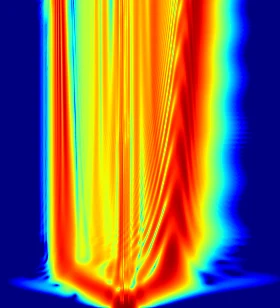
For anomalous dispersion (soliton regime), testing accuracy reaches 90.9% at N=10 and a fiber length of 70 m, while for normal dispersion it reaches 92.9% at N=10 and 40 m. Normal dispersion gives a gain of about 3% due to lower sensitivity to noise. An ideal model without quantum noise and readout noise shows upper limits of 96.7% (normal dispersion) and 95.0% (anomalous). Adding only quantum noise reduces accuracy to 94.8% and 91.9%, respectively, revealing an unavoidable penalty. Increasing nonlinearity (parameter N) and fiber length initially improves results, but after the soliton fission threshold, accuracy can drop. The optimal phase modulation depth is 0.25π, and amplitude modulation depth is 0.5. Even when the image is reduced to 7×7 pixels, accuracy approaches 90%.
Implications
This work is the first to quantitatively separate the contributions of nonlinear dynamics, encoding parameters, and noise to the performance of a fiber-based ELM. Unlike neighboring studies that focus either on quantum effects or on other physical systems, here a complete parameter map for practical implementation is provided. It is shown that quantum noise in the input pulses is not a technical detail but a fundamental limitation that must be considered in design. This places the work alongside attempts to use nonlinear optics as a computational resource, but with unprecedented detail.
Future development
The model can be extended to the vector GNLSE accounting for polarization, which would allow an additional degree of freedom for encoding. Multimode propagation opens the way to spatial encoding and readout, although it would require significant computational resources. Also promising is reading out the spectral phase using a local oscillator, which could increase encoding density. These directions promise to improve accuracy and expand the class of solvable tasks.
Impact
The results are directly applicable to the development of photonic accelerators for classification and regression tasks. They also provide guidelines for supercontinuum ELM experiments, helping to choose the dispersion regime and pulse parameters.
Next steps
The immediate next step is to include polarization dynamics in the model and compare with experimental data. Then, multimode fibers and phase readout should be explored.
Key open problems
For photonic neuromorphic computing, a key unresolved problem is achieving accuracy comparable to digital neural networks while maintaining energy efficiency. This work shows that fundamental quantum noise limits accuracy to about 95%, which must be considered when assessing the technology's potential. This connects the research to the broader question of the limits of analog computing.
The knowledge machine's view
This section is addressed to the author of the paper and their colleagues. Neighbouring works were found by meaning-based search across our archive, not by word overlap. We do not review: we show the field around the work.
What the work does
The study models an extreme learning machine based on femtosecond pulse propagation in optical fiber, using the generalized nonlinear Schrödinger equation to classify MNIST digits. The authors vary encoding parameters, fiber length, and noise level, achieving accuracy above 90% and uncovering a fundamental limitation imposed by quantum noise in the input pulses.
Where its strength is
The strength of the work lies in its systematic numerical analysis, which quantitatively separates the contributions of nonlinear dynamics, encoding parameters, and noise, providing a complete parameter map for practical implementation of fiber-based ELMs.
Where it could go next
- It might be interesting to compare the performance of the fiber-based ELM with other physical computing systems, such as quantum chips for photon manipulation, to assess advantages in speed and energy consumption.based on: A Quantum Turnstile Chip for Photons arXiv:2511.00570
- A related approach uses neural networks with light for medical data analysis; you could adapt your system for biomedical signal processing tasks where speed and low power are crucial.based on: Dense Connections vs. Residual Paths: How DenseNet-121 Outperforms ResNet-50 in Brain Cancer Detection arXiv:2505.11735
- It would be interesting to see how regularization or feature selection methods from neural network studies in physics (e.g., in weak lensing) could improve the robustness of your ELM when reducing input dimensionality.based on: Neural Networks vs. Dark Matter: A New Method for Analyzing Weak Lensing arXiv:2607.09867
Worth trying
- Test image encoding via random projections, as in some ELM implementations, to reduce the required feature vector length without sacrificing accuracy.
- Investigate how adding a small optical feedback loop or reservoir layers based on the same fiber affects class separability.
- Compare the energy consumption of your system with traditional digital ELM implementations for MNIST tasks, using metrics from photonic chip studies.
Why this may matter
This work provides quantitative benchmarks for designing photonic neuromorphic systems, showing which parameters are critical and what fundamental limits quantum noise imposes. It could accelerate the transition from conceptual demonstrations to practical devices capable of performing machine learning tasks with high speed and low energy consumption.
Nearby works in our archive
- Neutrino Rebellion Decoder: How AI Reads Chaos in Stellar Coressimilarity 0.53
- A Quantum Turnstile Chip for Photonssimilarity 0.51
- Neural Networks vs. Dark Matter: A New Method for Analyzing Weak Lensingsimilarity 0.51
- SpecFANN: Lightning-Fast Sketch of a Star's Spectrumsimilarity 0.50
- How to Track Heat Across an Entire Room with Just One Thermometersimilarity 0.50
- Machine Learns to See the Hiddensimilarity 0.50
- Dense Connections vs. Residual Paths: How DenseNet-121 Outperforms ResNet-50 in Brain Cancer Detectionsimilarity 0.50
The archive is sparse around this work: the closest review is only 0.53, against a usual 0.64. It looks like few have drilled nearby.
A 70-meter fiber with anomalous dispersion corresponds to about eight characteristic soliton fission lengths. The pulse energy is only 20.7 picojoules, which is less than the energy of a single visible photon multiplied by the number of photons in the pulse.
The idea of using a physical medium for computation echoes Greg Egan's novel "Permutation City," where consciousnesses run on unconventional computational substrates. Here, optical fiber serves as such a substrate, transforming light into answers.
Key numbers
- testing accuracy (anomalous dispersion): 90.9%
- testing accuracy (normal dispersion): 92.9%
- ideal accuracy without noise (normal dispersion): 96.7%
- pulse energy at N=10 (anomalous dispersion): 20.7 pJ
- fiber length (anomalous dispersion): 70 m